To the shore of the Libyan Sea: Lyttos, Agarathos Monastery and Ano Viannos
The most complete guide to Crete: 221 places on the map, 23 routes and 49 articles — with photos, videos and the story behind every place. Everything is open and free: no sign-up, no paid sections and no advertising, open or hidden. You can install the guide on your smartphone as an app.
Routes drawn along real roads
Weather at every stop
Full-text search
“Near me” by geolocation
Create your own printable itinerary
Satellite, terrain, dark mode
Works offline
⌕
Searches 1.7 million characters of descriptions, not just names
—places
4regions
—routes
—with video
Search results
—
Interactive map
Find what is near you
Filters narrow the map and the list at once. Zoom out and pins group together.
Region
Category
Фильтры карты
Landmarks
Featured places
RegionCategory
Routes
Ready-made day trips
Individual places
Articles about landmarks
To the shore of the Libyan Sea: Lyttos, Agarathos Monastery and Ano Viannos из Ираклиона
This journey runs through the central and south-eastern part of the regional unit of Heraklion, from the fertile upland of the Pediada, past vineyards, olive groves and bare hills, down to the south coast. The high points of the route are the ruins of the ancient city of Lyttos, the venerable monastery of Panagia Agarathos and the monastery of St Anthony near Arvi on the Libyan Sea. Between them lie places that no tour of Crete should leave out: the potters’ village of Thrapsano, the Minoan cult cave of Arkalochori, the hill town of Ano Viannos with its Byzantine frescoes, and the memorial at Amiras, which commemorates one of the gravest crimes of the Occupation.
Route: Heraklion – Agarathos Monastery
On the way to Agarathos Monastery
We leave Heraklion on the national road in the direction of Limenas Chersonisou. A few kilometres beyond Kato Gouves we turn south at the junction signed for Kastelli. The road climbs gradually, the coastal plain falls behind, and before long the broad, gently rolling country of the Pediada opens out – a name derived from the Greek word for a plain.
Kastelli
In the middle of a fertile hollow, surrounded by vines and long rows of olive trees, lies Kastelli, a lively market town and the centre of the Pediada district. Its name goes back to a Venetian castle that appears in the chronicles for the year 1271 as “Castello di Pediada”. Of the fortress, sadly, nothing is left; it was destroyed in the course of time, and the town’s secondary school now stands on its site. For centuries Kastelli was famous for its great fairs, which even in Ottoman times drew traders from far around and were still among the most important events of the region in the last century.
In the Ottoman period Kastelli served for a time as the seat of Omer Pasha. During the German Occupation there was a military airfield immediately beside the town. On the night of 4–5 July 1943 a British commando party under the Danish officer Anders Lassen, supported by Cretan guides and the local population, made its way on to the airfield; the sabotage destroyed several aircraft and large quantities of fuel and dealt the Luftwaffe a painful blow. The community commemorates these actions every year to this day. On the site of the old military airfield the new international airport of Heraklion is now being built, which is likely to change Kastelli fundamentally in the years to come.
Lyttos (Lyktos – not to be confused with Lato)
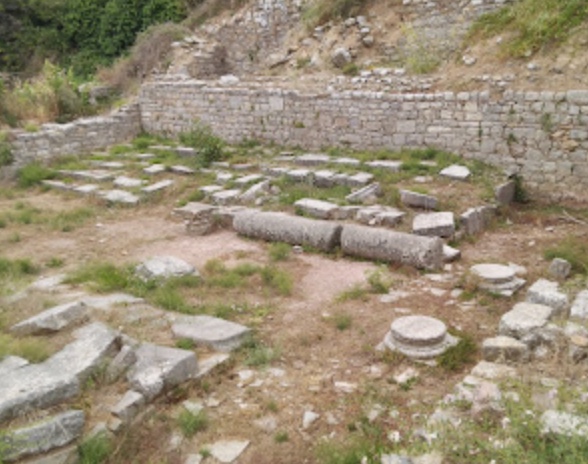
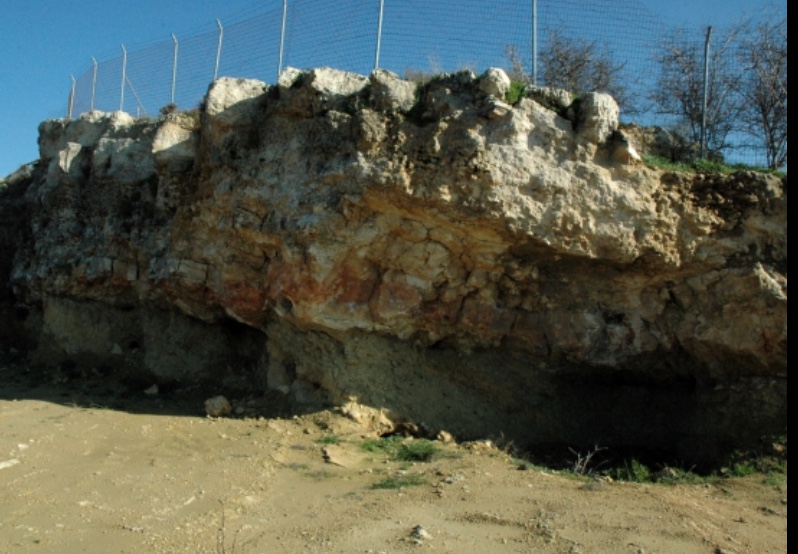
About four kilometres from Kastelli, by the village of Lyttos (formerly Xidas), the ruins of ancient Lyttos, or Lyktos, lie on a hill. The city is mentioned by numerous ancient authors, among them Hesiod, Strabo and the Byzantine geographer Hierocles. In Hesiod’s Theogony (lines 477–484) the parents of Rhea send their daughter to the rich land of Crete, to Lyttos, so that she may give birth to Zeus there and hide him from his father Kronos; the poet has the child concealed on a mountain he calls Aegaeon. Homer names Lyttos twice in the Iliad, first in the Catalogue of Ships among the Cretan cities that sailed with their vessels to the Trojan War. The city was held to be a Dorian foundation with close ties to Sparta – its people regarded themselves as Spartan colonists, a claim recorded by Aristotle – and it was so well placed, and so strong through its fleet, that according to tradition it long had no need of walls, when other city-states had fortified themselves long before. Its harbour, and the outlet for its trade, was Chersonesos on the north coast; Strabo puts the city 80 stades from the Libyan Sea.
Its great rival was Knossos. Twice Lyttos fell into the power of the Knossians – around 343 BC and in 220 BC – and both times, tradition has it, it regained its independence with Spartan help. On the first occasion the city was seized by the Phocian mercenary leader Phalaecus, and it was the Spartan king Archidamus III who drove him out. Especially devastating was the so-called Lyttian War: in 220 BC Knossos and Gortyn fell upon the city while its men of fighting age were far from home in the field, and destroyed it. The citizens found refuge at Lappa in the west, and Polybius, who tells the story, speaks warmly of the character of the Lyttians. But Lyttos recovered. In 183 BC it was among the thirty or so Cretan cities that concluded an alliance with King Eumenes II of Pergamon, and when Rome conquered the island under Quintus Caecilius Metellus (69–67 BC), Lyttos was one of the cities that resisted, and was sacked for it. All the same it was precisely in Roman times that the city saw its greatest prosperity.
Ancient Lyttos had a water supply fed by the spring at Kournia, which brought the water from the mountains of the Lasithi massif. Part of it was a tall stone aqueduct that carried the channel across a deep valley; a section survives near Kastamonitsa – a structure whose architecture and engineering still impress today. The city struck its own coins: on one side a flying eagle was shown, on the other the head of Zeus, together with the name of the Lyttians in Greek letters, ΛΥΤΤΙΩΝ.
Lyttos possessed the largest theatre on the whole island. The Venetian physician and botanist Onorio Belli described it between 1583 and 1586 as the largest he had seen on Crete, and wrote of fine statues round about; some of them had already been carried off to the gardens of Venetian nobles. In the course of time the theatre was buried under earth, so that the British admiral Spratt, around 1850, found no trace of it and doubted that it had existed. Its exact position has still not been uncovered; the excavators suspect it lies close to the chapel of St George. Severe earthquakes in AD 365 and 795 destroyed the public buildings, and the city fell into decay.
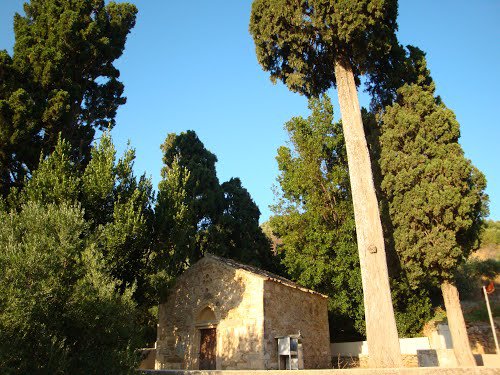
The first excavations were undertaken by Italian archaeologists at the end of the 19th and the beginning of the 20th century, and later, in the 1980s, by the Greek Giorgos Rethemniotakis. Since 2021 a team under the ancient historian Angelos Chaniotis – the Lyktos Archaeological Project – has been uncovering a council house (bouleuterion), a Sebasteion dedicated to the imperial cult, Roman shops and a paved street. Among the most spectacular finds are a marble statue of the emperor Hadrian, found without its head, and statue bases for Hadrian, his wife Sabina and other members of the imperial house. Today a few ruined windmills stand on the hill of the ruins, together with two Byzantine chapels, that of St George and that of the Holy Cross (Timios Stavros); from here there is a broad view across the Pediada to the sea.
Agarathos Monastery
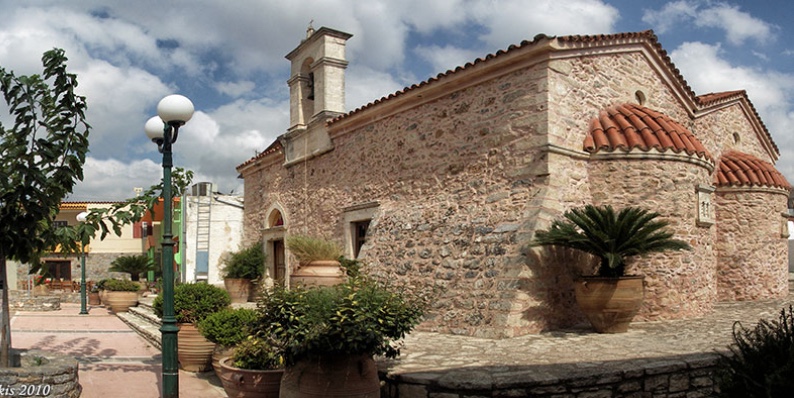
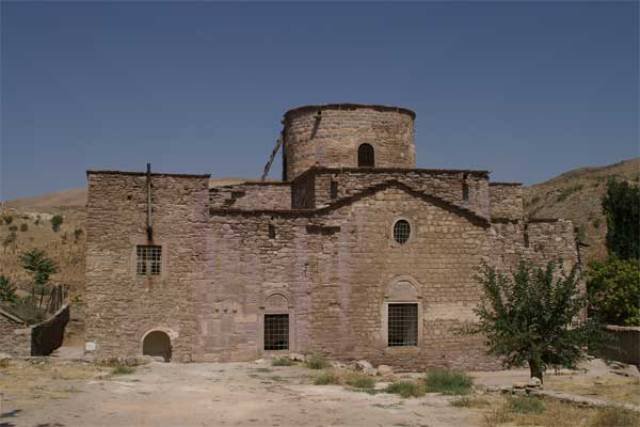
Among centuries-old olive trees and luxuriant vineyards rises the monastery of Panagia Agarathos (Μονή Αγκαράθου), dedicated to the Dormition of the All-Holy Mother of God.
Find on the map
Introduction
Only 22.8 kilometres separate the monastery from Heraklion. It serves at the same time as the parish church of the neighbourhood, and formerly had a two-aisled church, one aisle of which was dedicated to St Minas, a saint held in particular veneration on Crete. Agarathos is today one of the most important monasteries for men on the island – nineteen monks were counted here in 2001 – and is directly subject to the Archdiocese of Crete. It is open daily from 8.30 until sunset, and admission is free.
History of the monastery
The monastery lies in the territory of the village of Sampas, in the municipality of Minoa Pediadas, on the south-western slopes of the hill of Soros Pantelis, at an altitude of 538 metres. It owes its unusual name to a legend: beneath a bush of agarathia – a woolly-leaved Jerusalem sage native to Crete (Phlomis lanata) – a miracle-working icon of the Mother of God is said to have been found long ago, and on that spot the church was later built. The former two-aisled church was raised on the ruins of a still older one and consecrated in 1894; its bell tower, blown down by a storm the year before, was rebuilt at the same time. The complex, which has the look of a small fortress, was declared a protected monument in 1935.
The beginnings of the monastery are obscure. According to one tradition it was founded as early as the 10th century under Nikephoros Phokas, and its origins are in any case placed in the second Byzantine period, between 961 and 1205; it is securely attested in writing from the 15th and 16th centuries. In 1504 the Kallergis family, to whom it had belonged, made the monastery over to the monk Neophytos, under whom it grew into one of the great spiritual centres of its day. Agarathos is mentioned in a manuscript of 1532 from the Biblioteca Marciana in Venice, in a contract of 1538 and in the records of the scholar Cornelius. The historic gateway bears the dates 1583 and 1585, and a vaulted storeroom of 1628 is associated with the name of Abbot Maximos Loukaris, who is held to have been the brother of the later patriarch Kyrillos Loukaris.
In Venetian times the monastery became a nursery of learning, wealthy and well peopled, with many of its monks coming from the island of Kythera. Several men who began their path here rose to patriarchal thrones, among them Meletios Pigas, Patriarch of Alexandria, and Kyrillos Loukaris, Patriarch of Alexandria and later Ecumenical Patriarch of Constantinople; Silvester the Cretan, the scholar Joseph Bryennios and Bishop Gerasimos Palaiokapas are likewise connected with Agarathos. The monastery guarded not only spiritual treasures such as the old icon of the Panagia Orfani but also valuable documents, which were later taken to Kythera for safe keeping.
The monastery also played its part in the history of Cretan resistance to the Ottoman conquest. In 1646 Abbot Athanasios Christophoros led a band of men from the surrounding country into battle against the Turks. That the monastery was not destroyed in the Ottoman period it owed to the diplomatic skill of the first Metropolitan of Crete after the conquest, Neophytos Patelaros, who established friendly relations with the Grand Vizier Ahmed Köprülü. Even so, Agarathos remained a centre of revolt, and in the later uprisings, 1821 among them, it was repeatedly plundered and laid waste in reprisal, and each time rebuilt.
In the monastery there is a hall dedicated to Patriarch Theodoros II of Alexandria. On display there are gifts, liturgical vestments and personal belongings that the patriarch has made over to the monastery.
Among the monks of Agarathos have been outstanding churchmen, including the present Patriarch of Alexandria and All Africa, Theodoros II, who has held that office since 2004, as well as numerous bishops whose names enrich the history of this monastery and of the whole Orthodox world.
The monastery buildings
For all the catastrophes and plunderings, the monastery of Panagia Agarathos has kept the dignity of its old fabric. This is grouped round the katholikon of 1940, which is painted with modern frescoes. The church, built on the cross-in-square plan, replaced the earlier two-aisled one. The feasts kept here are the Dormition of the Mother of God on 15 August and that of the Great Martyr St Minas on 11 November. Just outside the monastery walls stands an old church dedicated to St Raphael.
A guest house and a refectory are open to visitors. There are the old buildings to see, the secluded cells, the quiet paved courtyard, a church museum – installed in the former storerooms and the old olive mill – and a library of manuscripts. The carved stonework scattered about the precinct dates from the time of Abbot Maximos Loukaris (1619–1641) and recalls the era when Agarathos was counted among the five richest monasteries on Crete. The monks of today work vineyards and olive groves on organic principles.
The life of St Minas
St Minas was born in Egypt, towards the end of the 3rd century, into a pagan family, and grew up in the world of the old gods; tradition names his parents as Eudoxios and Euphemia and his birthplace as Nikiou, near Memphis. His heart, however, remained open to the call of God, which led him to Christianity while he was still young. Later – at fifteen, it is said – he took up the career of a soldier in the Roman army, where he distinguished himself by intelligence and courage, serving at Cotyaeum in Phrygia.
At a time when Rome had not yet accepted Christianity and the persecution of the faithful began under the emperors Diocletian and Maximian, Minas faced a choice between loyalty to his faith and service to the empire. He laid down his military rank and withdrew into the desert. There he spent his days in prayer and fasting, preparing himself for martyrdom for Christ.
When the approaching hour of his witness was made known to him in a divine revelation, Minas publicly confessed his faith during a pagan festival and was thereupon arrested. Despite torture he did not renounce Christ and was executed, at Cotyaeum around the year 309 – a defiance of the pagan gods and of imperial power alike. Christians recovered his remains and brought them to Egypt, where, the legend runs, the camel carrying them halted near Lake Mariout and would go no further; his tomb there, at Abu Mena south-west of Alexandria, became a major place of pilgrimage, from which small clay flasks stamped with his image were carried all over the Mediterranean world.
St Minas, soldier of Christ and martyr, left a legacy of faith and of miracles that moves believers throughout the world to this day. Some of the best known of his miracles follow.
The miracle of the greedy innkeeper
In Constantinople a pilgrim on his way to the feast of St Minas put up at an inn. The greedy innkeeper saw the traveller’s money, killed him, cut the body in pieces and hid it in a barrel. When St Minas appeared before the inn in the guise of a horseman and asked after the pilgrim, the innkeeper denied that he was dead. But the saint found the barrel with the mortal remains, raised the murdered man to life again and brought the innkeeper to repent of his sin.
The rescue of the servant
A rich Christian had a silversmith make two dishes, one bearing the name of St Minas, the other his own. The finer one he kept for himself. But when his servant went to rinse it in the sea during a voyage, the dish sank – and the servant with it. The unfortunate man turned to God in prayer and was saved by three saints, St Minas among them; they brought him safe and sound back to shore, and in his hands he held the lost dish.
The miracle of Heraklion on Crete
In 1826, after the outbreak of the Greek Revolution, the Turks planned a massacre of the Christians who had gathered in the church of St Minas in Heraklion. During the Easter service, when the attack was imminent, St Minas appeared on a white horse, struck terror into the assailants and prevented the bloodshed. Since then he has been regarded as the patron saint of the city of Heraklion, and his feast on 11 November is a great holiday there.
The miracle of El Alamein in the Second World War
In the Second World War, when the Axis powers threatened to break through to the Suez Canal, a Greek brigade fought within the British army for the defence of Egypt – the homeland of St Minas. According to tradition, during the decisive battle of 1942 the saint appeared before the Greek troops at El Alamein at the head of a caravan of camels and put heart into the soldiers, so that they went into the fight with renewed strength.
From Agarathos Monastery to the Libyan Sea
From Agarathos towards the Libyan Sea
From Agarathos Monastery we drive back in the direction of Kastelli, but before reaching the town we turn south at the fork in the village of Apostoli. Six kilometres on, some 30 kilometres south-east of Heraklion, the road brings us to Thrapsano.
Thrapsano
The village stands 340 metres above sea level among vineyards and olive groves, and at the last census had a little under a thousand inhabitants, yet for centuries the chief occupation here has been neither wine nor oil but clay. Thrapsano is regarded as the largest pottery centre in Crete; the craft is documented from 1598, and tradition carries it back to Minoan times – the villagers are commonly spoken of as descendants of the Minoan potters. In the 1970s there were more than 150 workshops; today 17 or 18 remain. They still work by the inherited methods: the vessels are thrown on the wheel, fired in the kiln and painted by hand. The most celebrated products are the great pithoi – pitharia in everyday Greek – the traditional storage jars for oil, wine and grain, of a shape that any visitor to the storerooms of Knossos will recognise at once.
In earlier times the potters of Thrapsano, known as Ventemarides, left home in May and travelled the island in small teams until about the middle of September. The seasonal campaign itself was called the ventema. They set up their workshops in the open air in whichever districts had just brought in a good harvest, for that was where storage jars were needed – and where there was money to pay for them. The masters are known throughout Crete for their independence of mind, and for their determination to guard the secrets of the trade and hand them on to the young; a Cretan proverb still turns on the skill of the Thrapsaniot craftsman. Today much of the pottery is sold abroad, as far afield as England, the United States and Australia. Every July the village holds a pottery festival. The people of Thrapsano are also flower growers, specialising in several varieties of carnation, raised both under glass and in the open field.
From Thrapsano we continue south to Arkalochori, a market town on the western edge of the Pediada plain, 32 kilometres from Heraklion.
Arkalochori
Here – or, more exactly, about half a kilometre south-west of the town, at a spot called Profitis Ilias (the Prophet Elijah) – we visit a remarkable cave that served as a place of worship from Early Minoan times, that is from about 2500 BC. It first came to scholarly notice in 1912, when local peasants sold some twenty kilos of Bronze Age weapons from it as scrap metal. Joseph Hatzidakis began to dig that same year and recovered bronze votive weapons and silver double axes; in 1934, after a child had picked up a gold double axe, Spyridon Marinatos took charge, working with Nikolaos Platon. The finds were of extraordinary value: daggers, knives, swords and hundreds of double axes in gold, silver and bronze – twenty-five of them gold and seven silver – some with engraved decoration, together with miniature weapons in gold. Among them is the longest sword to survive from prehistoric Greece, 1.05 metres from end to end, and two of the double axes carry signs in Minoan script; the marks on the best known, the bronze Arkalochori Axe, are now generally thought to be the work of an illiterate craftsman imitating writing. The offerings are strikingly warlike for Minoan Crete and suggest that a martial deity was worshipped here; ingots of copper alloy and the remains of a bronze workshop indicate that metal was worked on the spot.
Parts of the cave were violently destroyed, probably around 1500 BC – perhaps in the course of the armed conflicts of the Late Minoan period, or, on another view, by earthquakes connected with the eruption of Thera, or simply through natural erosion of the rock. Whatever the cause, the collapse of the roof sealed the votive deposits beneath it and so preserved them. There is consequently little to see at the site itself. The most important finds are displayed in the Archaeological Museum of Heraklion. Some scholars have even suggested that the cave may be connected with the legendary Labyrinth, whose name is said to derive from the labrys, the double axe.
Also worth seeing is the church of the Archangel Michael near the town, with its fine wall paintings. Arkalochori itself celebrates two great panigyria: on 6 August, for the feast of the Transfiguration, and on 21 May, in honour of Saints Constantine and Helen. Anyone who happens to be here on those days will see that the Cretans know how to celebrate as wholeheartedly as they work. In October the town is the setting for the Crete Half Marathon. Arkalochori also became widely known through the severe earthquake of 27 September 2021, of magnitude 5.8, whose epicentre lay close by and which left the town badly damaged.
Beyond Arkalochori the road crosses plains and hills where tilled fields alternate with small woods; some of the hills are almost bare. The further south one goes, the greener it becomes, and the landscape grows steadily more attractive. The road now leads us east: we pass Kato Viannos and carry on to Ano Viannos, about 60 kilometres from Heraklion.
Ano Viannos (Upper Viannos)
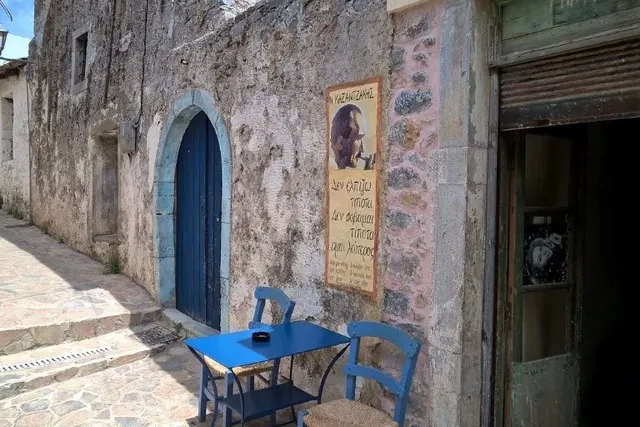
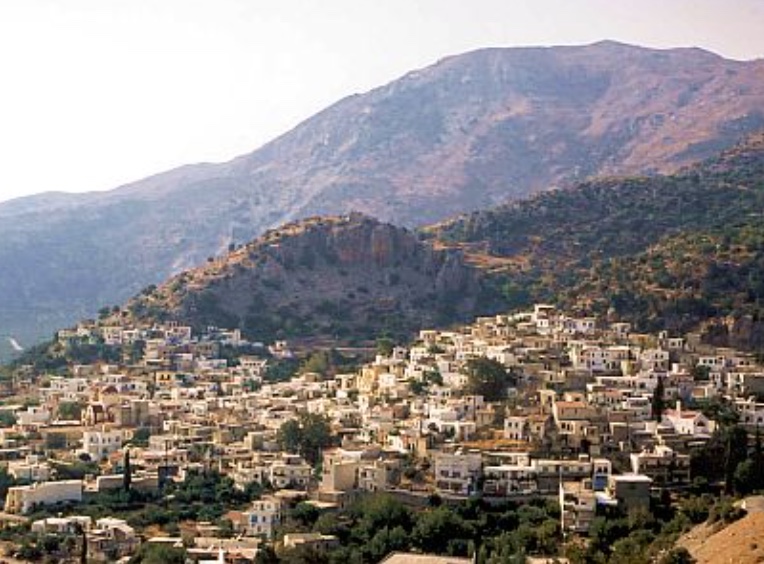
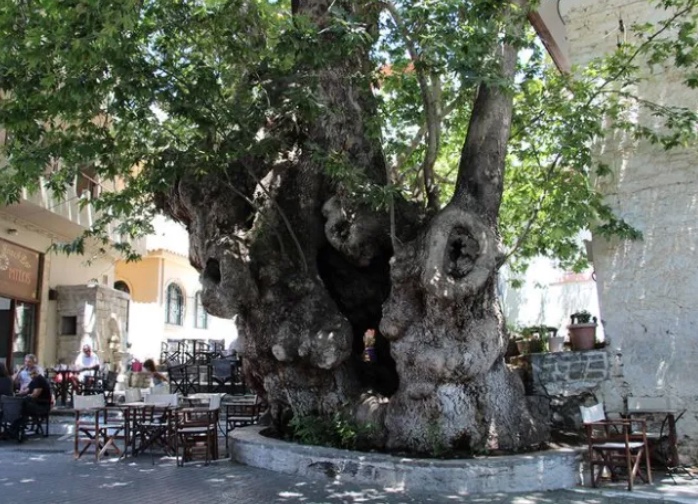
The little town lies at about 550 to 560 metres on the southern slopes of the Dikti Mountains and is the seat of the municipality of Viannos; it has around a thousand inhabitants. From here a splendid view opens over a broad, cultivated plain, most of it given over to olives, down to the Libyan Sea. All around grow oak woods, plane trees centuries old, olive groves and myrtle, and streams murmur on every side. The townspeople have always met beneath the mighty planes of the main square.
The town has kept the traditional building style of the region: stone houses with tiled roofs, paved courtyards and narrow lanes, and springs set with care in stone surrounds. Ano Viannos is fairly large, with several squares, tavernas and kafenia where one can try uncommon local dishes made from the freshest ingredients. In the centre there are also a folklore museum and a restored watermill. Near by lay the ancient city of Biannos (Viannos), known from the written sources, which struck its own coins bearing the image of Artemis and, on the other side, a flower; it has never been excavated. The town has paid for its independence more than once: the Ottomans destroyed it in 1822 and again in 1866.
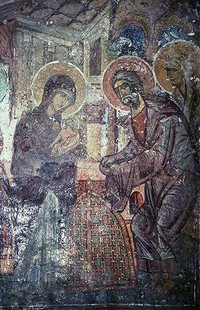
Two churches deserve particular attention: that of St Pelagia (Agia Pelagia) and, below it, the church of St George (Agios Georgios), with frescoes of the 14th century. Agia Pelagia is a small building at the top of the town, reached on foot through steep and narrow lanes, and the view from its terrace repays the climb. According to the inscription at the entrance its paintings date from 1360, and they are attributed to the painters Nikoletos and Kostas Makris. Among the subjects are three scenes from the life of St Pelagia, the Last Judgement with the damned – the sinners are placed close to the door – mounted saints, and St Bartholomew carrying his own flayed skin. In Ottoman times the eyes of the saints were scratched out, and the marks can still be made out today.
The people of Viannos are proud, too, of their fellow countryman Ioannis Kondylakis, a journalist and writer known throughout Greece and regarded as one of the fathers of the Greek chronographima, the short topical newspaper sketch. A bust on the central square commemorates him, and the house where he was born has been arranged as a small museum.
Memorial to the victims of National Socialism
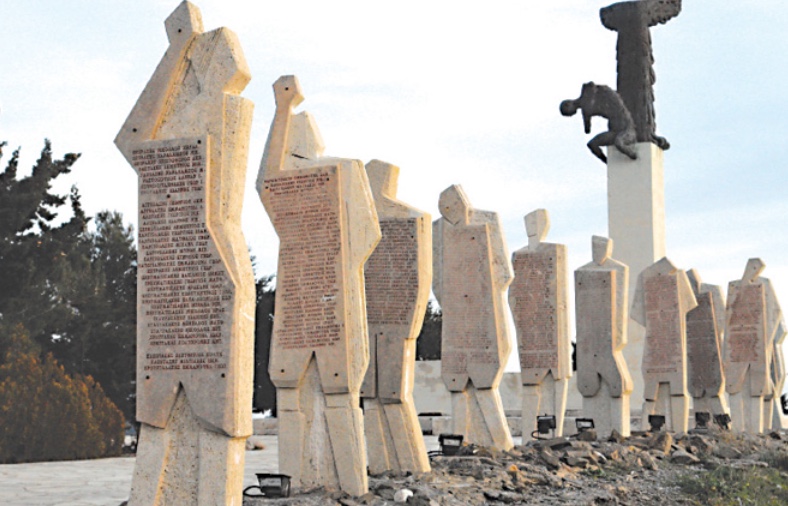
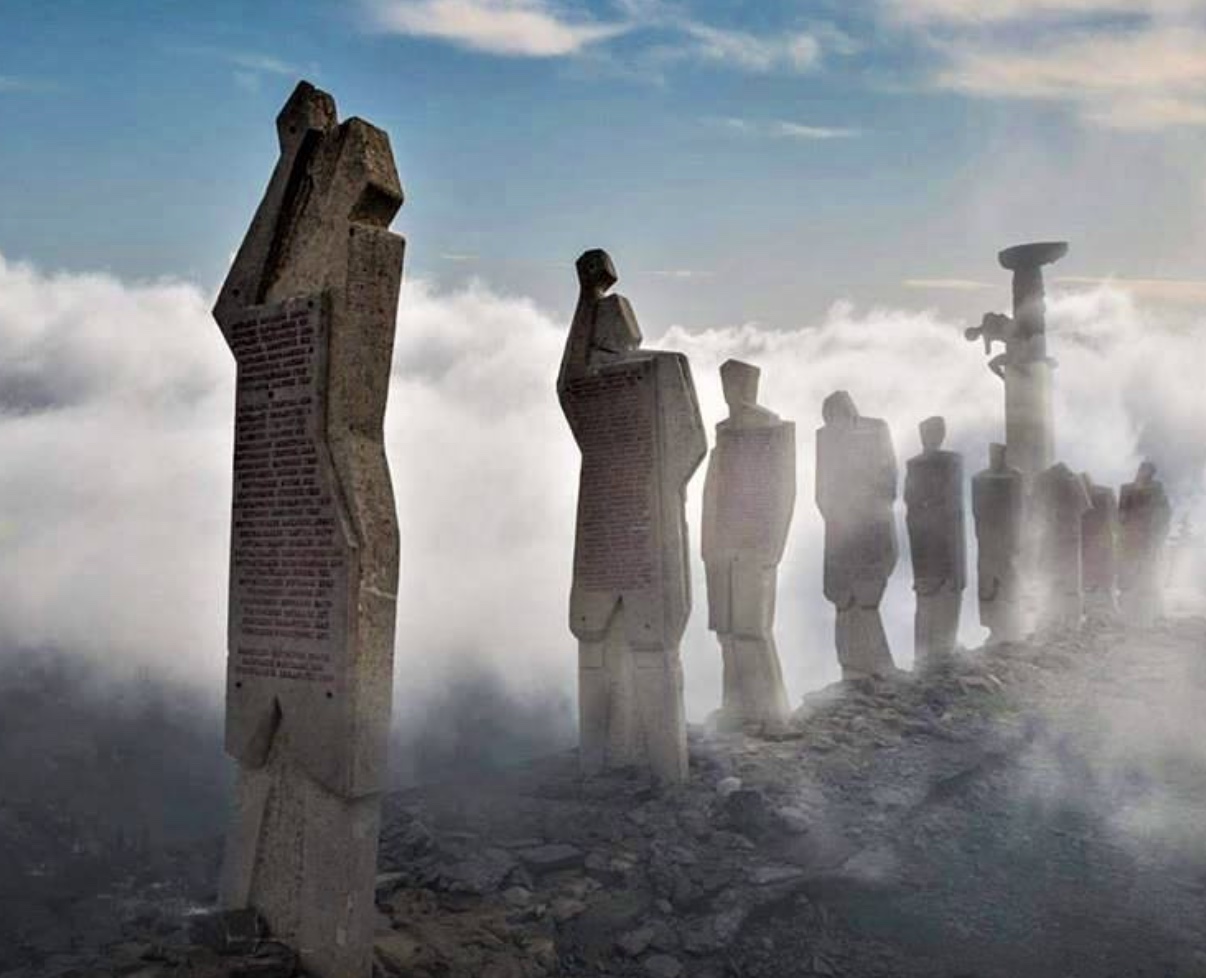
Six and a half kilometres further on, at the Amiras–Arvi crossroads, rises the memorial to the people of this district who were shot by German troops between 14 and 16 September 1943. The massacre was a savage reprisal for the daring raids of the guerrilla leader Manolis Bandouvas and his men, who had inflicted heavy losses on the Germans. The immediate cause was a fight at Kato Symi: on 10 September Bandouvas attacked the small German outpost there, set up the previous May, and killed two soldiers; two days later, with some forty men, he ambushed the infantry company sent in response, routed it and took twelve prisoners. On the orders of General Friedrich-Wilhelm Müller, more than 2,000 men of the 65th Infantry Regiment then moved into the district. All males over sixteen were to be executed on the spot, along with anyone arrested in the countryside, and in some twenty villages – among them Amiras, Vachos, Kefalovrysi, Kato Symi, Gdochia, Myrtos, Mournies and Riza – men, women and children were killed without any form of trial; almost a thousand houses were looted, burnt or blown up, and the survivors were forbidden to bury their dead or return to their homes.
The number of victims is disputed: a Cretan commission of inquiry, on which Nikos Kazantzakis also served after the war, gave 401 executed; other counts run to about 460 or to more than 500 dead. Bandouvas was evacuated to Egypt in November 1943. Müller, captured by the Red Army and extradited to Greece, was tried in December 1946 and shot on 20 May 1947; no one else was ever brought to justice. Every year on 14 September a commemoration is held here, observed throughout the municipality of Viannos as a day of mourning.
Arvi – on the shore of the Libyan Sea
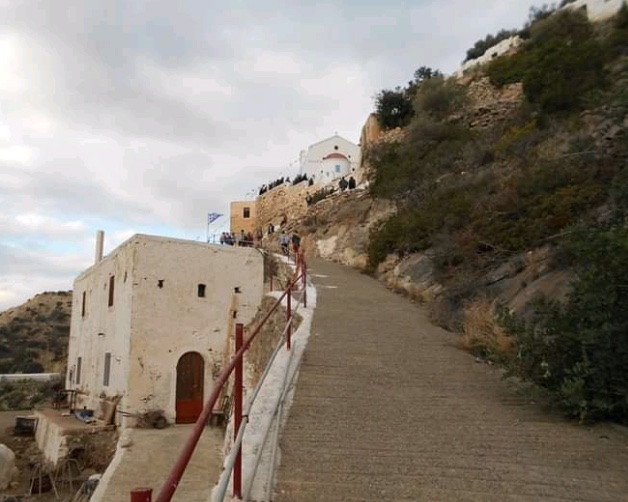
The village, 79 kilometres from Heraklion and 35 west of Ierapetra, has a small bay, a beach of coarse sand mixed with pebbles, clear water and little tavernas right on the shore; a longer and quieter pebble beach runs away to the west. The hills around are thickly covered with pines, and the contrasts of colour in this corner are a pleasure in themselves. Thanks to its warm, sheltered climate – locals say that even the swallows spend the winter here – bananas thrive at Arvi, some in the open and some in greenhouses. The fruit is small, scented and distinctive in flavour, and it became famous across Greece after 1981, when banana imports were banned. The place is old: it has been settled since at least 2600 BC, and in Roman times it was a port of some consequence. Visitors should see the church of the Panagia and the monastery of St Antony of Arvi, built on the steep side of the gorge. The monastery knew periods of great prosperity in the past; today only some of its dilapidated buildings survive, among them two churches dedicated to St Antony. His feast is kept on 17 January.
Notes on the route
This route links the interior of the Heraklion regional unit with the south coast of Crete. Along it the ancient city of Lyttos, the monastery of the Panagia Agarathos and the monastery of St Antony at Arvi lie within easy reach of one another, so that the journey brings together archaeology, Orthodox heritage and some impressive natural scenery.
Lyttos and Lyktos
In travel writing the forms “Lytto”, “Lyttos” and “Lyktos” all occur; in Greek the city is Λύττος or Λύκτος. The same ancient city is always meant, the one beside the modern village of Lyttos, formerly Xidas. It appears in Homer’s catalogue of the Cretan cities, and Hesiod has Rhea come to Lyktos to bear Zeus. Lyktos was a large Dorian polis whose people regarded themselves as colonists from Sparta; its harbour was Chersonesos on the north coast. It was the rival of Knossos, and in 220 BC, in the Lyttian War, the Knossians and their allies destroyed it while its fighting men were away on campaign – the returning citizens found only ruins and took refuge at Lappa. It was afterwards rebuilt, according to tradition with Spartan help. Rome took the city in 67 BC, when it was sacked by Metellus, but it lived on long after.
On the archaeological hill there survive the terraces of the urban quarters, remains of the acropolis, Roman buildings, stretches of the aqueduct – Venetian manuscripts still describe one immense arch carrying the water across a valley – and the chapels of St George and of the Holy Cross. Arthur Evans thought of digging here before he settled on Knossos, and systematic work has resumed only recently, with a new excavation project begun in 2021. The name “Lytto”, it should be said, is merely a variant of Lyktos and has nothing to do with the goddess Leto, nor with the city of Lato near Agios Nikolaos.
The monastery of the Panagia Agarathos is dedicated to the Dormition of the Virgin and is among the oldest in Crete. Its history is closely bound up with learning, the copying of books and the public life of the island. To this day the agarathia, the plant to which local tradition traces the name, is held in honour within its walls. The Venetian documents, the building dates and the events of 1821 tell a single story: the monastery changed by degrees, passing through times of prosperity, destruction and rebuilding. What counts in its story is not only architecture and legend but also the part played by the Orthodox community in keeping education and the culture of the Church alive.
Arvi lies on the south coast, and so the route descends gradually from the uplands of the interior to the Libyan Sea. The combination of gorge, monastery, farming settlements and seashore gives this part of Crete its particular character. Behind the village opens the narrow gorge of Arvi, which once carried water all year round; watching over it is the church of the Panagia, with a wide view of the coast. The ravine is only about two kilometres long but drops 350 metres in a chain of some twenty waterfalls, one of them 85 metres high, and for 150 metres the stream disappears underground. It is a technical canyon for roped and equipped parties only, and dangerous for anyone else, so ordinary visitors should be content to look into its mouth from the monastery. The whole route makes a full day’s drive – Lyttos and Agarathos Monastery in the morning, Thrapsano and Ano Viannos around midday, and a sunset on the beach at Arvi to finish.