The road from Agios Nikolaos to the Dictaean Cave packs into a short distance almost everything that gives eastern Crete its character: Byzantine wall paintings at Panagia Kera, the hill village of Kritsa with its looms, the Dorian city of Lato, quiet Exo Lakonia, the former provincial capital of Neapoli and, finally, the fertile Lasithi Plateau with its windmills, an upland basin some eleven kilometres long and six wide. At the far end lies the cave sanctuary that was already revered in antiquity as the birthplace of Zeus. The route therefore runs from Minoan cult places through Greek antiquity to the monasteries and villages of the Venetian and Ottoman centuries.
The monastic history of the district is rich as well. Areti Monastery (Moni Aretiou) was founded towards the end of the 16th century by Markos Papadopoulos; its katholikon holds 17th-century works of the Cretan School of painting. It was from here that the seat of the diocese of Petra was later moved to Neapoli. The Cave of Milatos and Kremasta Monastery are closely bound up with the memory of the Orthodox communities and of the Cretan uprisings – in the cave alone some 2,700 villagers were besieged in 1823 – and they are best approached as places of remembrance rather than as casual stops on an excursion.
All the stops on the route are described below, in the order in which the road reaches them. The sections on the Dictaean Cave set out both the ancient myths and what archaeology has established, soberly and side by side.
The drive begins in Agios Nikolaos, follows the Mirabello valley to Panagia Kera, Kritsa, Lato, Exo Lakonia and Neapoli, and then climbs to the Lasithi Plateau, ending at the Dictaean Cave above Psychro. Villages, churches, monasteries and excavations follow one another along the way, and in them the many layers of Cretan history remain visible. With all the visits, the whole route needs a full day; the mountain roads are well built but full of bends, and the plateau, at an average of about 840 metres, can be markedly cooler than the coast, with snow lying on the surrounding peaks until the middle of spring.
From Agios Nikolaos the road first heads west through the Mirabello valley. About nine kilometres on, a kilometre short of the village of Kritsa at a spot called Logari, the church of Panagia Kera stands in an olive grove to the right of the road.
Stops along the route
Panagia Kera
Panagia Kera (Παναγία Κερά, “Our Lady”) is a three-aisled church of the 13th and 14th centuries, built of stone and roofed with tiles. The central aisle is the oldest part: it was put up with its barrel vault and dome in the 13th century and is dedicated to the Dormition of the Virgin. The side aisles – the southern one dedicated to St Anne, the northern to St Anthony – were added in the early to middle decades of the 14th century, together with the west entrance, the belfry and the heavy buttresses that give the building its squat, unmistakable outline. The frescoes, most of them 14th-century, are among the outstanding achievements of Cretan wall painting and form one of the best-preserved Byzantine pictorial programmes on the island. In the dome and central nave are Gospel scenes such as the Presentation, the Baptism, the Raising of Lazarus and the Entry into Jerusalem, with the Crucifixion and the Punishment of the Damned on the west wall.
The south aisle, dedicated to St Anne, tells the life of the Virgin in fourteen scenes – among them the meeting of Joachim and Anne, Anne’s prayer and the Birth of Mary – episodes drawn from the apocryphal gospels and painted here with a tenderness that visitors tend to remember. In the north aisle, which belongs to St Anthony, are Christ Pantocrator, bishops, apostles and an arresting Second Coming and Last Judgement, with Paradise and its Patriarchs set against the torments of the damned. Scholars see in these paintings a meeting of the so-called Macedonian tradition with the Cretan one, along with later traits that betray the influence of the Renaissance. The church was renovated in 1722 by a local family, and its icon of the Virgin was repainted ten years later by an unknown hand. Today the church is in the care of the Greek Ministry of Culture; an admission charge is made, and photography inside is restricted.
Kritsa
Kritsa lies on the slope above Mirabello Bay at an altitude of between 300 and 375 metres, about ten kilometres from Agios Nikolaos, and is one of the largest villages in Crete – in the Middle Ages it is thought to have been the largest of all. Its quarters, which bear names such as Palemilos, Koukistres, Christos and Pergiolikia, spread across the hillside in a shape that, lit up at night, is said to resemble a scorpion. The village has kept its traditional stone houses, its narrow paved lanes and a living craft tradition: many shops sell weaving, embroidery and lace, some of it still made in the village, which has long counted among the island’s chief weaving places. Kritsa took part in every Cretan rising and was destroyed more than once for it. The villagers are proud of their heroine Rodanthi, the “Kritsotopoula”, who disguised herself as a man, joined the uprising of 1823 and fell in battle.
In 1957 Jules Dassin shot his film “Celui qui doit mourir” (“He Who Must Die”) here, after Nikos Kazantzakis’s novel “Christ Recrucified”; many villagers appeared in the crowd scenes. Among Kritsa’s churches the Panagia Odigitria of 1852 stands out with its six domes, while the church of Afentis Christos is the focus of the Easter celebrations and of the summer festivals. Olives are the business of the place – the agricultural co-operative was formed in 1927 and its oil mill opened ten years later – and in summer many families move their flocks and their gardens up to the Katharo plateau, high above the village. Anyone with time to spare should settle into one of the kafenia on the main lane and enjoy the view over the olive groves to the sea.
Lato – one of the best-preserved ancient cities in Crete
Only about three kilometres north of Kritsa lies Lato (also known as Lato Etera), one of the best-preserved Dorian cities in Crete. It was founded in the 7th century BC, though the place may be older still – a name read as ra-to on the Linear B tablets has been connected with it – and most of what stands today belongs to the 5th and 4th centuries BC. The city owes its name to the goddess Leto, who in the Dorian dialect was Lato, although the deity shown on its coins and apparently most honoured here was Eileithyia, goddess of childbirth. Lato spread across a saddle between two peaks, each crowned by an acropolis. It commanded the valley and the port of Lato pros Kamara, today’s Agios Nikolaos, struck its own coinage and was the home of Nearchus, admiral of Alexander the Great. The hill city was destroyed in about 200 BC; the port lived on into Roman times.
Within the excavated area one can make out the agora, a sanctuary, a theatre-like flight of steps, the prytaneion in which the city’s sacred fire burned, a central cistern and remains of the water supply, as well as a portico, an exedra and, on a terrace to the south, the so-called Great Temple. A steep stepped street lined with houses, shops and workshops leads up from the city gate to the centre. Arthur Evans made a small investigation here in 1894–96; systematic excavation was begun by the French School under Joseph Demargne in 1899–1901 and resumed from 1968. The ground is rough and stony. From the agora a wide view opens over Mirabello Bay – one of the finest viewpoints in eastern Crete.
Exo Lakonia
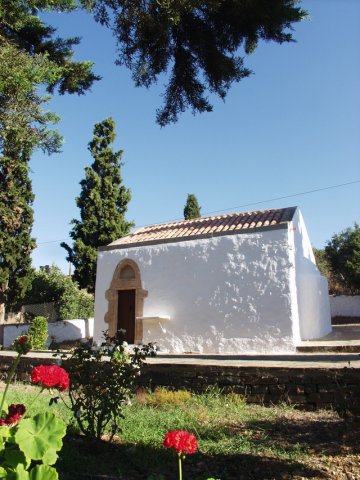
A wood of pines and eucalyptus leads to a secluded village where every turn of the road opens new, wide views of the Lasithi mountains. In this quiet country it is worth taking time over the church of the Archangel Michael, a remarkable Byzantine monument with splendid wall paintings, reached by a surfaced road.
The church, a single barrel-vaulted nave that is plain on the outside, stands on the southern edge of Lakonia. Its frescoes were painted in 1431/32 and are regarded as one of the best-preserved pictorial programmes of the 15th century in Crete. They show five scenes from the Gospels and a cycle devoted to the Archangel Michael, including the miracle at Chonai (Colossae), the Synaxis of the Bodiless Powers with Michael and Gabriel, and the less often painted episode of the prophet Nathan before David, with the archangels announcing to the king that his sin is forgiven. On the west wall two panels on a gold ground portray the donors, members of the Mochiotis family, in the dress of their day: Michael and Nikolaos in local costume, the latter with bow and arrow, and Ioannis with his wife, the couple holding a model of the church in their hands.
The village also has a distillery, known locally as “Rakadiko tou Stavrakaki”, where raki can be tasted – the strong Cretan spirit distilled from the pressed grape skins left over from wine-making, made here by the traditional method.
After the walk round Exo Lakonia the road meets, after about six kilometres, the main road from Agios Nikolaos to Neapoli. From there we continue towards Neapoli.
Neapoli
The town of Neapoli lies at about 260 metres in the green, fertile upland valley of upper Mirabello, some ten to twelve kilometres from Agios Nikolaos and about 45 kilometres from Heraklion. Its origins go back to Venetian times, when the place was called Kares. It was destroyed in the troubles and revolts of those centuries but rose again each time; under Ottoman rule it was known as Kainourio Chorio, “New Village” – Yeni Şehir to the Turkish administration – and from that the name Neapoli, “New Town”, eventually emerged.
A time of change and prosperity
In 1868, while still under Ottoman rule, Neapoli was given its new name and a new face. The man responsible was Kostis Adosidis, an Orthodox Christian of Greek descent who governed the province as a pasha in the service of the Sublime Porte. Under him an administrative building – today’s law courts – a hospital that later served as a secondary school, and other public buildings went up, and the town became a model seat of government. From 1868 until 1904 Neapoli was the capital of the province of Lasithi; that role then passed to Agios Nikolaos. The seat of the diocese of Petra was likewise moved here from Areti Monastery.
Famous sons and churches
Neapoli has given the world a pope: Petros Filargis of Kares, born around 1339, who was orphaned as a child and taken in by Franciscans, studied at Padua, at the Franciscan house in Norwich, at Oxford and in Paris, and in 1409 was elected pope by the Council of Pisa, which had opened on 25 March; he was crowned as Alexander V on 26 June – a most unusual career for a shepherd boy from Crete. On the way he had risen, with the backing of Gian Galeazzo Visconti, to be bishop of Piacenza, Vicenza and Novara, archbishop of Milan in 1402 and a cardinal in 1405. His pontificate fell in the years of the Western Schism and lasted only until the night of 3–4 May 1410, when he died suddenly at Bologna, where he lies in the church of San Francesco; the Roman Church later ranked him among the antipopes. Among the town’s chief buildings is the great cathedral of the Dormition of the Virgin (Megali Panagia) on the central square, whose feast on 15 August is the main festival of the year.
Ottoman rule and secret schools
Neapoli and its people lived through hard times under Ottoman rule. They include the tragic events in the church of St George as well as the work of the secret schools, which did much to keep Greek learning and culture alive.
Neapoli today: museums and architecture
Today Neapoli is proud of its museums: the Folklore Museum of the Cultural and Folklore Society of Ano Mirabello and the Archaeological Collection, housed in a renovated former orphanage and showing finds from ancient Dreros, whose ruins lie on a hill east of the town. Old windmills, handsome town houses and traditional kafenia on the large square give the town its particular charm. Olives and olive oil remain the mainstay of the valley. The local speciality to try is soumada, a very sweet, non-alcoholic almond drink, served chilled.
Kremasta Monastery
Kremasta Monastery (Μονή Κρεμαστών) lies about 2.5 kilometres south of Neapoli on the steep, wooded slopes of Mount Kavallaras, on the road that climbs by way of Vryses to the Lasithi Plateau. It owes its name – “the hanging one” – to its position: built like a small fortress, it seems to be suspended from the mountainside. According to a founder’s inscription it was established in 1593 by the monk Mitrofanis Agapitos, who gave his entire fortune for the purpose. It is dedicated to the Archangels Michael and Gabriel, and its feast is kept on 8 November. A surfaced road leads to the gate.
The buildings climb the slope in tiers around a horseshoe-shaped courtyard, with the single-aisled, barrel-vaulted katholikon at the highest point. It preserves a gilded, carved iconostasis of the 19th century, a 17th-century icon of Christ Enthroned of the Cretan School and an altar table of 1622 – the year to which the church itself is assigned – carved with a relief of Christ and vine tendrils. In the 19th century the monastery maintained a school, founded in 1821, which was well regarded throughout Lasithi; the present abbot’s quarters are said to have served as a secret school in Ottoman times. In 1866 Turkish troops wrecked the monastery, and the relics and books that the monks had hidden in a cave were spoilt by damp. From 1868 to 1871 Kostis Adosidis resided here while his new capital was being built below. Resistance fighters sheltered within its walls during the German occupation. The buildings were restored from 1992, a newer church of the Myrrh-bearing Women was built outside the enclosure, and since 1993 Kremasta has been a convent.
Local tradition names a monk, Nikolaos of Rhodes, as the founder of the first hermitage. Divine providence, it is said, led him to this district, where he found a miracle-working icon of St George. Nikolaos withdrew to a small cave that can be seen from the monastery on the slope opposite, and there he was also buried. Later, so the legend continues, his bones made their way to Rhodes in an equally miraculous manner: a Rhodian ship was sailing along this coast when the sailors noticed a bright star that came to rest above the mouth of the cave and shone like the sun. They climbed up, found the relics and carried them to the saint’s homeland.
The miracle-working icon of St George is, according to tradition, still in the monastery. The original is brought out for veneration only on the great feast days; a copy is available to pilgrims throughout the year.
The Cave of Milatos
Not far from here, near the coast a little east of Sisi and Malia, the village of Milatos preserves the name of an ancient settlement, one that tradition counts among the Cretan towns that sent men to the Trojan War. In the nearby Cave of Milatos – a low, many-chambered cavern of some 2,100 square metres with eight entrances, used by man since the Neolithic – about 2,700 people from Lasithi and Mirabello took refuge in February 1823, defended by some 150 armed men against the troops of Hasan Pasha. After a fifteen-day siege, from 3 to 15 February, many of the men were killed, eighteen priests among them, and the women and children were sold into slavery. In the cave there is now a chapel of St Thomas, built in 1935, beside an ossuary holding bones of the dead; the victims are commemorated there each year. The entrance is reached by an old footpath of about 200 metres from the parking place.
The Lasithi Plateau
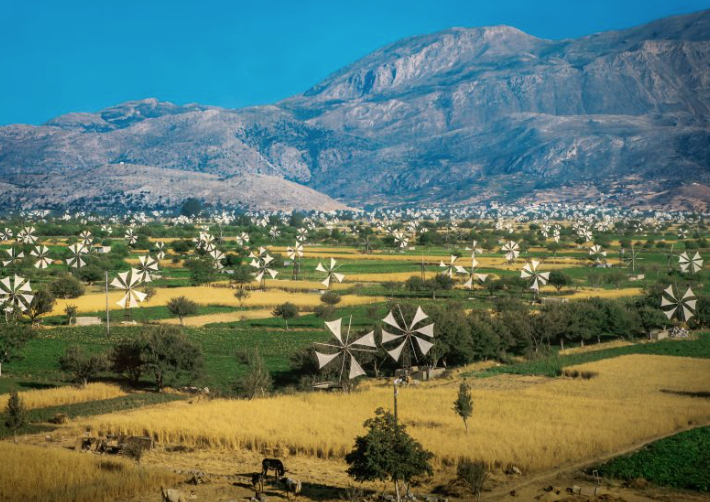
We leave Neapoli by the road that leads across the Lasithi Plateau to Tzermiado.
On the way up into the mountains – there are windmills everywhere – we pass through small traditional settlements. Every village has one church or several where one can stop, and the tavernas serve excellent Cretan cooking. The plateau itself lies at around 850 metres, is ringed by peaks on every side and has been planted for centuries with potatoes, vegetables and fruit, on soil renewed each spring by the silt that the snowmelt carries down. It was not always so: in 1293 the Venetians, weary of the rebels who sheltered here, cleared the plateau, razed its villages and forbade cultivation and return on pain of death, a ban that held for more than two centuries. When the land was resettled, a grid of drainage ditches, the linies, was dug between 1514 and 1560 to lead the winter floodwater to the Chonos sinkhole at the western edge; they are still in use. The white-sailed irrigation windmills, built to a local design, date from the 1920s and once numbered about ten thousand, though most have since given way to motor pumps.
Tzermiado
Tzermiado is a comparatively young place: it grew up in the 15th century, in Venetian times, and probably bears the name of its first inhabitants, the Tzermiadis family; in 1630 Francesco Basilicata mentions it as “Zermiades”. The village lies at the northern foot of Mount Selena at about 850 metres and is today the seat of the municipality of Oropedio Lasithiou, the largest of the plateau’s villages, ahead of Agios Georgios. The architecture is typically Cretan – stone houses with tiled roofs, and a great deal of greenery. The village has accommodation of every category, kafenia and tavernas serving Cretan food. In the uprising of 1866–1869 the village was destroyed after Ottoman troops had surrounded the freedom fighter Michail Korakas here.
Above all one should climb, by a farm track and a stretch of the E4 long-distance footpath, to the site of Karfi at about 1,100 metres; the name means “nail”, and the limestone knob that marks the summit does indeed stick out of the mountain like one. Here lie the ruins of a Late Minoan refuge settlement, laid out by Minoans after the decline of the great palaces – according to tradition in flight from the Dorians – and occupied in the period known as Late Minoan IIIC, roughly 1200–1000 BC. John Pendlebury and the British School excavated it between 1937 and 1939, uncovering paved lanes and blocks of houses with central hearths. On the highest point stood an old sanctuary with an altar, from which came the clay goddesses with cylindrical skirts and upraised arms now in the Heraklion Archaeological Museum; a little lower down are round tombs with corbelled domes of the kind typical of the Late Minoan age, grouped in two cemeteries. The view from the top is superb.
Very close to the village rises a fort known as “Kazarma”, with the church of the Holy Cross (tou Timiou Stavrou) beside it. The church of the Holy Trinity, with its tall bell tower, is also worth noting. North of the village stand 27 stone windmills; they belong to a type unique in Crete, whose sails turn in one direction only.
Since 1986 these mills have been protected by the state as a cultural monument. Outside Tzermiado, towards the hamlets of Farsaro and Marmaketo, opens the Cave of Trapeza (Spilaio tis Trapezas), at 860 metres, richly hung with stalactites and stalagmites, some of them broken. A cobbled, stepped path shaded by oaks climbs to its narrow mouth in about five minutes; inside, a damp passage leads to two main chambers with side recesses, divided by a massive stalagmite. People lived here from the Neolithic onwards; when they moved to the nearby hill of Kastellos the cave became a sanctuary for the worship of ancient deities and later a burial place, and in popular speech it is also called Kronio and linked with the cult of Kronos. Pendlebury dug it systematically in the mid-1930s, and archaeologists found ample evidence of all this, ranging from the Neolithic to the Byzantine period: gold objects, figurines, Early Minoan ivory statuettes and Egyptian scarabs of the Eleventh Dynasty, proof of early contact between Crete and Egypt.
For travellers who would like to experience a panigiri – a patronal festival with a market, food and drink, and singers and dancers from the district – here are the feast days in Tzermiado and the surrounding villages:
10 February – feast of St Charalambos
29 August – feast of St John (the Beheading of the Baptist); the church of the Holy Trinity keeps its feast at Pentecost, a movable date
9 December – feast of St Anne
30 August – in the village of Plati, feast of St Alexander
30 August – in the village of Psychro, feast of the Holy Girdle of the Virgin (Agia Zoni).
1 July and 1 November – in the village of Mesa Lasithi, feast of the Holy Unmercenaries (Agioi Anargyroi) Cosmas and Damian
Anyone who happens to arrive on one of these days may count themselves fortunate.
We drive on to the village of Psychro to visit the famous Dictaean Cave (Diktaion Andron), where legend has it that Zeus came into the world.
The cradle of Zeus: the Dictaean Cave (Diktaion Andron)
The Dictaean Cave, the Diktaion Andron, lies at 1,025 metres above the village of Psychro and was held in ancient tradition to be the birthplace of Zeus. The story is as old as Hesiod, whose “Theogony” sends Rhea to Lyttos and hides the child in a cave on Mount Aigaion; later writers, Apollodorus and Diodorus Siculus among them, name Mount Dikte. According to the myth Rhea concealed her child from Kronos, to whom it had been foretold that one of his children would overthrow him. In place of the infant she handed him a stone wrapped in swaddling clothes, which he swallowed.
The Kouretes guarded the child and drowned out his crying by beating their spears rhythmically against their shields. This tale explains the sacred character of the cave and its standing in the religious tradition of Crete. Archaeology has shown that the cave served around 2800 BC as a dwelling and burial place and around 2000 BC became a cult centre, taking over from the Cave of Trapeza; its busiest period fell in the later Middle Minoan age, offerings continued into Geometric times, and around 700 BC its religious importance passed largely to the Idaean Cave.
Later traditions linked the cave with King Minos: every nine years he is said to have come before Zeus here to receive guidance and laws. To the same cycle of legends belong the goat Amaltheia, who suckled the young god, and the bronze guardian Talos; the seer Epimenides, too, is supposed to have slept here for decades. Towards the end of the 19th century shepherds came upon the first finds, and excavations followed: Joseph Hatzidakis and Federico Halbherr dug in 1886, Arthur Evans in 1896, Pierre Demargne briefly in 1898, and David Hogarth, on the largest scale, in 1900, when a stuccoed altar came to light in the upper cave; John Boardman published the finds in 1961. They included bronze double axes, weapons, knife blades and needles – many of them wedged as offerings into the crevices of the stalactites in the lower grotto – fragments of some thirty offering tables, some with Linear A inscriptions, lamps of stone and clay, figurines, sealstones and jewellery from the Neolithic to the Roman period, and the bones of sacrificed bulls, sheep, goats, deer and boar. They are now kept chiefly in the Heraklion Archaeological Museum and in the Ashmolean Museum in Oxford, with smaller groups in the Louvre and the British Museum.
The cave is open to visitors. From the car park at Psychro two paths lead up in about 15 minutes; the left-hand one is considered the easier, and those who wish can ride up on a donkey. Inside, an upper chamber gives way to a steep descent into the lower grotto, where the visitor finds, over some 2,200 square metres, stalactites, stalagmites, columns and a small underground lake from which stalactites rise, all seen from about 250 metres of made path with electric lighting. The cool, damp air and the uneven, often slippery ground call for sturdy footwear and care, and a light jacket is welcome even in high summer.