Zakros: the Minoan palace and the Gorge of the Dead
The most complete guide to Crete: 221 places on the map, 23 routes and 49 articles — with photos, videos and the story behind every place. No sign-up, no trackers.
Routes drawn along real roads
Weather at every stop
Full-text search
“Near me” by geolocation
Create your own printable itinerary
Satellite, terrain, dark mode
Works offline
⌕
Searches 1.7 million characters of descriptions, not just names
—places
4regions
—routes
—with video
Search results
—
Interactive map
Find what is near you
Filters narrow the map and the list at once. Zoom out and pins group together.
Region
Category
Фильтры карты
Landmarks
Featured places
RegionCategory
Routes
Ready-made day trips
Individual places
Articles about landmarks
Zakros and the Gorge of the Dead
Zakros is one of the four known palatial centres of Minoan Crete, alongside Knossos, Phaistos and Malia – the smallest of them and the most remote. The site lies on the east coast, a few steps behind the shingle beach of the hamlet of Kato Zakros (Κάτω Ζάκρος), eight kilometres by road below the mountain village of Ano Zakros with its abundant springs. The sheltered bay was the last safe anchorage before the crossing eastwards: it connected the interior of Crete with the sea lanes to Cyprus, Syria and Egypt, and already in the time of the first palace a paved and guttered road three metres wide led from the town to the harbour. That trade was the foundation of the place’s wealth is shown by the raw materials found in its storerooms – elephant tusks from Syria and six copper ingots in the shape of ox-hides – and by imports such as Canaanite jars and stone bowls from Early Dynastic Egypt.
Through the gorge to the sea
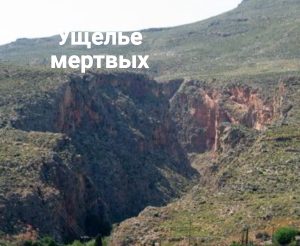
The finest way to reach Kato Zakros is through the ravine known as the Gorge of the Dead (Φαράγγι των Νεκρών). The name goes back to burials in the caves and recesses of its sheer, reddish-grey walls: in Minoan times the dead were laid to rest in these natural rock chambers. It does not, then, commemorate a battle or some mass death, but is the archaeological trace of funerary customs over several periods. A waymarked footpath runs through the gorge, which is also the final stretch of the E4 European long-distance path on Crete. The ravine is about four kilometres long and drops only some 150 metres, so that, depending on where one starts – in the village of Ano Zakros or at a parking place further down the road – the walk takes between one hour and a good two, or nearer three at a leisurely pace from the village; the path follows the stream bed between oleanders and plane trees and is not difficult. In summer expect great heat and carry all the water you need; in winter the stream can make the path impassable. There is a bus from Kato Zakros back up to the village, which spares walkers the return climb.
The palace
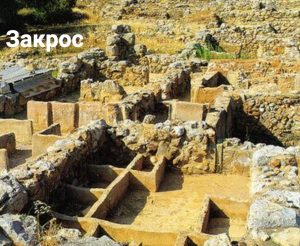
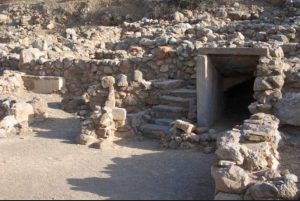
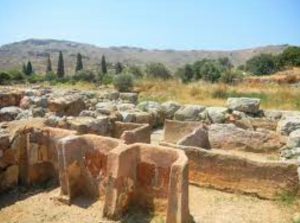
A first palace was built at the beginning of the 2nd millennium BC; after earthquake damage it was rebuilt around 1600 BC, and it is this later complex that the visitor sees today. Some 150 rooms were grouped round a rectangular central court of about 30 by 12 metres, a good deal smaller than the court at Knossos, with a second paved court to the west. On the west side lay the cult rooms with treasury, archive and lustral basin – the treasury of the shrine alone held a large number of chalices and ritual vessels as well as bronze double axes – together with a pillared hall of ceremonies, storerooms and workshops; on the east the so-called residential quarters with a large circular cistern hall, once roofed, into which seven steps descend; and on the north a kitchen. Several built springs and wells bear witness to a carefully planned water supply. The excavated part covers about 8,000 square metres, though the figure depends on whether only the palace is counted or also the houses of the town, which climbs the slope in terraces to the north and included oil and wine presses and a bronze-smelting furnace. The finds include pottery, seals, stone vessels and Linear A documents – 31 tablets and some 560 sealings.
The discovery is a tale of narrowly missed opportunities. The British archaeologist David Hogarth dug several houses of the town in 1901, finding bronze tools, pottery, loom weights and a winepress, and broke off a few metres short of the palace. It was left to Nikolaos Platon to come upon the complex in 1961 – he went on working here until his death in 1992 – and to find it, unlike the other palaces, unplundered: the inhabitants had evidently abandoned it in haste and never returned. So pieces of unique quality remained where they had been left, among them the rock-crystal rhyton with a handle of crystal beads, a bull’s-head rhyton of chlorite, and a stone vessel carved in relief with a peak sanctuary. They are now on display in the Archaeological Museum of Heraklion, with further finds in Sitia.
Around 1450 BC the palace was destroyed by fire. The eruption of the volcano on Thera falls within the same broad period, but a direct causal link between the eruption and the end of Zakros is not regarded as proven: scholars discuss earthquakes, fire and the political upheavals of the Late Minoan period. As a centre in the earlier sense the palace was never rebuilt; only in parts of the town did life go on for a while.
Myth and reality
The legend of King Minos and his conversations with Zeus belongs to Greek mythology, not to the documented history of Zakros. The notion of connecting the Minoans with Atlantis is likewise a modern hypothesis without archaeological confirmation; so long as Linear A remains undeciphered, the administrative and religious texts of the Minoans cannot be read.
For a visit, early morning or late afternoon is best, as the site has almost no shade; in the lower-lying parts the risen water table often leaves standing water, in which terrapins live. Afterwards the little bay with its tavernas under the tamarisks is an invitation to linger – Kato Zakros is one of the quietest places on the island.