Kapsa Monastery: the cliffside house of St John the Baptist
The most complete guide to Crete: 221 places on the map, 23 routes and 49 articles — with photos, videos and the story behind every place. No sign-up, no trackers.
Routes drawn along real roads
Weather at every stop
Full-text search
“Near me” by geolocation
Create your own printable itinerary
Satellite, terrain, dark mode
Works offline
⌕
Searches 1.7 million characters of descriptions, not just names
—places
4regions
—routes
—with video
Search results
—
Interactive map
Find what is near you
Filters narrow the map and the list at once. Zoom out and pins group together.
Region
Category
Фильтры карты
Landmarks
Featured places
RegionCategory
Routes
Ready-made day trips
Individual places
Articles about landmarks
The Monastery of the Prophet and Forerunner John at Kapsa
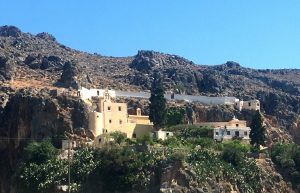
The Monastery of the Prophet and Forerunner John at Kapsa (Moni Timiou Prodromou Kapsa) lies in the far south-east of Crete, a mere 57 metres above the sea and yet seemingly lifted into the sky: its white buildings cling to a steep and utterly bare slope of grey-red rock in which wind and water have hollowed caves large and small. Immediately beside it the wild Pervolakia Gorge opens to the sea; the monastery stands on the western side of its mouth, looking out across the Libyan Sea. It grew up on the site of an old cave church dedicated to John the Baptist and to the Holy Trinity, and it ranks among the most important monuments of Orthodox history on Crete. Like the rest of the Church of Crete it comes under the Ecumenical Patriarchate of Constantinople, and a small community of monks still lives here. From Makrygialos it is some seven kilometres along the coast road towards Goudouras; from Ierapetra a little over thirty, from Sitia just under forty. Along this stretch the landscape grows harsher and stonier with every kilometre, almost North African in character, and between the rocks lie small bright coves of tamarisk and fine shingle.
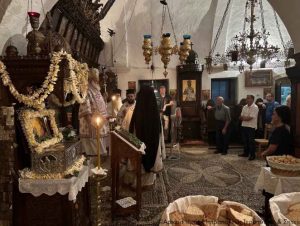
In the katholikon, the main church, the floors are laid with sea pebbles set in ornamental and religious patterns, and there is a carved wooden iconostasis. The screen was made in 1869 by the woodcarver Minas Chatzis – Chatziminas, as he is also remembered – from Lasithi, and painted in 1874, the year of the founder’s death, by Antonios Alexandridis. The church has two barrel-vaulted aisles, and its older part lies wholly within the living rock; on the walls of the chapel of the Baptist traces of frescoes of the 13th and 14th centuries can still be made out. Among its treasures are two icons of the Cretan School: a Virgin and Child, the Panagia Vrefokratousa, of the early 15th century, and a St John the Baptist of the 16th. Above the entrance an inscription of 1882 names the two men who renewed the monastery, Gerontogiannis and his grandson. From the terraces the eye takes in the whole wide bay, and in clear weather reaches the island of Koufonisi, some five and a half kilometres off Cape Goudouras; pot plants flower in the courtyard, and beneath the vine pergola guests are offered a refreshment in the old monastic manner. All these details, together with the old walls, tell of the community’s history and of the order in which it was built.
A walk through the monastery
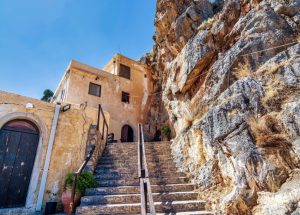
Seen from the road, Kapsa looks like a small fortress chiselled into the hillside; cars are left at its foot. Beyond the gate one climbs by flights of steps from terrace to terrace: on four levels are ranged the cells, the guest wing, the refectory, the kitchen, the bread oven and the storerooms, and beneath them the great cistern that collects the rainwater from the roofs and courtyards – for a long time, since the only well was brackish, the community’s drinking water. At the centre is the cave church. Its interior is dim and narrow, the rock lies bare on walls and ceiling, and the light of the oil lamps is caught in the silver of the reliquary. In the south-west corner is the rock-cut tomb of the founder. Into the church there once opened the window of the cell in which he spent his last years and from which he followed the services. Those with time to spare should afterwards sit for a while on the wall of the upper courtyard: below, the coast road winds through its bends; beyond it lies the sea in every shade from turquoise to deep blue; and apart from the wind and the cicadas there is hardly a sound.
The monastery is open to pilgrims and visitors from 6.30 am to 12.30 pm and from 3.30 pm to 7 pm. Plain dress in keeping with the dignity of the place is required, and the rules are applied more strictly here than elsewhere: shoulders and knees must be covered, shorts are not welcome, and women are expected to wear a skirt. The faithful venerate the wonder-working icon of St John the Baptist, the tomb and relics of the founder, the relics of other saints and a fragment of the Life-giving Cross. The cave in which the venerable Joseph Gerontogiannis lived as an ascetic for seventeen years can also be visited: a maintained path leads from behind the monastery about a hundred metres to the north-west, to a grotto hung with stalactites where water trickles steadily from the roof – water which pilgrims regard as holy. During the hours of prayer silence is kept throughout the monastery.
The history of the monastery
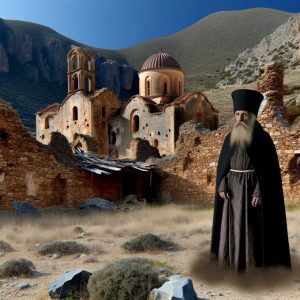
When the monastery was founded is not known; written sources are lacking. Its only codex, drawn up in 1890 by Archimandrite Joseph Gerontakis – a descendant of the devout Joseph Gerontogiannis – and confirmed by the late Bishop Amvrosios of Ierositia, records that from time immemorial a very old little monastery had stood on this rock, perhaps of Venetian or even of Byzantine origin. More recent scholarship supports the supposition: the frescoes in the chapel of the Baptist are dated to the 13th and 14th centuries, and the foundation is placed anywhere between the 13th century and the 15th. Tradition has it that a raid from the sea, by pirates or by Turks, destroyed the monastery in 1471 and that the district was afterwards left desolate; only the little church built into the rock remained standing. The monastery was adorned with four icons on wood, one of the Mother of God and three of St John the Baptist. Its layout is idiosyncratic and unlike that of the other monasteries founded around the middle of the 19th century, for here everything had to be stepped up a cliff in four tiers. Scratched into the walls and the ambo of the Baptist’s church are dates running from 1552 to 1809, the marks of pilgrims and monks, which testify that the place remained a spiritual refuge for generations, even when the buildings had long since fallen into ruin.
Some years after the death of the venerable Joseph Gerontogiannis his grandson, Archimandrite Joseph Gerontakis, took charge of the monastery, continued his grandfather’s work and pressed ahead with its enlargement. He had new cells built, acquired land and brought water to the monastery from the spring of the Holy Forty (Agii Saranta) – a considerable achievement in a district where the only well gave brackish water and the community had until then depended on its rainwater cistern. Under his leadership new monks settled here; in 1881 the community numbered five monks and five laymen. The inscription of 1882 over the church door dates from his time, and in 1890 he wrote down the history of the house in its codex.
In 1900, with the publication of the charter of the Church of Crete (Law 276/1900 of the Cretan State), Kapsa Monastery was dissolved as an independent community and attached to Toplou Monastery, whose full dedication is to the Panagia Akrotiriani – Our Lady of the Cape – and St John the Theologian. The abbot of the day, Archimandrite Joseph Gerontakis, could not reconcile himself to the decision and left for the island of Symi, where he was given a parish. There he remained to the end of his life; he died in 1933. Kapsa thereafter remained for many years dependent on Toplou, the great fortified monastery at the opposite, north-eastern corner of the province, and it is run as Toplou’s metochi to this day.
In the resistance
During the Italian and German occupation the monastery took part in the resistance. Many Greek partisans, together with officers and men of the Allied forces, hid in the almost inaccessible country around Kapsa until they could be taken off from the remote coves by British submarines and ships and carried to Egypt. The abbot at the time, Ilarion Syntychakis, and his monks gave the fugitives shelter, food and care – although the occupation authorities had threatened death for any help given to foreign soldiers. For a time a wireless set was also operated from the monastery.
That so remote a monastery should have played such a part is explained by its position. After the Battle of Crete in May 1941 thousands of British, Australian and New Zealand soldiers were left behind on the island and made their way into the mountains. Eastern Crete, with the prefecture of Lasithi, was assigned to the Italian occupying forces; only after Italy’s capitulation in September 1943 did German troops move into the region. The uninhabited south-east coast, with its caves, gorges and hidden coves, lent itself to clandestine embarkations, and a monastery that had always taken in strangers at first aroused no suspicion. That it was cleared in November 1943, a few weeks after the Germans arrived, fits the pattern, as does the fate of the mother house at Toplou, which was drawn into the same work.
In spite of arrests, harsh interrogations and torture, the monks gave away neither the names of those in hiding nor any details of the wireless traffic. They had joined the struggle against the occupiers out of Christian duty and loyalty to their country. This only fed the suspicion of the German authorities that espionage was being carried on at Kapsa. In November 1943 they therefore declared the district a prohibited zone – a “dead zone”, as it is remembered locally – in which no one was allowed to live, and ordered the abbot and all who lived there to leave the monastery at once. The monks did not come back until the Germans had gone.
After the end of the war the hieromonk Ilarion returned and set about rebuilding. Since then the monastery has continued on its way with a small number of monks. A notable share in this belongs to the late Gerontissa Agathangeli Karydi (died 2007), a nun who served in the monastery for more than fifty years and did not leave it even in the hardest times. In 1975 the present abbot, Archimandrite Methodios Perakis, settled at Kapsa; he has devoted himself with great zeal to the renewal and adornment of the buildings. Following a thorough study of the fabric by specialist engineers, the west wing and the inner courtyard of the complex were restored and consolidated in 2005 and 2006 under the supervision of the 13th Ephorate of Antiquities; at the same time the frescoes in the katholikon were secured and cleaned.
The succession of abbots who have led the monastery since the departure of Joseph Gerontakis is preserved in the tradition of the Metropolis of Ierapytna and Sitia: Methodios Vrygionakis and Iakovos Tsiriakis were followed by Ilarion Syntychakis, the abbot of the war years; after him came Kyrillos Katsogresakis and Iakovos Sfendarakis, before Methodios Perakis took charge in 1975. Today he is assisted by the archdeacon Evgenios. The community was never large; that it has endured through every rupture – ruin, dissolution, expulsion – it owes not least to the pilgrims who have kept faith with Gerontogiannis.
The life of St Joseph Gerontogiannis
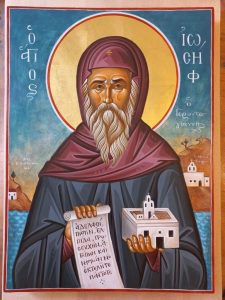
Ioannis Vitsentzos, later known as Gerontogiannis – “old Giannis” – was born in 1799 in the half-ruined monastery of the Baptist (Prodromou) at Kapsa, in one of its abandoned cells. His devout parents, Emmanouil and Zambia, had fled from the harassment of the Turkish authorities to the ruins of this desolate and secluded place. Here the boy was born and here, in the cave church, he was baptised. Later, when the persecutions eased and circumstances allowed, the family moved to the nearby village of Lithines. Schooling was denied to Christian children in the countryside, and he never learned to read or write; what he knew of the church services he picked up by ear, well enough to help with the chanting, while he worked his father’s fields and minded the family’s sheep on the slopes around Kapsa.
When he came of age he married Kalliopi, a daughter of the Gerontakis or Gerontis family, which was itself persecuted by the Turks. She was in hiding on the south-east coast because she feared the fate of her only sister, who had taken her own life rather than be dishonoured by the Turks. It was for that very reason that her parents had sent Kalliopi to the lonely shores and caves near Kapsa Monastery. There she met Ioannis, there the two were married in the cave church among the ruins, and she bore him four children: three daughters and a son.
Gerontogiannis was unbending towards the Turks, but above all he was a believing Christian. As a young man he was, by all accounts, hot-headed to the point of recklessness, and more than once he came to the notice of the Ottoman authorities and was hunted by the gendarmes. He therefore often hid with his family in the Pervolakia Gorge, three and a half kilometres of rock walls in whose caves and clefts no one could track him down. For the greater part of the year they lived on the metochi of Katsaroli, not far from Lithines.
The tragedy at Katsaroli
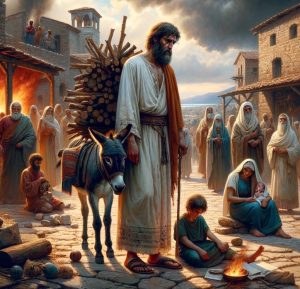
According to tradition, Ioannis had gathered firewood one Sunday and loaded it on his pack animal in order, as was his habit, to sell it in the villages of Armeni and Chandras, up on the plateau, and buy wine with the proceeds – on a day, that is, when he ought to have been in church. He took his wife Kalliopi with him and left her with her relations in Lithines; the children stayed behind alone on the metochi. On the way home Kalliopi was seized by a dark foreboding that something must have happened at the house while they were away.
When they arrived they found their youngest daughter, Irini, burnt to death in the yard by the threshing floor. Her brother and sisters had carried the child out of doors, believing that the wind would put out the flames that had caught her little dress. The accident in which the girl died Ioannis understood as God’s punishment for his sins, and above all for his breaking of the Lord’s day. It determined the rest of his life and became the occasion of his conversion.
He left the ruined monastery and settled for good in Lithines. The people of the village, his relations and acquaintances, watched his character change. The rough, quick-tempered and quarrelsome man became patient, merciful and gentle, a person without guile. Constant participation in the sacraments of the Church, fasting, prayer, almsgiving and unceasing repentance purified his heart and enlightened his mind, so that he was able to receive the divine revelation that was to be the turning point of his later life. “Without love, all is vanity” is the saying by which his teaching is remembered.
Forty-three hours
In 1841, at the age of 42, Gerontogiannis appeared to have died: he fell into a death-like sleep, and his family believed that he had passed away. An angel of the Lord, so the tradition of the monastery relates, caught him up into heaven like the Apostle Paul, and he beheld the hosts of the righteous in heavenly glory and joy, but also the manifold punishments of those condemned to everlasting torment. After 43 hours he awoke, serene and calm, and saw gathered about his bed a crowd of relations, neighbours and villagers. Among them was a paralysed old woman. He stretched out his hand to her, whispered a prayer and healed her before the astonished eyes of all those present.
Immediately afterwards he began to preach and to work wonders. Day after day people from the district of Sitia came to his house to see him, to receive his blessing, to hear his advice and to be freed from their afflictions. This did not, of course, escape the Turkish authorities. It was a year of unrest, for the rising in Greece still echoed and Crete too was in ferment, the island having only just passed back from Egyptian to Ottoman hands. The Turks accordingly declared Gerontogiannis a danger to public security; in their view the gatherings at his house pursued seditious ends under a religious pretext. Nor was the Church at first any better disposed: the bishop is said to have taken him for a charlatan, and to have been won over only when the old man’s prayer cured his mare. In truth those who surrounded the devout man were chiefly the sick and infirm, who sought relief, comfort and healing from him.
Before the pasha
Three times he was summoned before the court of the governor of Crete, Mustafa Pasha. But the continual persecutions, and the arrests that took him each time from Lithines all the way to Heraklion, achieved the exact opposite of what was intended: in every village through which the holy man was led, people ran together to greet him and receive his blessing. At the third arrest, too, a great throng of the faithful gathered. This angered the governor – the Igemonas, as the Greeks called him – and he ordered the guards to disperse the crowd and throw Gerontogiannis into prison without delay.
One of his advisers, however, Ioannis Kapetanakis, a native of Sitia, asked and was allowed to take the prisoner into his own house. Gerontogiannis was not permitted to leave it as long as the sentence was pending – which, so rumour had it, would be either banishment from the island or the dungeon. In those very days the governor’s child fell down a staircase, was gravely injured and lay unconscious; no doctor was able to bring it round. A father’s love moved the Turkish lord to send for Gerontogiannis, who had the reputation of a miraculous healer. Scarcely had he laid his hand on the child and said a prayer than it opened its eyes and was saved.
A similar cure was granted to the governor’s mother-in-law, whom he delivered from a long illness thought to be incurable. Then the Turkish lord released Gerontogiannis and allowed him to return to his village and continue his charitable work. In gratitude he even sent rich presents after him. Gerontogiannis, however, would accept nothing but seventeen oil lamps – kandilia for the church of the Panagia at Lithines.
Return to the wilderness of Kapsa
Later Bishop Ilarion Katsoulis of Ierositia (1846–1869) advised Gerontogiannis to withdraw to some remote place, so that the objections and complaints of the Turks might fall silent. No place could be considered but the half-ruined monastery of Kapsa, where he had been born, baptised and married. With the decision of the man of God to settle in the wilderness of Kapsa in 1841 the modern history of the monastery begins. The circumstances were favourable: after 1840 the administration of Crete under Mustafa Naili Pasha tolerated the restoration of monasteries and the repair of many churches that had lain abandoned for centuries. That naturally applied also to the monastery to which Joseph Gerontogiannis retired.
In 1841 the last owner of the land on which the ruined little monastery of the Prophet and Forerunner stood, Chatzi-Nikolaos Zafiridis of the village of Agia Triada near Sitia, made over the cave church and the surrounding land to Gerontogiannis, the founder and restorer of the monastery. Zafiridis had in his turn bought the property from a Turk, Dervis Aga Chatzarifakis. The old man could neither read nor write and left no written record of any kind; what exactly he found is therefore not known. What is certain is that the church of St John was standing and evidently drew many of the faithful from the surrounding villages – the dates scratched on its walls run on to 1809 – and that beside it stood two buildings, half in ruins. There was also a well of brackish water, a sign that a monastery had once stood here, on whose rubble the new one now rose.
The deserted monastery woke to new life. Once again pilgrims and the sick came, wishing to meet the hermit and receive his blessing for the healing of their infirmities. The venerable Gerontogiannis himself lived for seventeen years in one of the remote caves north-west of the rock church, a grotto about a hundred metres away on the steep side of the gorge, where water drips from the stalactites of the roof. The old cells, which he put into repair, he left to the numerous pilgrims and to the many novices who wished to take the monastic habit. Thus the first community of monks began to form.
All this made it necessary to restore the monastery, to repair the old buildings and to put up new ones. The building work dragged on over a number of years, interrupted only in 1858, when Gerontogiannis withdrew for five months to the island of Kasos because of a new revolt that had broken out on Crete. In 1861 the side chapel of the Holy Trinity was added to the main cave church as a second aisle, it too set into the natural rock. The buildings were stepped up the slope on four levels and comprised cells, a guest house, a refectory, a kitchen, a bread oven, storerooms and a large cistern for collecting rainwater. In 1863 the monastery was complete, and Bishop Ilarion Katsoulis of Ierositia consecrated the main church. On the same occasion Ioannis received the Great Schema, the highest degree of monasticism, and with it the monastic name Joseph. The carved iconostasis followed in 1869.
Agia Sofia and the last years
The venerable Gerontogiannis remained at Kapsa Monastery until the revolt of 1866. Fearing that the conquerors might destroy the monastery, he decided at that time to move with his community to the old, forgotten and abandoned monastery of Agia Sofia, which stands on a low hill at the western edge of the plateau of Armeni, about a kilometre from the village of Etia, in the middle of the province of Sitia and some twenty kilometres from Kapsa. It was a Venetian foundation, probably of the later 15th century and perhaps the work of the Cornaro family; a stone from its gate bears the date 1634. At Kapsa he left only a single monk as steward until 1870. At Agia Sofia the venerable Joseph undertook the complete restoration of the monastery and the cultivation of its lands, repairing the cells, working the fields and planting vineyards with the help of pilgrims’ offerings, and in a short time put its economy in order. But because there too many pilgrims came to him from the surrounding villages, he became the target of slander. On the instructions of the then Bishop of Ierositia, Neofytos Kalogeridis (1869–1878), he therefore returned in 1870 to his first monastery, and Agia Sofia was deserted once more.
The holy man lived in strict abstinence, in prayer and fasting. He took only dry food, chiefly olives, wild greens and rusks. The greater part of the day he spent praying in his cell. He followed the services through the window of his cell, which gave on to the church; only on Sundays, when he received Holy Communion, did he come down into the church itself. So he passed the last five years of his life.
According to the tradition of the Church the Lord had bestowed on him the grace of healing; every day the sick came to him seeking help in faith. His fame spread quickly over the whole of Crete and as far as the islands of Chalki, Kasos and Symi, and so day after day crowds of the faithful made their way to Kapsa, which became a place of pilgrimage for the whole island. Some sought wise counsel and guidance for their daily lives; others asked for the healing of illnesses and for deliverance from afflictions of the soul. With gentleness and compassion Gerontogiannis taught and strengthened the people and prayed for the sick, that the grace of the Lord might grant them health of body and soul.
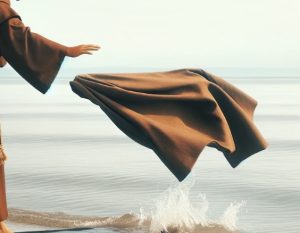
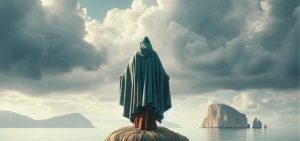
It was told far and wide that the holy man had made sea water sweet by touching it. He is also said to have cast his cassock upon the sea and used it as a raft to cross from time to time to the island of Koufonisi, which lies off the coast opposite the monastery. The venerable Joseph possessed, moreover, the gift of second sight: he recognised stolen goods, which pilgrims not infrequently brought him as presents, and required those who brought them to return them to their owners.
The death of the elder
The long years of asceticism had wasted his ailing body. His voice had grown thin, so that what he said could scarcely be understood. In the last months of his life he no longer left his cell. Foreseeing his death, he summoned the whole brotherhood before his departure to ask their forgiveness and to give his last counsels. He named the monk Anastasios as his successor, and he foretold exactly the day and the hour of his death. His grandson Joseph, then a deacon, and the monk Gennadios he asked to celebrate the liturgy together and to bring him the Holy Gifts.
On 6 August 1874, the feast of the Transfiguration, after receiving Communion he called the fathers once more into his cell and again asked their forgiveness. Then he crossed himself, lay down on his right side, folded his hands and gave back his soul to the Lord; he was 75 years old. His body became the object of popular veneration: for three days it lay in the church, and day after day people streamed into the monastery to bow before it and take their leave. On 9 August 1874 he was buried in the church of the Baptist, in the south-west corner, in a tomb hewn from the rock which had been prepared by his grandson, the future abbot Archimandrite Joseph Gerontakis. An inscription of 1882 over the church door names grandfather and grandson together as the renewers of the monastery.
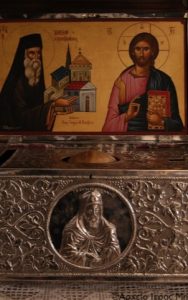
The raising of the bones of the venerable Joseph took place on 7 May 1982, 108 years after his death; it was undertaken, the diocese records, on the advice of the elder now venerated as St Porphyrios. The holy relics, from which according to the testimony of pilgrims a fragrance proceeds, rest – the skull among them – in a silver casket in the central part of the monastery church. To this day they draw thousands in search of help and are a focus of prayer for all who bear suffering. In 2004 Gerontogiannis was formally entered in the calendar of saints of the Orthodox Church; his memory is kept on 7 August, the day after his death, since the 6th itself belongs to the Transfiguration, with an all-night vigil at the monastery. On the Wednesday of Easter week – Bright Week, in Orthodox usage – the raising of the relics is commemorated as well.
The feast of 29 August and visiting today
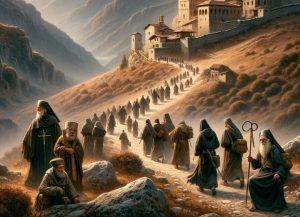
On 29 August, the feast of the Beheading of St John the Baptist, the faithful come to Kapsa from all over the island to take part in the Divine Liturgy and the panigiri. Many arrive on the eve, some on foot through the gorge or along the coast road from the villages round about, and spend the night in the courtyard and on the terraces of the monastery. The day has become a symbol of the unity of faith and custom: it joins people in common prayer and in the joy of the festival. A second all-night vigil is held on the night of 6 to 7 January, for the winter feast of the Baptist, and a third on the eve of 7 August for St Joseph himself.
Those who wish to combine the visit with a walk can descend or climb the Pervolakia Gorge, which begins at the village of Kato Pervolakia and after some three and a half kilometres, and a drop of about 300 metres, reaches the sea right beside the monastery. In summer it is dry, almost without shade and lined by high walls riddled with caves – the very rocks among which Gerontogiannis once hid with his family. Stout footwear and plenty of water are essential, and in high summer one should set out early in the morning. The usual plan is to leave the car at the monastery and walk up and back, or to arrange a taxi between Makrygialos and the upper end. Below the monastery is a quiet beach of large round pebbles with a few tamarisks for shade, where one can wait out the heat of the day until the monastery reopens in the afternoon. And anyone who stands up in the courtyard, with the sea below and the low outline of Koufonisi opposite, will understand why this barren rock has for centuries drawn people in search of solitude.
For the visit itself the same holds as in every inhabited monastery on Crete, but here it is taken with particular seriousness: speak quietly, ask before taking photographs inside the church, and let the monks go first. Candles are lit in the vestibule, and a small offering is customary. Many pilgrims first kiss the icon of the Baptist, then the casket of the saint, and only afterwards go to the tomb in the rock niche. Those who are not Orthodox are free to watch all this in silence; no one expects them to imitate it. The best hours are the early ones – the gate opens at half past six: in the morning light the rock face glows golden, the air is still cool, and as a rule one has the monastery and the sea to oneself. On the two great feast days in August, the 7th and the 29th, by contrast, it is wise to arrive early and be prepared to wait: the cave church holds only a fraction of the faithful, and most follow the liturgy from the courtyard and the terraces.