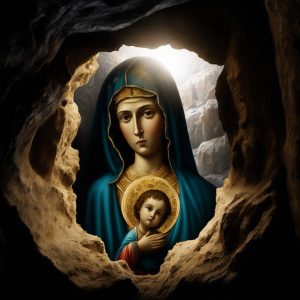
Panagia Faneromeni at Trachilas: the second Faneromeni monastery, above the Gorge of All Saints near Sitia
The most complete guide to Crete: 221 places on the map, 23 routes and 49 articles — with photos, videos and the story behind every place. No sign-up, no trackers.
Routes drawn along real roads
Weather at every stop
Full-text search
“Near me” by geolocation
Create your own printable itinerary
Satellite, terrain, dark mode
Works offline
⌕
Searches 1.7 million characters of descriptions, not just names
—places
4regions
—routes
—with video
Search results
—
Interactive map
Find what is near you
Filters narrow the map and the list at once. Zoom out and pins group together.
Region
Category
Фильтры карты
Landmarks
Featured places
RegionCategory
Routes
Ready-made day trips
Individual places
Articles about landmarks
Faneromeni Monastery at the Gorge of All Saints
Not far from the small town of Sitia, in the varied country of eastern Crete, lies the Agion Panton gorge (Φαράγγι Αγίων Πάντων), the Gorge of All Saints – a place for an unhurried walk rather than a mountaineering feat. The starting point is the village of Platani, in the olive country of Skopi; from there the path follows the bed of a winter stream northwards to the sea, and almost every bend opens another page of history or of pious legend. The route is one of the waymarked geo-routes of the Sitia UNESCO Global Geopark, and it ends on a small beach, also called Agioi Pantes, where the stream spreads into a patch of wetland before reaching the Sea of Crete.
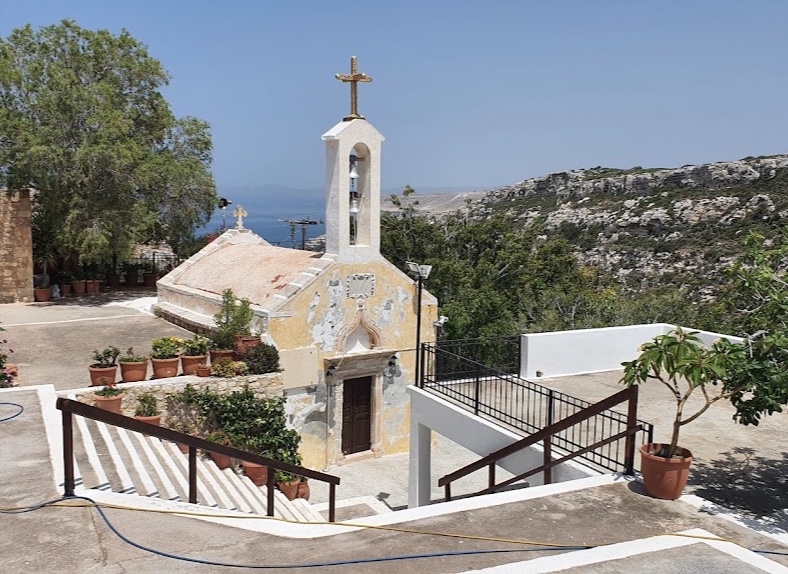
The walk brings us to the second Faneromeni monastery of our journey (Moni Panagias Faneromenis), which stands on the north coast some eight kilometres west of Sitia and about a kilometre and a half back from the shore, between the headlands of Vamvakia and Trachilas. As at the first monastery of that name, the story of its foundation turns on the appearance of an icon of the Mother of God, and it is this that gives the place its particular standing among the faithful. Faneromeni means “she who has appeared”, “she who has revealed herself”.
The monastery rises with some dignity out of the green of the ravine. It is a place of prayer, but also a keeper of the memory of Orthodox Crete: within its walls are old icons and wall paintings more than five centuries old – the earliest date scratched into the plaster is 1455 – which speak of deep devotion and of the long life of the site. The complex stands near Cape Trachilas, within the gorge itself, with a fine view out to sea; it belongs to the Metropolis of Ierapetra and Sitia and is looked after by the parish of Skopi. There are no monks here now. For most of the year the buildings stand quiet, and they come to life only for the great feasts. A surfaced road reaches the monastery, so those who do not wish to walk the gorge can drive to the gate.
The monastery was destroyed under Ottoman rule, in January 1829, and lay abandoned for half a century. Its rebuilding became a token of the stubborn faith of the Cretans. Today any Orthodox Christian, and indeed any visitor with a feeling for such places, can sense here the link with the past and the peace that seems to belong to old sanctuaries.
A general history of the monastery
The antiquity of the site is attested by the inscriptions that survive on the south-west side of the katholikon, the main church: graffiti left by the hieromonks and brothers Gabriel and Meletios Pantogalos, and the names of the great Cornaro family. The origins of the monastery lie far back, but no exact date of foundation can be given; the 13th century is sometimes suggested. In the view of N. I. Papadakis the monastery certainly existed but was destroyed by pirates in the 16th century. He writes: “From the earlier date we conclude that the monastery was founded before 1455; from the later one, which marks the end of the visits, that it ceased to exist after 1536 and was probably destroyed in Barbarossa’s raid (1537/38)” (N. I. Papadakis, “The Church of Crete”, p. 112). The coast of Sitia was notorious in the 15th and 16th centuries for pirate descents, and the town of Sitia itself was laid waste by Hayreddin Barbarossa in 1538. Since the building cannot be dated precisely, while the inscriptions and years to be read in the church run from 1455 to 1598 – 1455, 1469, 1471, 1483, 1486, 1487, 1499, 1505, 1514, 1529, 1532, 1580 and 1598 have all been recorded – one may safely say that the church was standing by the middle of the 15th century and that the complex had taken its present form by 1624 at the latest.
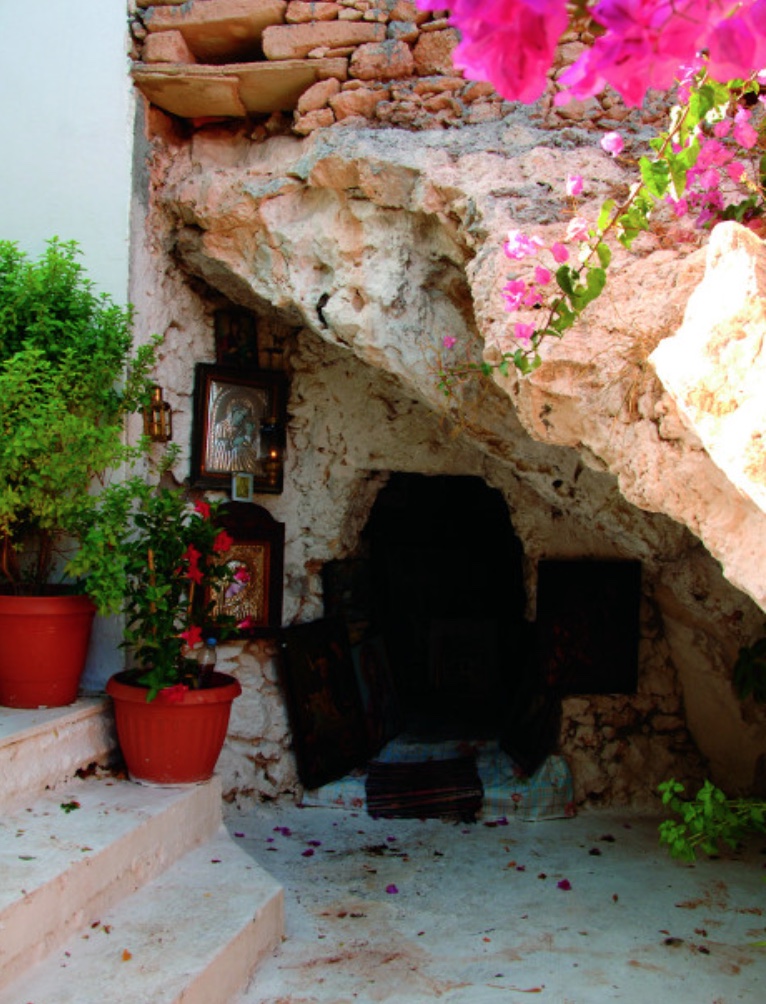
The centre of the complex is the two-aisled church, dedicated to the Dormition of the All-Holy Mother of God and to St George. The katholikon is surrounded by later buildings, which serve as cells for the “dekapentistes”, the pilgrims of the fifteenth of August. Inside the church is a small cave in which, according to the legend, the icon of the Virgin was found and which occasioned the building of the church. Besides this cave there are others round about in the Gorge of All Saints, long regarded as a place of solitude and prayer for ascetics. The cave to the west of the church is now thought to have been the dwelling of a hermit before either church or monastery existed.
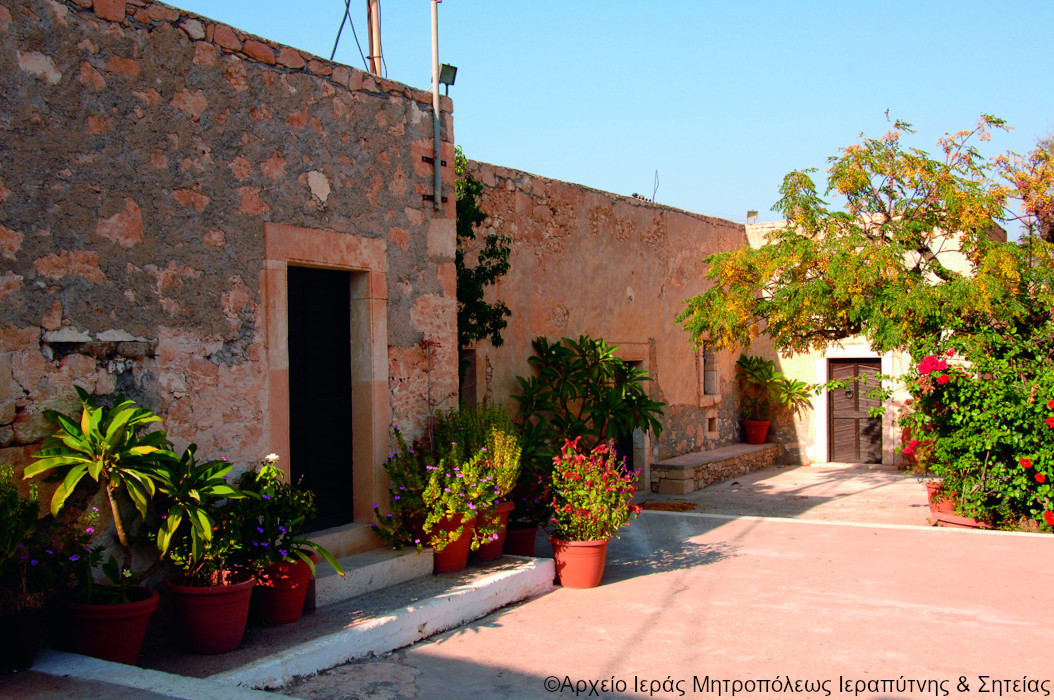
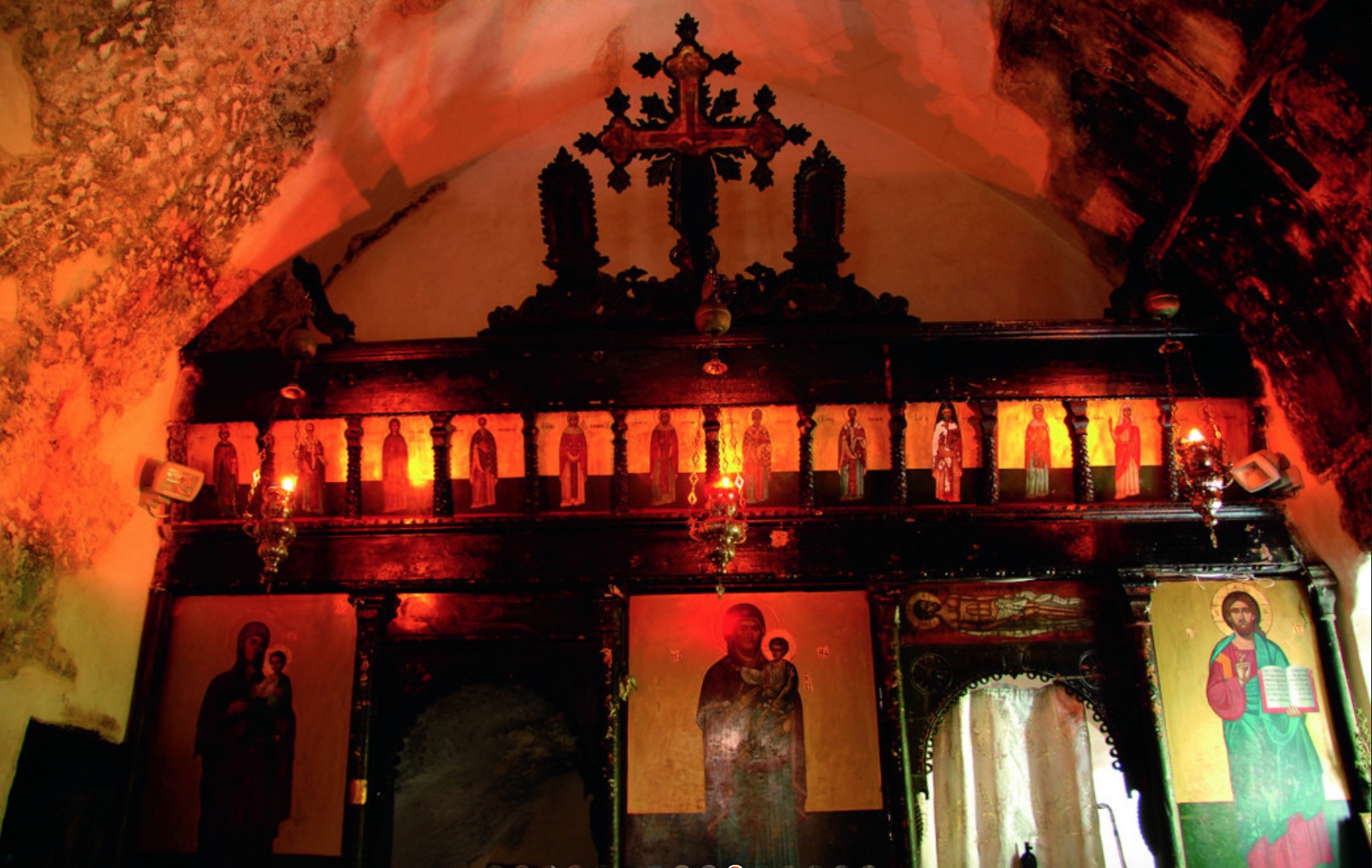
Building the church called for considerable ingenuity, since space was cramped and the requirements of Orthodox church architecture were strict. Nor could the builders leave the cave of the Faneromeni outside the church. The usual orientation towards the east was therefore abandoned, and the master mason laid the building out from north to south. The holy bema, the raised floor of the sanctuary, is fitted into a low cave in roughly dressed rock. The church has two doors because it has two altars, set side by side on the rock in symmetrical recesses. Six very old cells survive in the medieval manner, with iron-bound doors and small barred windows; there is also a room used as a dormitory.
As well as the monastic cells there are numerous private ones, built by local people at the expense of the parish – most of them from the village of Skopi – to house pilgrims, above all in August. From every village of the municipality of Sitia, and especially from the neighbouring ones of Skopi, Piskokefalo, Achladia, Chamezi, Exo Mouliana, Myrsini and Mesa Mouliana, as well as from the town of Sitia itself, the dekapentistes come to seek the grace of the Panagia, and for the feast of the Dormition great crowds of pilgrims gather. The miraculous icon is kept for the rest of the year in the parish church of St George in Skopi and is carried to the monastery in procession on the eve of the feast, with banners and chanting, to be taken back when the celebrations are over. The inner courtyard is spacious; during the dekapentismos many people find rest there on the stone benches of the church, and above the holy bema the shape of the cave is preserved.
The “Great Cell”, with its broad medieval arch, is the relic of an old working building in which the monastery’s olives were once milled. The “Tholos” is a cell in the upper range with a vaulted stone ceiling. The “Oven House” is a large cell at the beginning of the upper cells with a huge oven, in which bread was baked for the monastery and for many of its dependent farms (metochia). Besides the Oven House, many people still remember the oil press within the complex, which was used by the tenants and stewards of the monastic estates. Some of the ancillary buildings date only from the 18th century.
The church, its painted decoration and the inscriptions of the katholikon deserve close attention, both for their state of preservation and for their quality. Best preserved of all is the doorway in the south wall. Its finely carved frame of soft poros limestone, with a twisted moulding, rests on inverted capitals with floral ornament. Above it rises a sloping lintel with a pointed, fluted relief arch, crowned at the top with a pine-cone finial and finished at the springing with a flower motif. Scratched into the door frame is a graffito of the year 1469, one of the oldest dates in the building.
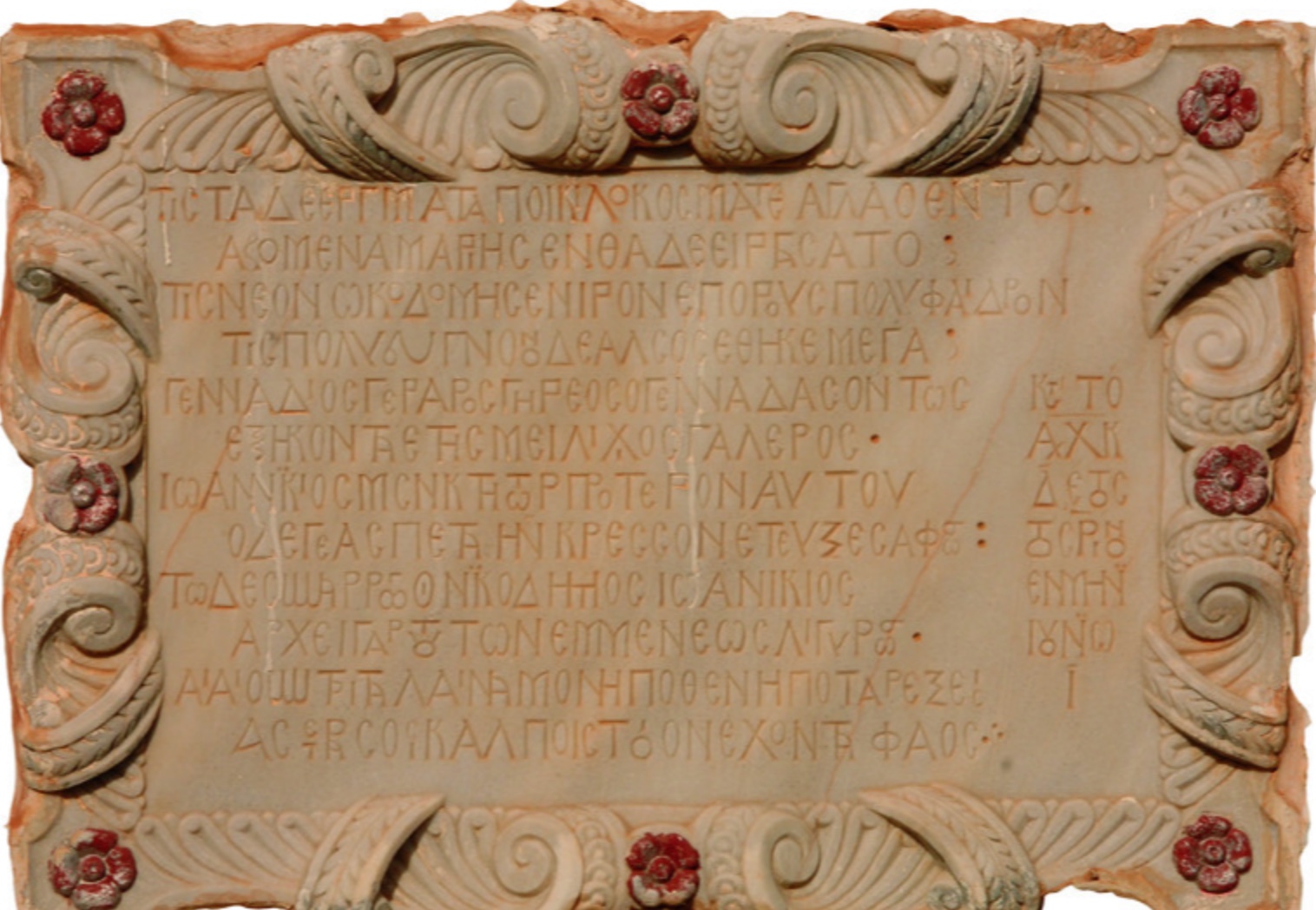
Above the lintel is set an inscription to which we owe what is known of the monastery’s history. It records that the restorer of the monastery in 1624, after its destruction in Barbarossa’s raids of 1538, was Gennadios, and that before him Ioannikios had been its founder. The work was carried out in the last decades of Venetian rule in Crete – Candia itself would surrender to the Ottomans in 1669 – at a time when monastic life on the island was flourishing.
The Greek inscription, as rendered by Stylianos Alexiou, runs roughly as follows: “Who, out of reverence for Mary, raised these works with their manifold ornament and splendour? On the mountain that spreads the fragrant grove a new and lovely sanctuary has been built. The vigorous Gennadios, advanced in years, truly great-hearted, a gentle nobleman, sixty years of age. Ioannikios was the founder before him, and he has already much improved his great works. His helpers are Nikodemos and Ioannikios, whom he directs with strength and skill. Alas, poor monastery, when and whence will you ever again find so bright a star in your bosom? In the year of our salvation 1624, in the month of June, on the 10th day.”
The inscription consists of six elegiac couplets and is composed in an archaising Greek that is not free of mistakes. It names the abbot Gennadios and the venerable Ioannikios, together with the monks who helped in the work, Ioannikios and Nikodemos. In the opinion of Alexiou the original founder Ioannikios is the same man as the one named in the inscription, which underlines his importance in the history of the house; the local legend of the foundation likewise gives the name Ioannikios to the first monk who settled beside the cave.
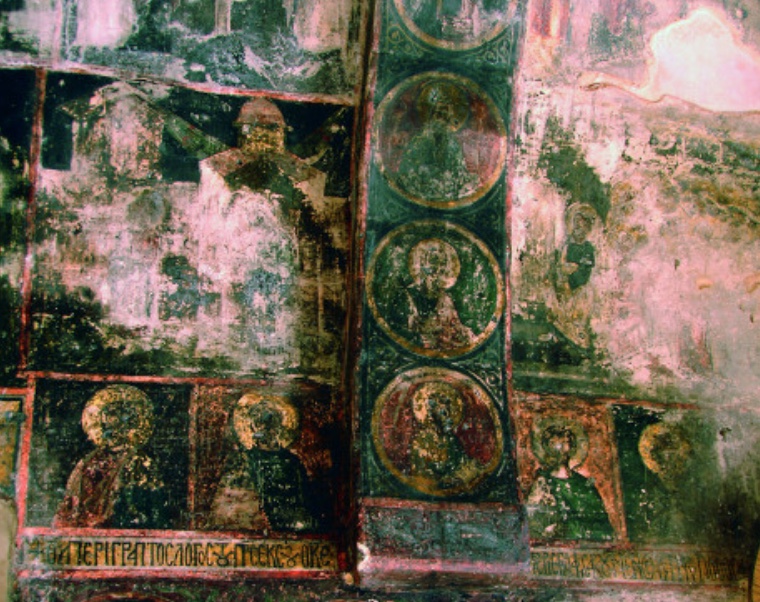
The aisle in which the inscription is found is divided from the holy bema by a wall pierced with two arched openings. The painted decoration, which once covered the entire surface, can be made out from the traces of colour that remain, and on the north wall there are signs of a second campaign of painting laid over the first. Thanks to funds from the parish of Skopi, the walls were cleaned and consolidated by conservators of the 13th Ephorate of Byzantine Antiquities. The surviving frescoes are hard to read because of layers of soot, damaged paint and modern coats of mortar; the blackening is generally put down to a fire set by the Turks.
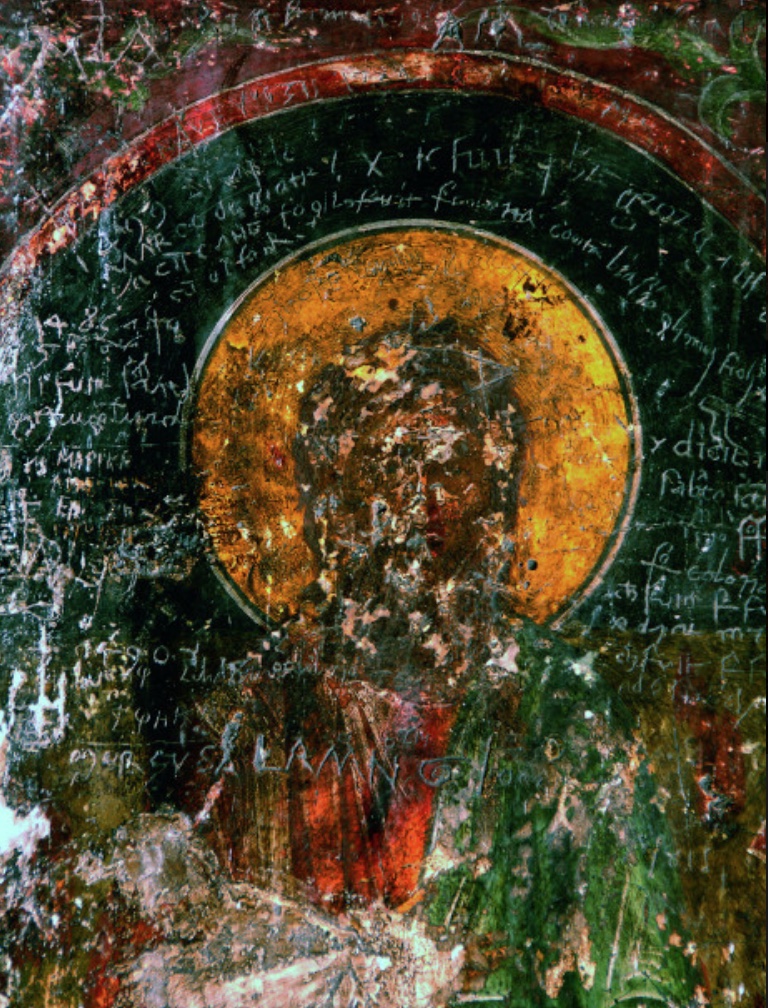
The scenes uncovered include the punishments of the damned on the lower part of the south wall – naked figures among flames and serpents – the Virgin enthroned in Paradise and the Apostle Peter with the keys on the west wall, and full-length saints on the side walls, among whom St Anthony and St Prokopios have been identified; medallions with saints and prophets fill the spandrels. An inscription in capital letters at the south side of the dome speaks of the “ineffable Word of the Father, from thee, Mother of God”. On the inner walls of the church numerous inscriptions and dates were found, evidence of the long history of the monastery and of its high reputation. Graffiti on the south and west walls name notable people who visited it, among them members of the great Cornaro family: a Nikolaos Cornaro styled lord of Achladia, an Andreas with the date 1490 and a Marcus who signed on 23 February 1532. Other visitors wrote in Latin letters – a Petros Buffo in 1461, a Nicola Michele in 1471, a Georgius Colona on 21 April 1499 – so that the wall reads like a visitors’ book of Venetian Sitia.
Under Turkish occupation the monastery, on the testimony of Emmanouil Angelakis, who lived in Crete at the time, continued to exist until 1829 and kept “at least a minimum complement” of monks (Emmanouil Angelakis, “Setia”, p. 221). Written evidence for each individual year of this period has not survived. The state of the monastic property at the beginning of the 20th century nevertheless suggests that the place was never wholly without care: community life went on, and buildings and land were kept up after a fashion.
In 1829, during another Cretan rising, Faneromeni Monastery was destroyed. The Ottomans who had left Sitia plundered the monastery and wrecked everything they could find, including icons, whose eyes were scratched out as a sign of “terrible fanaticism” (Emmanouil Angelakis, “Setia”, p. 221). The buildings were then left empty.
After fifty years of oblivion the monastery was rebuilt in 1879, as a date cut into the lintel of one of the cells records. N. Psilakis notes in the second volume of his “Monasteries and Hermitages of Crete” that Faneromeni held no great attraction for the monks of the 19th century who were trying, where they could, to restore old monasteries. After 1870 it passed into the possession of Toplou Monastery, whose monks tried to save and repair what they could. The work concerned the cells and the communal rooms; the oil press was put back in order, and the surrounding precinct was repaired as well. The years from 1870 to 1900 formed a short but significant phase in the life of the house, during which the monks of Panagia Akrotiriani at Toplou took continual care of the fabric. The Pantogalos brothers, whose names are scratched on the south wall of the church, are thought to have been among these restorers from Toplou.
From 1900 the hieromonk Grigorios Papadakis took charge of the monastery as its steward. The monk Gerasimos and the nun Salome lived there too. After a pilgrimage to the Near East, Grigorios went back to his own monastery to do penance and refused to return to Faneromeni. The buildings fell into decay once more, and the church was left without services.
According to documents in the archive of the diocese of Lasithi, the monastery was let to private tenants after 1900, though little land remained to it. In 1900, under the statute of the Church of Crete – Law 276 of that year – Faneromeni was declared dissolved for want of monks and attached to the stauropegial Monastery of Panagia Akrotiriani and St John the Theologian at Toplou. Later the local people secured the transfer of the church and buildings to the parish, which led to litigation between Sitia, Piskokefalo and Skopi over possession of the monastery. In the end the Court of First Instance of Lasithi awarded it to the community of Skopi, but its property was expropriated, so that the monastery was left with only the cells, a few gardens and the offerings of the pilgrims.
When the parish of Skopi fell vacant in 1937, a priest from Chamezi took it on. The parish committee of Roussos Fragoulis, Agapitos Kotsifakis and Konstantinos Vasilakis built and renovated the cells and made the first rainwater cistern, which was enlarged after the 1950s. The inner courtyard had already been laid out in 1917, when acacias and other trees were planted that give shade to the pilgrims to this day. More recently the Metropolis and the parish have set about restoring the exterior of the church and clearing the courtyard of unsuitable modern additions.
The full walk through the gorge is about 19 kilometres there and back and takes some six hours; the waymarked geo-route through the ravine proper takes about two hours and twenty minutes. The going is on a stream bed and earth paths, and in a wet winter the Skafidaras runs with water. In winter and spring anemones, violets and poppies are in flower; in summer there are long stretches without shade, though the plane trees give welcome cover along the stream. A visit around 15 August has a particular atmosphere, but the monastery is then very crowded.