Chrysoskalitissa – the monastery of the golden step — visitor guide
The most complete guide to Crete: 221 places on the map, 23 routes and 49 articles — with photos, videos and the story behind every place. Everything is open and free: no sign-up, no paid sections and no advertising, open or hidden. You can install the guide on your smartphone as an app.
Routes drawn along real roads
Weather at every stop
Full-text search
“Near me” by geolocation
Create your own printable itinerary
Satellite, terrain, dark mode
Works offline
⌕
Searches 1.7 million characters of descriptions, not just names
—places
4regions
—routes
—with video
Search results
—
Interactive map
Find what is near you
Filters narrow the map and the list at once. Zoom out and pins group together.
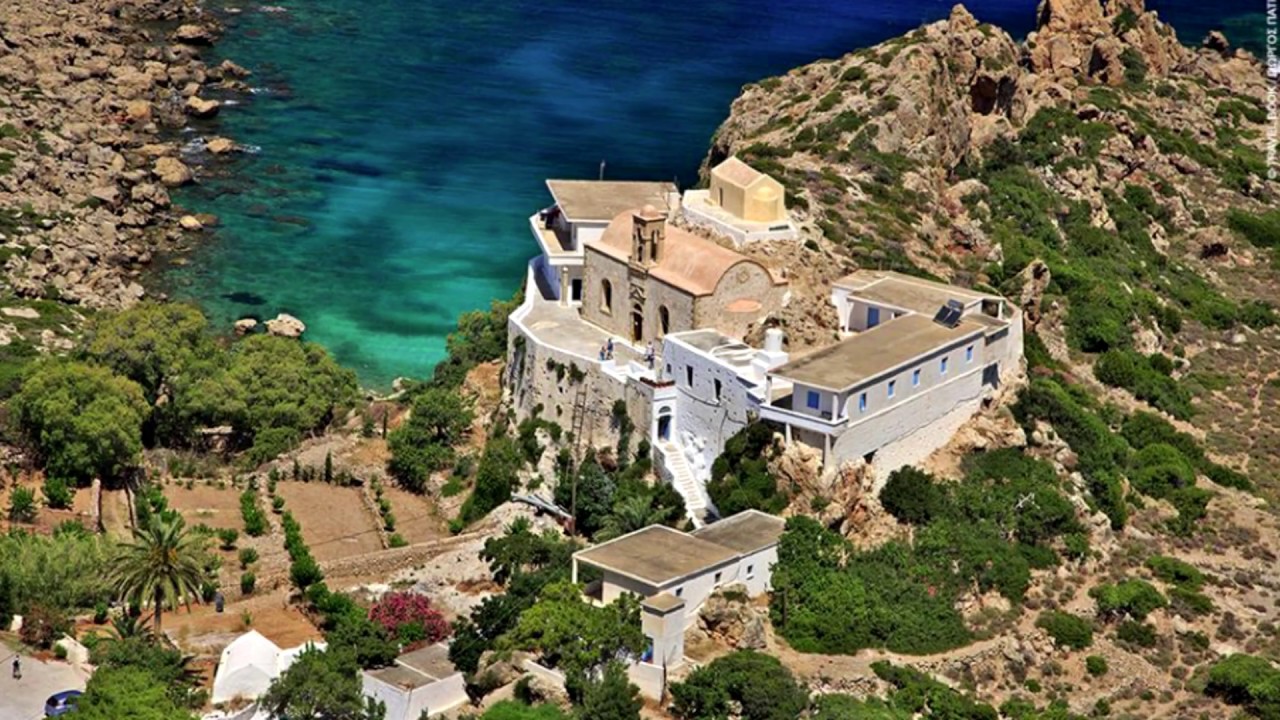
The name “Chrysoskalitissa” is bound up with the legend of a golden step – the last on the staircase that climbs from the foot of the rock to the monastery. Some 72 kilometres south-west of Chania, in the district of Vathi in the old province of Kissamos (today the Innachori area of the municipality of Kissamos), the building rises about 35 metres above the surf of the Libyan Sea: a white, almost fortress-like block with blue-framed windows which from a distance looks more like a ship stranded on a cliff than an abbey. Anyone driving to the lagoon of Elafonisi, five kilometres further south, is bound to pass it – and should not grudge the half hour needed for the climb.
Find on the map
Introduction
The legend of the golden step
The monastery’s name is usually translated as “golden staircase” or “golden step”. The monastery counts ninety-eight steps, the ninety-eighth being the one of pure gold. According to one tradition the last step is golden but shows itself only to those whom the Holy Spirit enlightens, that is to the truly devout; according to another the monks hid the monastery’s gold beneath the step so that it should not fall into Ottoman hands. A third and more sober version relates that in Ottoman times the Patriarchate sold off the monastery’s property, golden step included, to settle crushing taxes – whereupon the house stood abandoned for a while.
History of the monastery
The exact date of foundation is unknown; the beginnings are placed in the 15th or 16th century, that is in the late Venetian period, and the years around 1500 are often named. The first written evidence dates from 1637: a Venetian register lists the monastery as “Madonna Ghunoskaletessa” – evidently an older form of the name, Panagia Gounoskalitissa. In spite of Venetian rule the house remained Orthodox, and it belongs to this day to the Church of Crete under the Ecumenical Patriarchate of Constantinople. Local tradition further maintains that the rebel Georgios Kantanoleon and his son Petros were buried here in 1527, men whose fate lived on later in the literary tale of the “Cretan Weddings”.
After the massacre of Elafonisi at Easter 1824 the Ottoman–Egyptian troops, so the story runs, laid waste the churches along their route – ten ruined places of worship in the neighbourhood are spoken of. Chrysoskalitissa, however, they could not harm: a swarm of bees nesting in the niche of the icon is said to have put the plunderers to flight. A wayside shrine at the lower entrance commemorates this miracle.
New life came in the 19th century. During the Egyptian administration of Crete (1831–1840) a monk named Ioannikios, who is said to have come from the island of Kythira and was the first to settle here after the devastation, had new buildings put up; from 1855 the monk Manassis Karagiannakis renewed the complex with donated money, built a guest house, cells and storerooms and brought back a silver-clad icon of the Virgin from Smyrna in 1866. His work was carried on by the monk Meletios Kalitsounakis. In 1894, finally, the old cave church built against the rock was pulled down and the rock cut away: between 9 May and 10 August the present two-aisled church was built, dedicated on 15 August to the Dormition of the Virgin and to the Holy Trinity.
In 1900 the brotherhood was dissolved and the monastery’s land was sold; the house was made subject to Gonia Monastery (Panagia Odigitria) near Kolymvari. The measure falls within the years of the autonomous Cretan State, which at that time merged a good many small monasteries. Individual monks nevertheless went on living by themselves within the old walls and kept them in repair; one of them, Father Gregory Plokamakis, served here for more than half a century. In 1940 Chrysoskalitissa was refounded as a convent; after the last nun died in 2008, it has been a male monastery again since 2012. Today it receives pilgrims and visitors; whether one may spend the night in the cells depends on space and on the rule of the house in force at the time.
The finding of the icon and the monastery’s tradition
How the icon was found is told in several versions. The best known concerns a farmer of the district – in other versions a shepherd – to whom a light appeared in the evenings, like the flame of a candle, pointing to a niche in the rock. There, the legend says, lay an icon of the Dormition of the Virgin that had been hidden during the Byzantine Iconoclast controversy, the period usually dated to the years 726 to 843. When people tried to move the image to a more convenient place it returned of its own accord to its niche: a sign that the church was to be built exactly here, on the rock. The hard stone, the tale goes on, became soft as a sponge in the process.
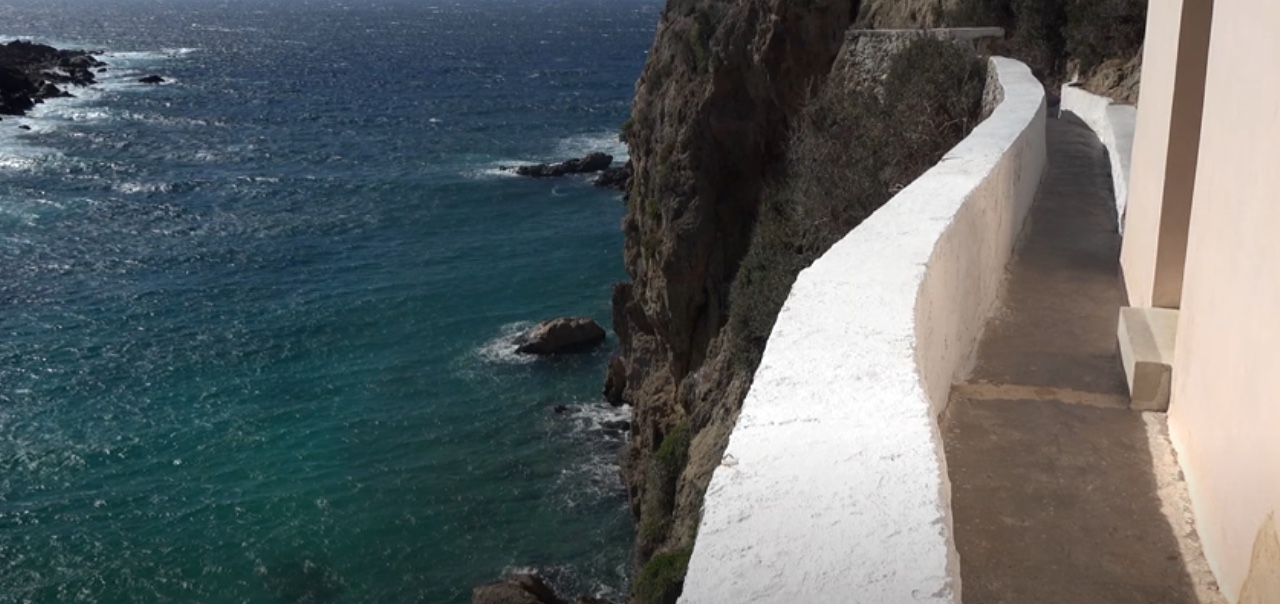
The icon of the Dormition (Koimesis) venerated today, and held to be wonder-working, is dated to the second half of the 17th century. It has one peculiarity: the Virgin’s head lies on the right-hand side of the picture, contrary to the usual composition. On 15 August, the feast of the Dormition, the monastery celebrates its patronal festival, to which the faithful travel from all over western Crete. Besides the church, visitors find a small ecclesiastical and folk museum in the vaulted rooms built into the rock; below the rock lie the buildings in which the aged monks once lived. From the terrace the view ranges far over the sea and down the coast to Elafonisi – at its finest in the hour before sunset. On the shore below the monastery archaeologists have identified the remains of a small fishing settlement of the Middle Minoan period, and traces of Late Neolithic and Early Minoan occupation have turned up in the neighbouring coves: the spot was inhabited long before the monks.