Akrotiri peninsula: the monasteries of Agia Triada, Gouverneto and Katholiko
The most complete guide to Crete: 221 places on the map, 23 routes and 49 articles — with photos, videos and the story behind every place. No sign-up, no trackers.
Routes drawn along real roads
Weather at every stop
Full-text search
“Near me” by geolocation
Create your own printable itinerary
Satellite, terrain, dark mode
Works offline
⌕
Searches 1.7 million characters of descriptions, not just names
—places
4regions
—routes
—with video
Search results
—
Interactive map
Find what is near you
Filters narrow the map and the list at once. Zoom out and pins group together.
Region
Category
Фильтры карты
Landmarks
Featured places
RegionCategory
Routes
Ready-made day trips
Individual places
Articles about landmarks
Three monasteries, one landscape
North-east of Chania the Akrotiri peninsula pushes out into the Sea of Crete like a broad, flat shield – a roughly circular promontory of some 112 square kilometres, joined to the rest of the island by the neck of land between Chania and Souda, with Souda Bay sheltering beneath its southern flank. Its name means simply “the promontory”. Antiquity knew it as Kiamon, the Byzantines as Charaka, and the Venetians called it Melecha. Today most visitors to western Crete land here, at Chania’s Ioannis Daskalogiannis airport on the central plateau, without suspecting that a few kilometres further on begins one of the most self-contained monastic landscapes on the island. Most of the peninsula is a raised tableland; only in the north does it rise into a chain of bare limestone hills, among them Skloka. At their foot, near the hills above Stavros and surrounded by olive groves, vineyards and cypresses, lies the Tzagaroli monastery of the Holy Trinity. Four kilometres further north, on a stony upland, the fortress-like Gouverneto stands guard; and deep in the Avlaki Gorge below it hide the ruins of Katholiko, counted among the oldest monasteries in Crete. Anyone who links the three in a single day walks through centuries of Cretan history – and through a legend that reaches back further still.
The monastery of the Holy Trinity
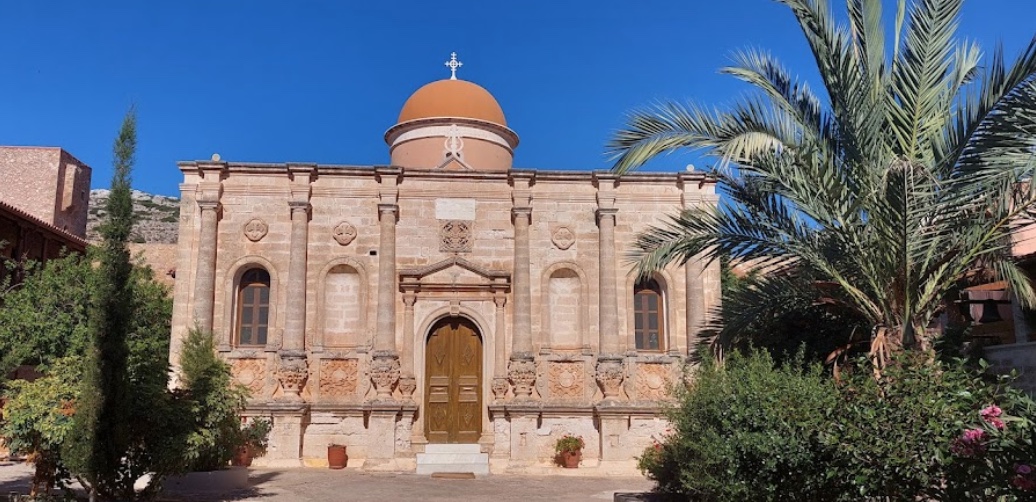
The Tzagaroli monastery of the Holy Trinity (Moni Agias Triadas Tzagarolon, Μονή Αγίας Τριάδας των Τζαγκαρόλων) is an Orthodox abbey of the 17th century on the Akrotiri peninsula, about fifteen kilometres from Chania. As a stauropegial house it answers directly to the Ecumenical Patriarchate of Constantinople rather than to the local bishop, and it is regarded as the most mature work of the Cretan Renaissance in monastic architecture. It remains a working community, with a library of rare books and a small museum.
Find on the map
Introduction
Foundation and building history
A smaller abbey with its own church already stood on the site; Greek accounts call it the monastery of the Mourtari, dedicated to the Holy Apostles. In 1612 the monks Laurentios and Jeremias Tzagarolo began to rebuild it on an altogether grander scale. The brothers came from a Venetian family, the Zangaroli, long settled in Crete and by then Orthodox in faith. Jeremias, equally at home in Greek and in Latin learning and a friend of Meletios Pigas, Patriarch of Alexandria, also understood the art of building, and took his cue from the treatises of the Italian master Sebastiano Serlio. Work advanced quickly at first: a door to the cellars carries the date 1613. After Jeremias’s death in 1634 his brother Laurentios carried the project on. In 1645, however, building stopped abruptly: the Ottomans took Chania when the great dome of the church had risen no higher than its springing. In Ottoman times the monastery was known as Selvili Manastır, the “Monastery of the Cypresses” – the avenue that still leads up to the gateway explains the name.
Later history
In 1821, the year of the Greek uprising, the monks abandoned the monastery and Ottoman troops burnt it down; many relics, manuscripts and charters were lost. In 1830 the monks Kalliopios and Grigorios obtained permission to finish the church, and only then, nearly two centuries after it was begun, was the dome finally closed. In 1833 a school with boarders opened within the monastery walls, and in 1864 the handsome bell tower was added. From 1892 to 1905 a seminary for priests was housed here, and during the rising of 1896–97, when Akrotiri served as the headquarters of the Cretan revolutionaries, the monastery was both their command post and their hospital; numerous Christian families took refuge inside it.
In the Second World War the monastery was used at first as an ammunition store. After the Germans took Crete in 1941 a military school was set up here, together with quarters for 150 to 200 soldiers, and the buildings suffered considerable damage. The occupiers also posted a guard at Gouverneto, further up the hill.
Architecture
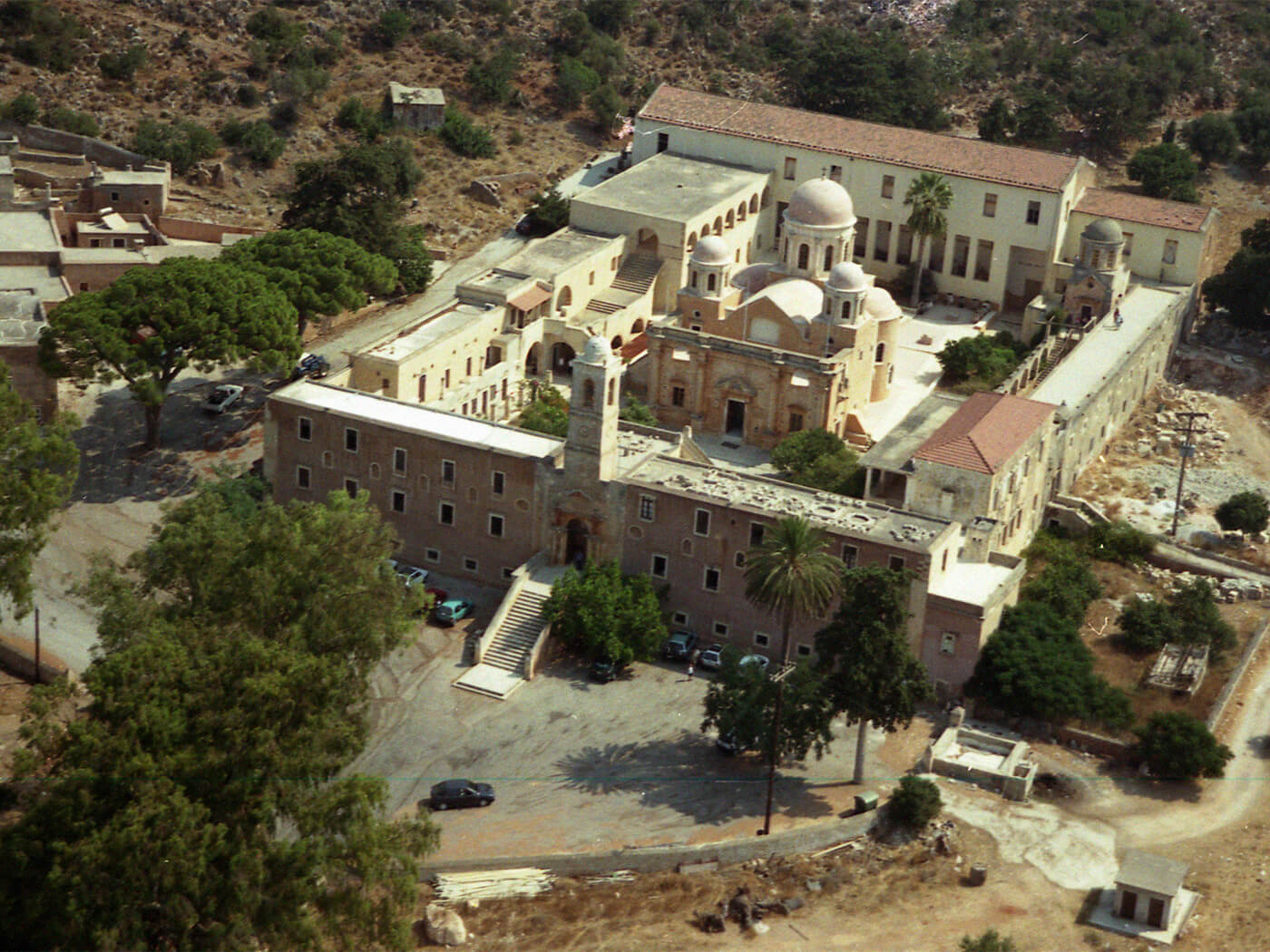
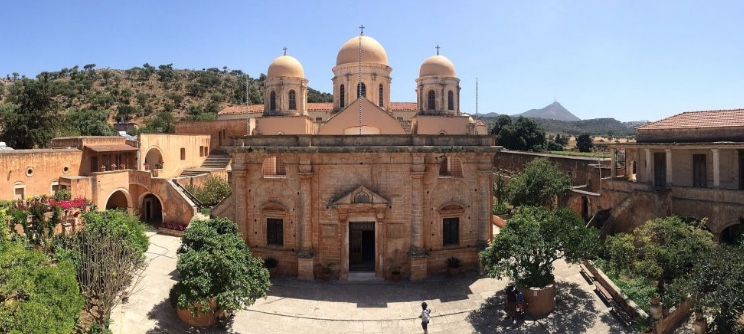
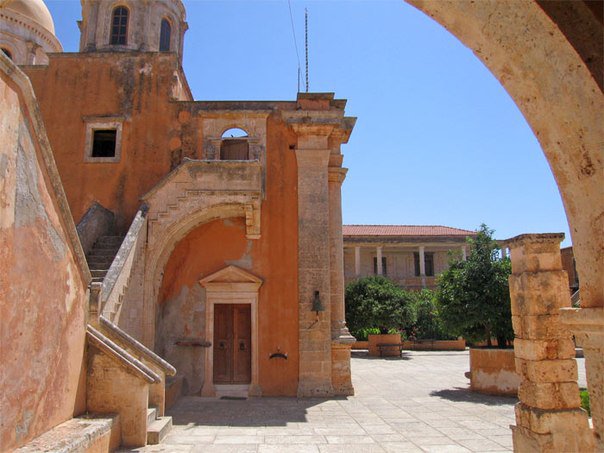
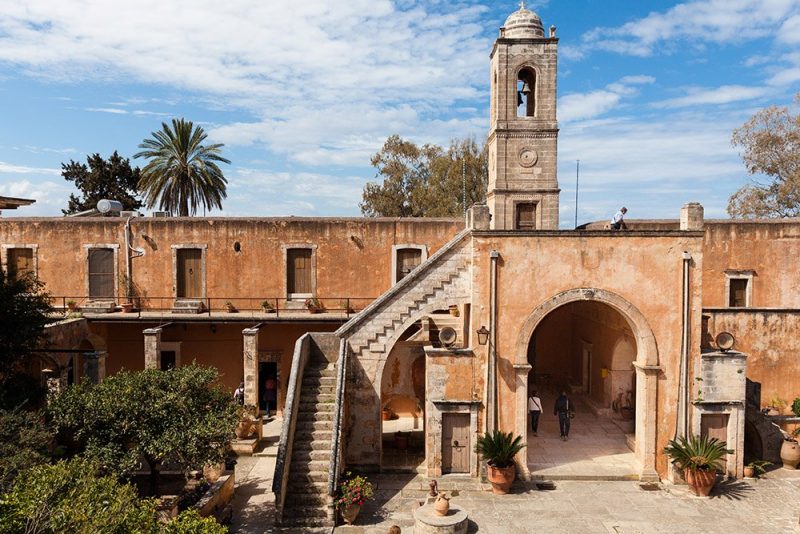
The monastery forms a closed quadrangle around an inner court, in the middle of which stands the katholikon. The main entrance is on the west side; a broad flight of open steps climbs to it and ends on a landing. On either side of the gate, massive Ionic columns set in pairs carry the architrave. Above them stand smaller pairs of Corinthian columns framing a round arch, and over these rises a large pediment with a Greek inscription giving the year 1631. The design of the gateway, worked in limestone, unmistakably reflects the work of Sebastiano Serlio.
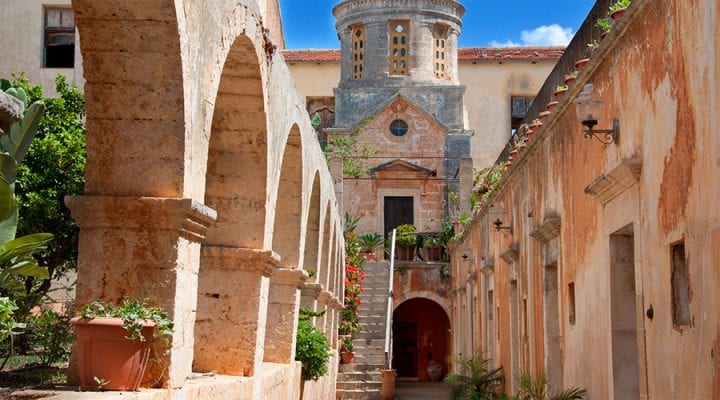
Serlio’s influence can also be traced in the overall plan of the west range, which has three storeys on the outside but only two within. The Tzagarolo brothers evidently drew on ideas the Italian architect had worked out in his seventh book for building on a slope – on exactly the kind of ground the monastery had to contend with. The courtyard rests on an artificial terrace; beneath it lie the vaulted rooms in which oil and wine were pressed and stored, as well as a large cistern for rainwater. It is in these cellars that the door dated 1613 is to be found.
The west range contains the monks’ cells, the wine cellars and the old olive mill. The north side is taken up by the library, the south by the ossuary and the abbot’s lodging. The church school that operated in the monastery grounds at the end of the 19th century and the beginning of the 20th was accommodated in the east range.
A small museum shows what survived fire and plunder: icons of the 16th and 17th centuries, among them a St John the Theologian of about 1500 and a St Nicholas, a Last Judgement by the 17th-century painter Emmanuel Skordilis, a parchment manuscript of the Liturgy of St Basil, liturgical vestments and vessels, and a manuscript in the hand of Jeremias Tzagarolo himself. At the same time Agia Triada is still a working estate. The monks produce organic olive oil, wine, honey, vinegar and olive-oil soap; the produce is sold in the monastery shop and some of it is exported. Agia Triada is also the last place to find water and lavatories before the road climbs to Gouverneto and the gorge.
The katholikon, the main church
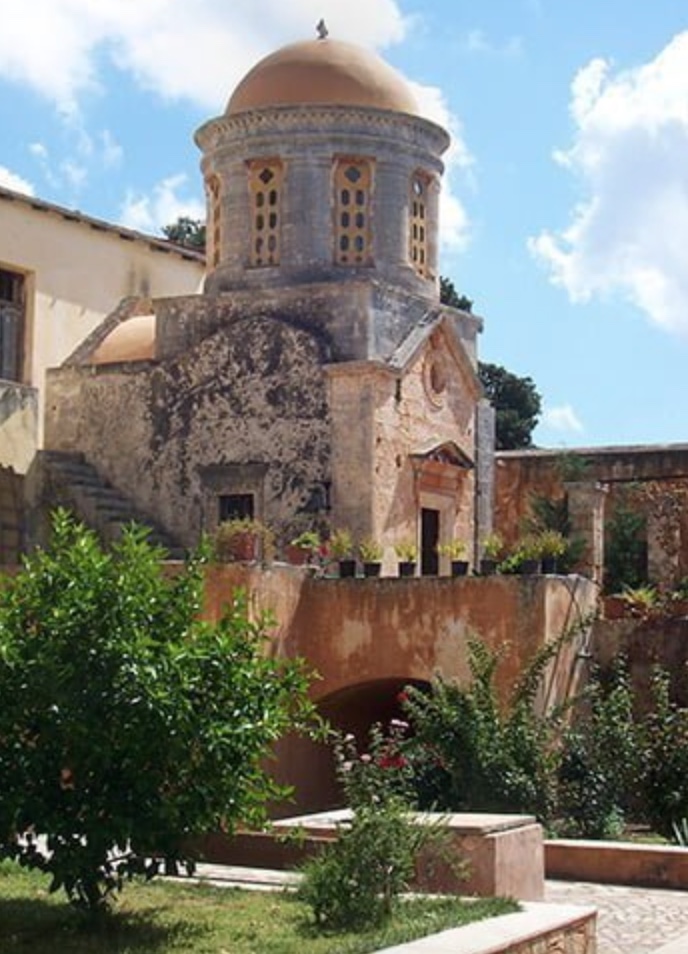
From the main entrance a vaulted passage leads into the inner court, where the katholikon stands. It is built of dressed stone as a three-aisled domed basilica – more precisely, a domed triconch with a narthex set at right angles to the main axis and side chapels – a cruciform church crowned by three domes, the large one over the centre and a smaller one over each chapel. The architectural language, and the carved ornament above all, takes its inspiration from the West. The iconostasis, made about 1836, is of carved and gilded wood; most of its icons are said to be by the painter Merkourios of Santorini. The church has two chapels, that of the Zoodochos Pigi, the “Life-Giving Spring”, and that of St John the Theologian. Beside the katholikon, within the court, stands the small church of Christ the Saviour. The monastery keeps its patronal feast at Pentecost.
The monastery of Our Lady of the Angels
Gouverneto Monastery (Moni Gouvernetou), the abbey of the Mother of God, Our Lady of the Angels (Kyria ton Angelon), is among the most important monasteries of Akrotiri and a significant monument of Cretan monastic architecture; it was listed as a protected monument in 1935. It lies about 19 kilometres north-east of Chania on the northern side of the cape, at an altitude of roughly 260 metres; the narrow road climbs to it from Agia Triada for four kilometres through a small ravine.
Find on the map
Introduction
The sanctuary is dedicated to the memory of St John the Hermit, whose life, according to the monastery’s tradition, ended in the 11th century in a cave in the Avlaki Gorge: a hunter took him for an animal and killed him by mistake. Legend names St John himself – often identified with John Xenos, “the Stranger” – as the founder. It is more likely that the monastery was laid out by monks from Katholiko who continued his ascetic way of life. To escape the raids of pirates they left Katholiko, too close to the shore, and founded a new and safer house higher up – in 1537, as an old inscription at the entrance attests. In 1620 the monastery passed into the care of Agia Triada and its abbot Jeremias Tzagarolo; in 1632 the Patriarchate recognised the veneration of the saint, and work on the church began. A census of 1637 counted sixty monks, which made Gouverneto one of the largest communities in Crete, and it was still that size when the Ottomans invaded in 1645. The church, however, was completed only centuries later: narthex and side chapels were added in 1894. In 1821 the monastery was sacked and seven monks were killed as they fled. The German occupation of 1941–44 did further harm, and a thorough restoration has been under way since 2005.
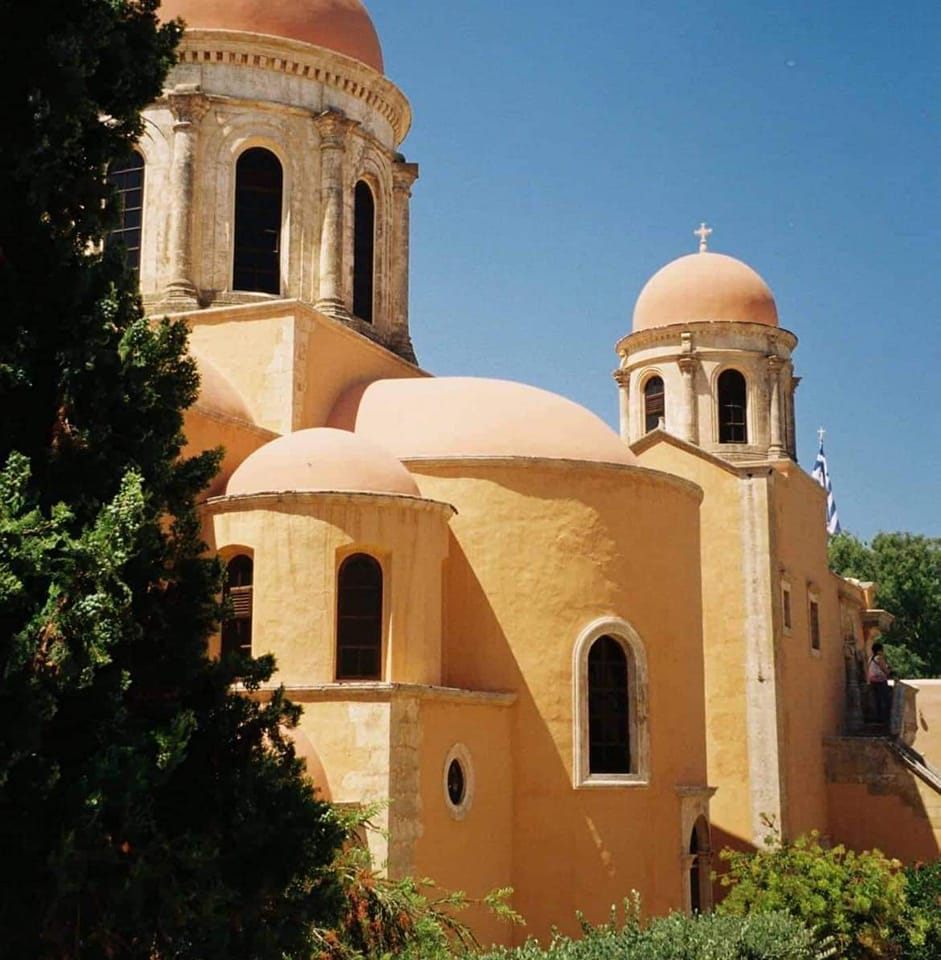
From outside Gouverneto resembles a small fortress: a rectangle of about forty metres by fifty with four corner towers, two of which survive, and some fifty cells on two storeys. The church in the courtyard is a domed cross-in-square; its façade is adorned with engaged columns and stone grotesques in the Venetian taste – monsters carved in relief on the narthex – whose meaning remains a puzzle. The side chapels are dedicated to the Ten Saints of Crete (Agioi Deka) and to St John the Hermit, and there is a small museum of church art and relics. The monks keep strict order: shorts and beachwear are not permitted, the gate is closed in the middle of the day and on some weekdays – by custom Wednesdays and Fridays – it does not open at all. It is wise to ask about opening times beforehand, the more so since the path to the gorge starts inside the monastery’s grounds.
The old monastery
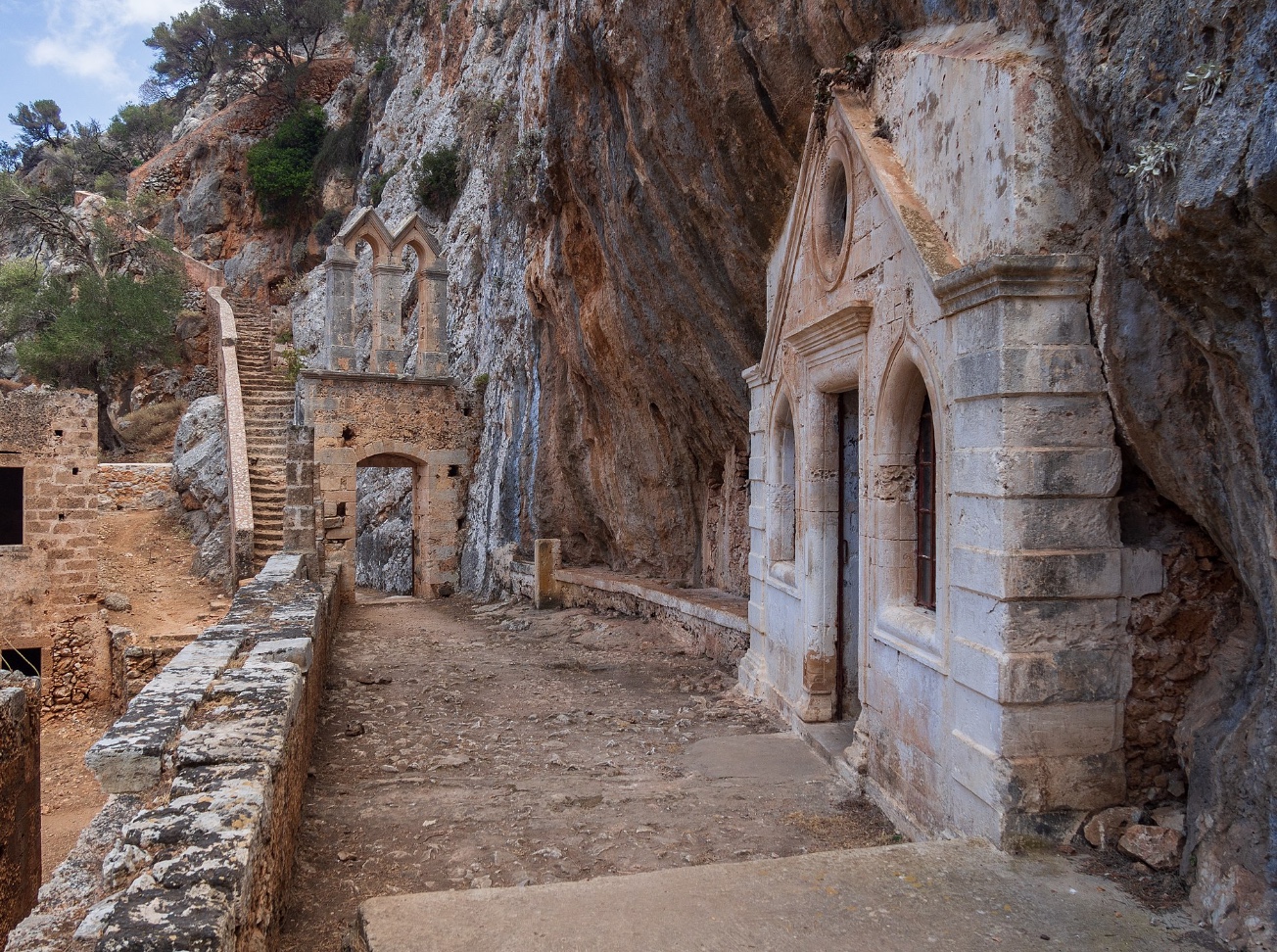
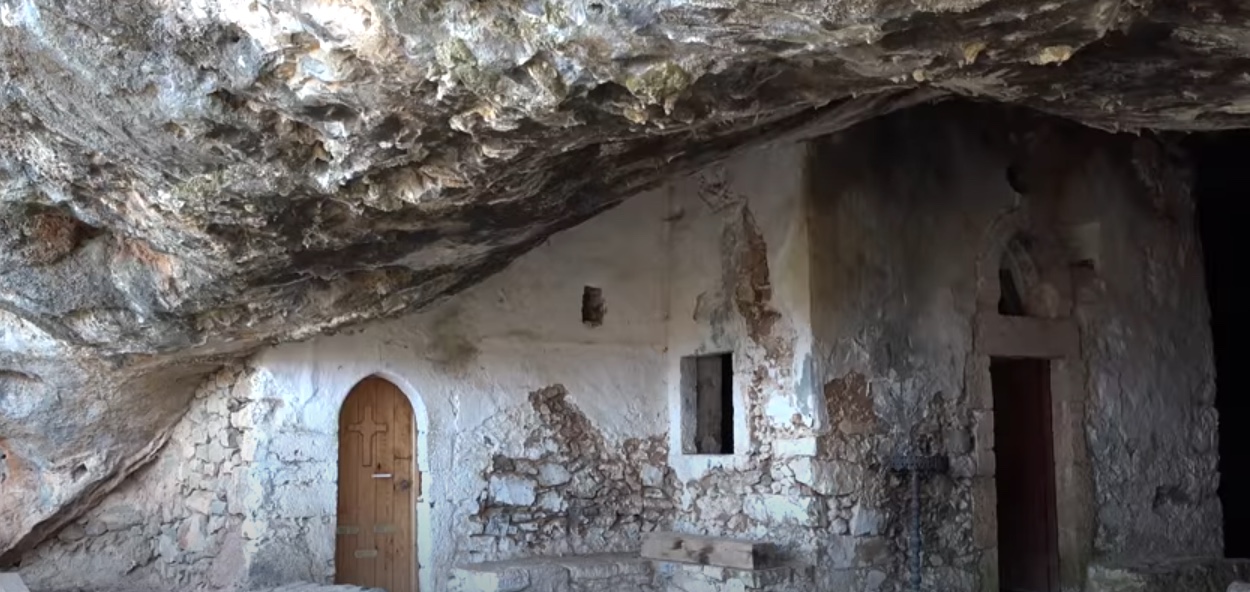
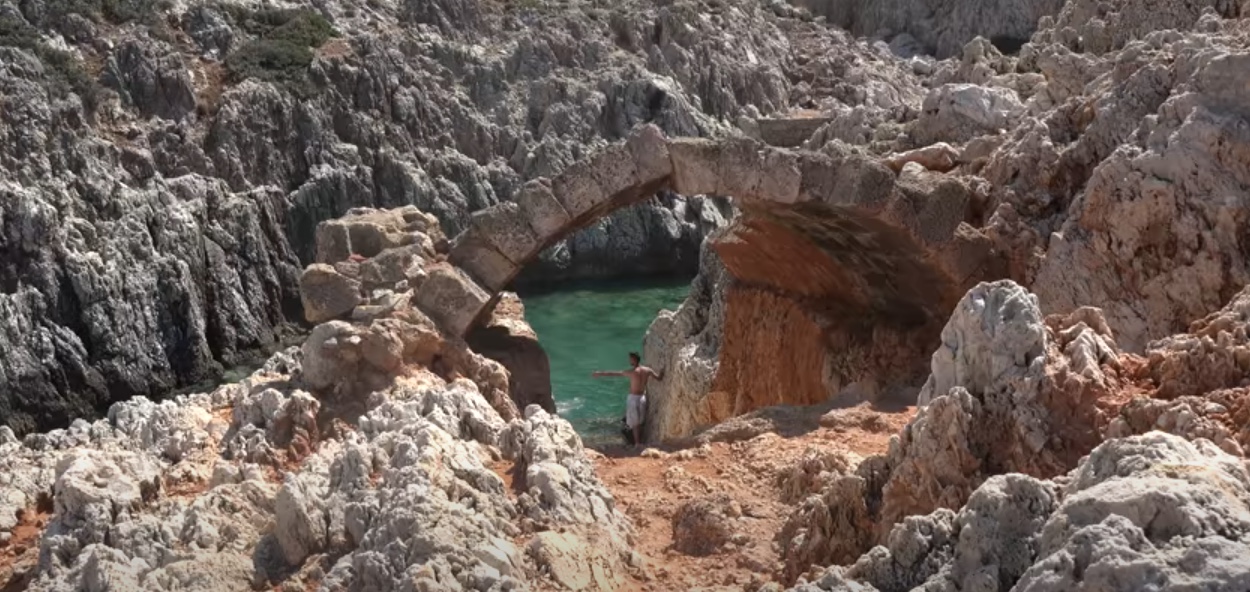
The Holy Monastery of St John the Hermit, Katholiko Monastery (Moni Katholikou), is today a ruin; its visible buildings date from the 16th and early 17th centuries, but the beginnings of monastic life on the spot go back much further – tradition speaks of the 5th or 6th century. It lies not far from Gouverneto in the Avlaki Gorge, directly beside the cave in which St John died. The church consists of a small hollow in the rock, its front built up in dressed stone; before it lies a courtyard carried on vaults and thrown across the ravine on a massive stone bridge, which turns the gap between the two walls of the gorge into a broad square. The bridge, with the vaulted storerooms beneath it, a two-storeyed building and a belfry, belongs to the rebuilding carried out in the 17th century under Jeremias Tzagarolo, once again with an eye on Serlio. Wild fig trees have now taken possession of the ruins.
The Avlaki Gorge and the cave of St John the Hermit
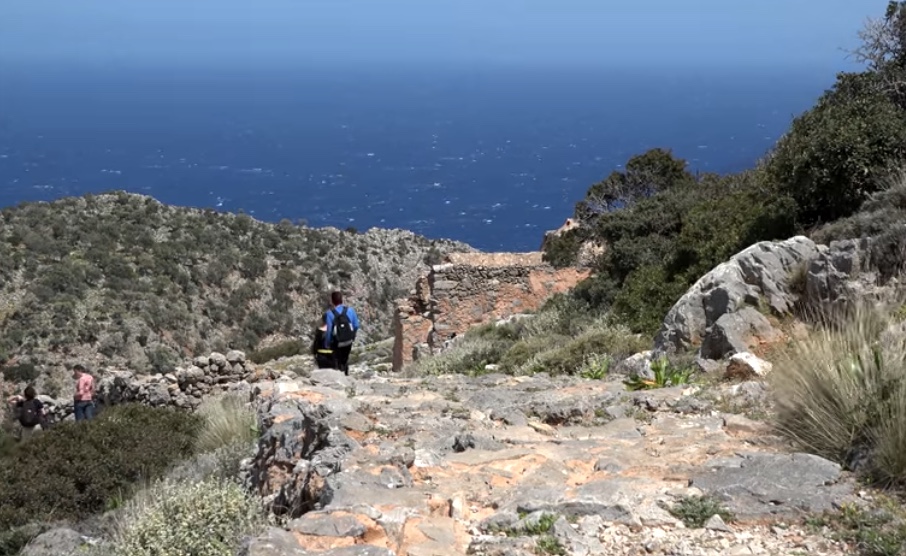
From Gouverneto Monastery a paved path, stepped and cobbled, leads north through the Avlaki Gorge as it drops towards the sea. Low cushions of thorn, thyme and naked rock keep the walker company; there is hardly any shade, no water and, down in the gorge, no mobile signal.
The descent is fairly easy, but the way back can be hard going for anyone unused to walking, particularly on hot summer days, when temperatures of 35°C and more are common. It is best to set out early in the morning or late in the afternoon, and the kindest seasons are April to June and September to early November. Without stops it takes about three-quarters of an hour to reach the sea, and a good deal longer to return; to Katholiko and back is a little over three kilometres. Plenty of water and stout shoes are essential – the last stretch above the old monastery is over loose stone.
Arkoudospilios, the Bear Cave
After ten to twenty minutes the path reaches the famous cave of Arkoudospilios with its petrified she-bear: a large grey stalagmite a good two metres high which, inside the cave, seems to stoop over a basin of water. Legend has it that the Mother of God turned the animal to stone because it was drinking the monks’ precious water. At the entrance stands the small chapel of the Panagia Arkoudiotissa, Our Lady of the Bear; its feast is kept on 2 February, at Candlemas, when pilgrims keep an all-night vigil here. The cave can be reached only on foot, from Gouverneto.
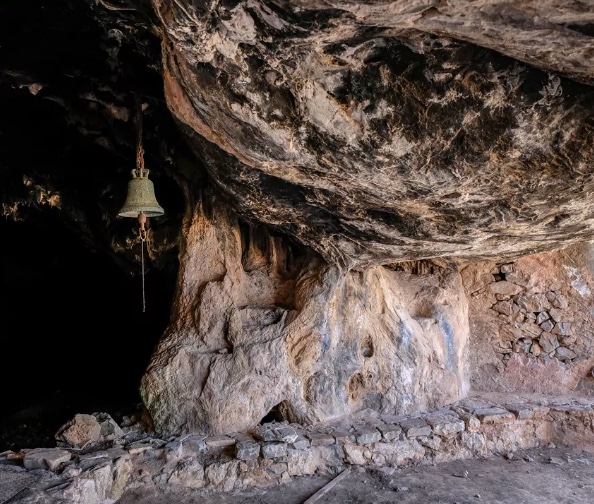
Continuing downhill, at the last by some 140 steps cut into the rock and winding back and forth across the slope, one comes to Katholiko Monastery with the church of St John the Hermit described above. All around, the caves of the former hermits open in the walls of the gorge. The saint’s own cave is the bed of a former underground stream; at its far end visitors are shown a basin of flowstone and the “couch of St John”.
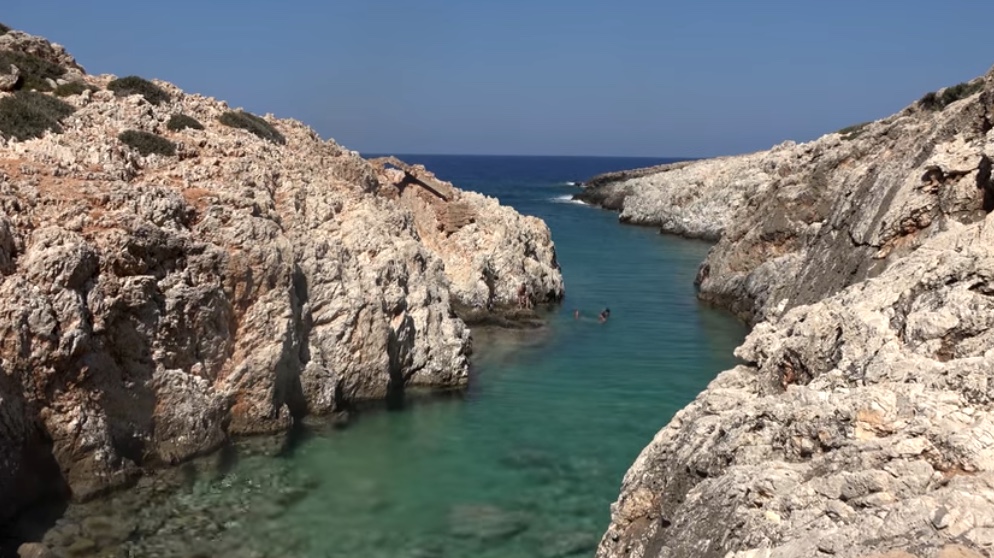
After about ten minutes more, the path follows the dry stream bed to a small inlet cut into the coast like a fjord, which once served as the monastery’s harbour; the remains of a boathouse hewn out of the rock can still be seen. A large rock shaped like a ship lies at the mouth of the gorge, and local tradition explains it as a pirate vessel turned to stone by the curse of an abbot of Katholiko. The water is blue-green, but bathing is forbidden under the monastery’s rule. From here begins the climb back to Gouverneto.
The life of St John the Hermit
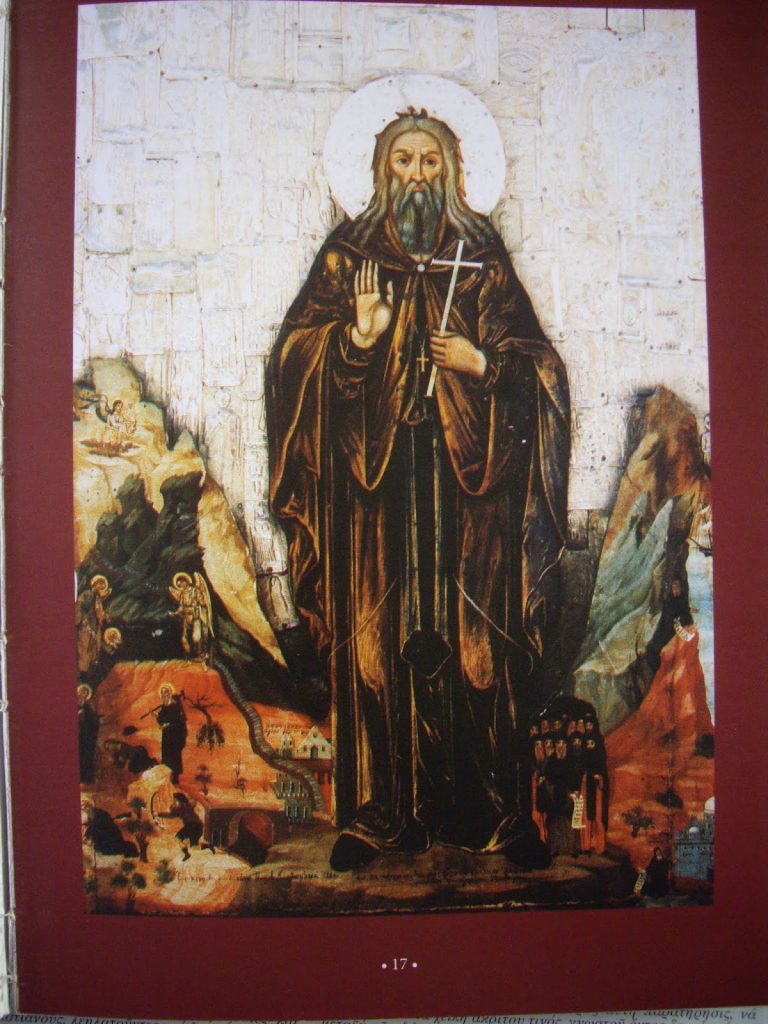
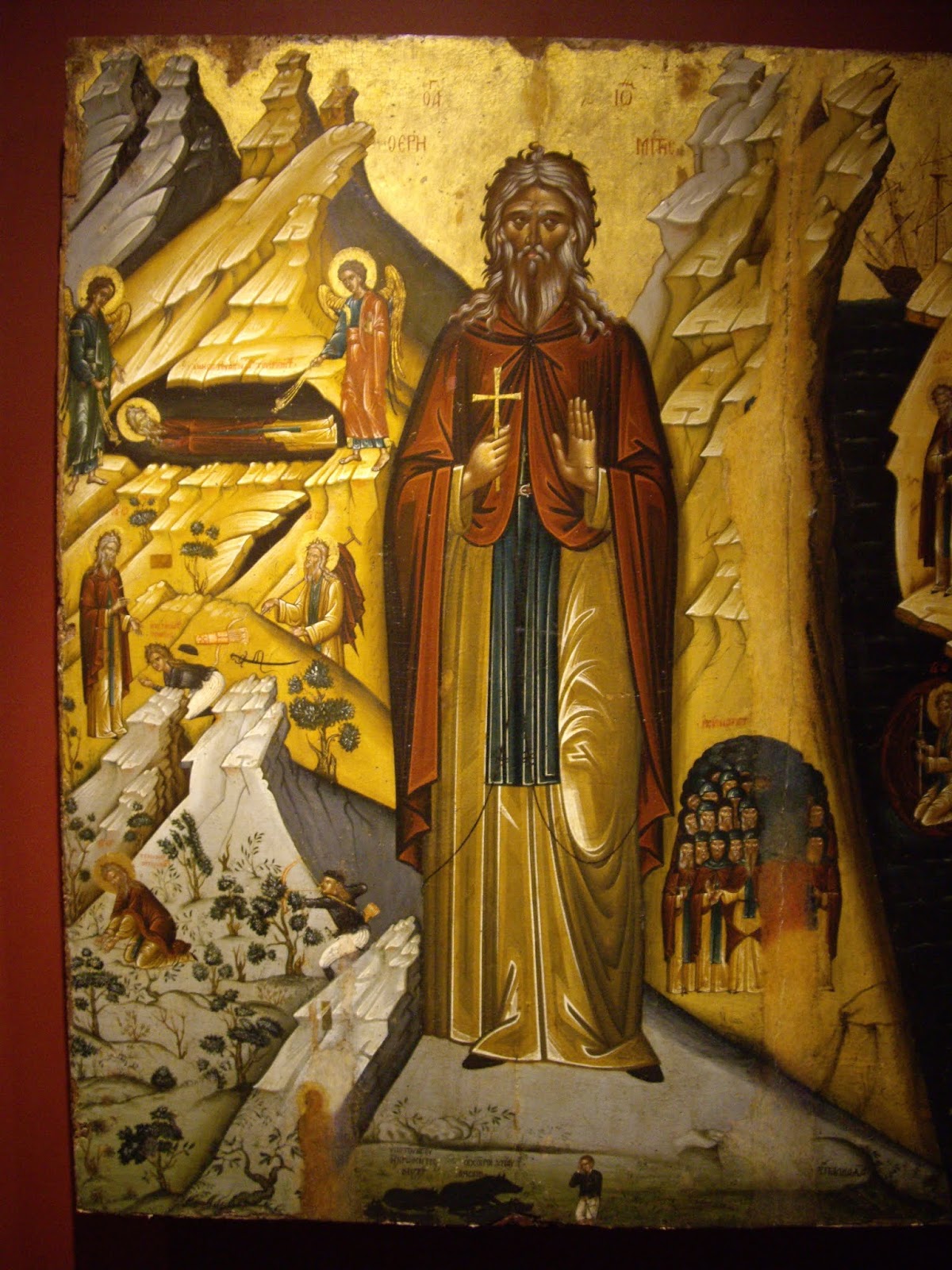
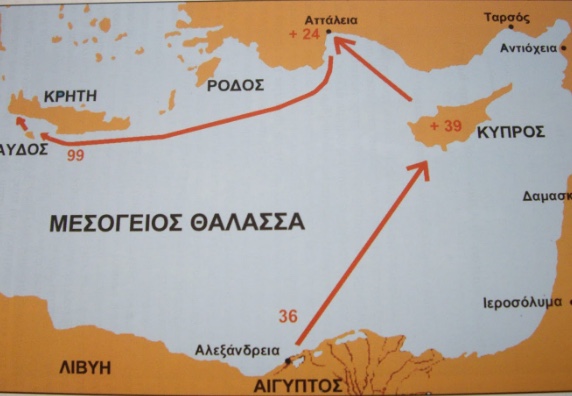
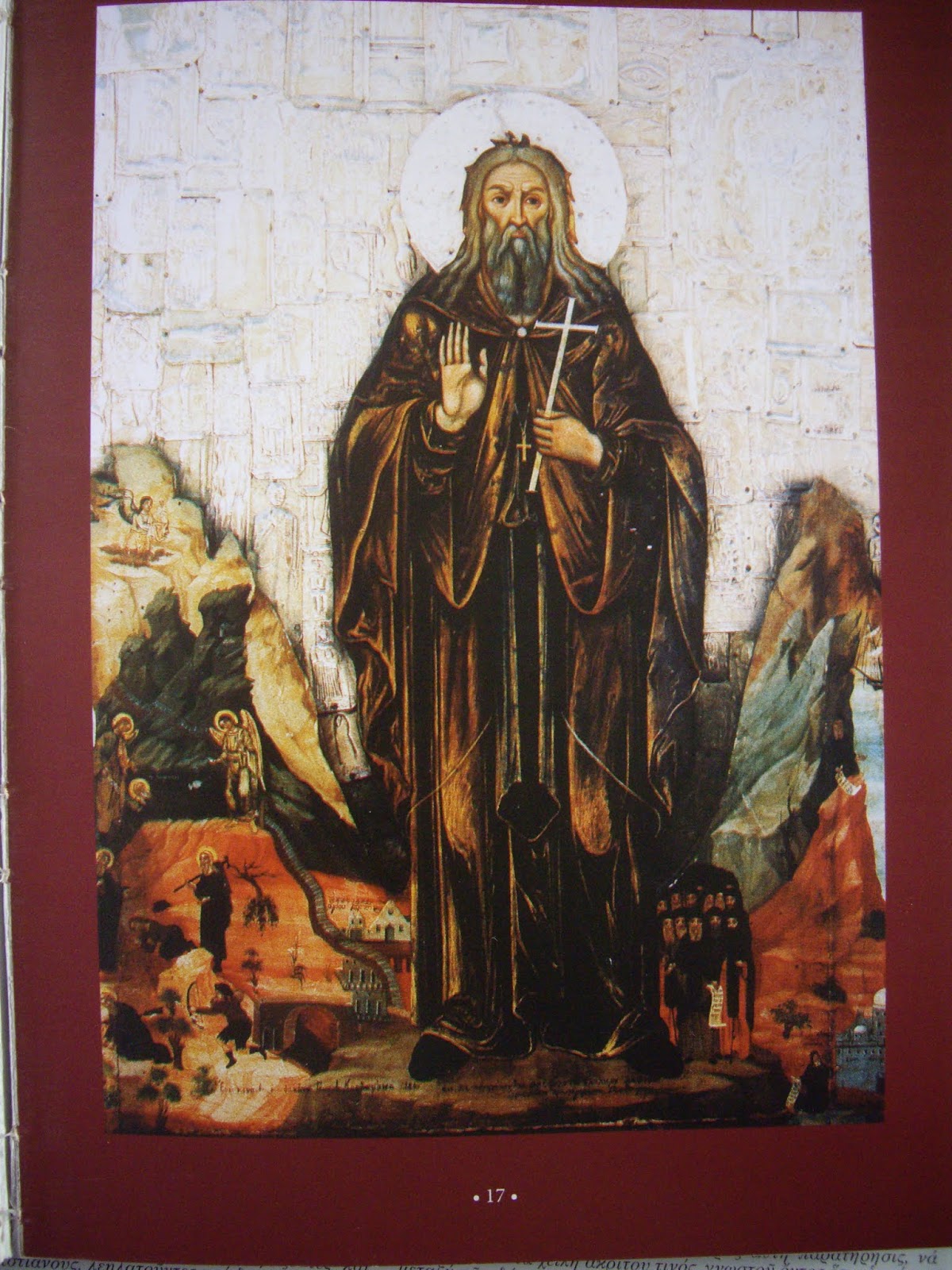
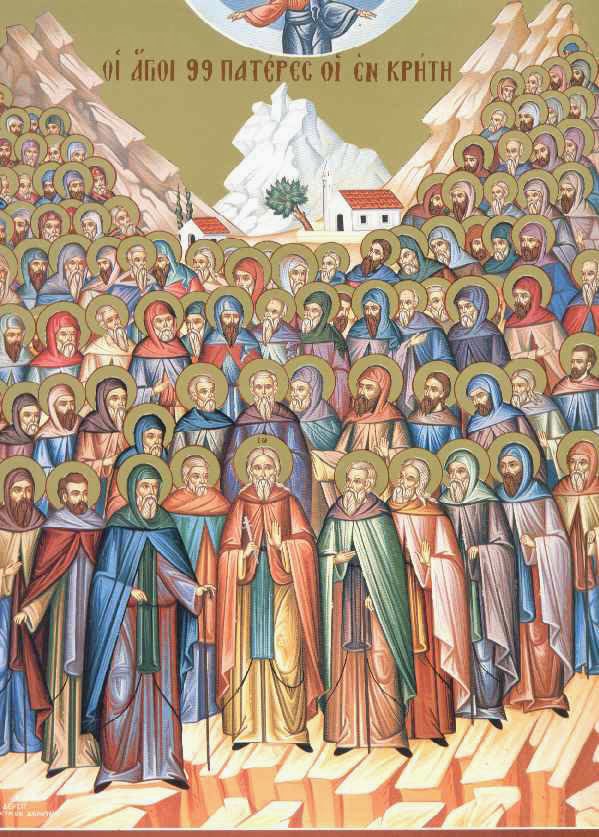
St John the Hermit (Agios Ioannis o Erimitis) came from Egypt. When he lived is uncertain: the monastery’s tradition places his death in the 11th century, the Life itself speaks of Venetian rule over Crete, and some versions even name the years around 1550. He preached in Cyprus, in Attaleia and in Crete, where he arrived with ninety-eight holy fathers – with John they were ninety-nine. The prayers say of this company that, with Christ as their head, they made up the full hundred.
According to their Life, it was out of great humility that the saints came to Crete. They were looking for a place of solitary prayer, for their fame followed them wherever they went and drew crowds of people, not a few of whom were healed of their afflictions.
So John and thirty-five other Egyptian ascetics set out from Egypt for Cyprus, obeying the divine command to the patriarch Abraham: “Get thee out of thy country, and from thy kindred, and from thy father’s house, unto a land that I will shew thee” (Genesis 12:1, King James Version). In Cyprus the report of their holiness spread quickly across the whole island. Many came to them because they received benefit for soul and body alike, and many of the sick were made well. There were, besides, thirty-nine other fathers living as ascetics in various parts of Cyprus. When they heard of the virtue of the newcomers from Egypt, they too sought them out and joined them, to lead from then on a common ascetic life.
Since the Cypriots now also wished, in obedience to that word of God to Abraham, to leave their homeland, they all turned their backs on the island and crossed to the opposite coast of Asia Minor, to Attaleia. There they met twenty-four more hermits, who attached themselves to them. In this way the number of the holy fathers reached ninety-nine, and they made up “with Christ as their head, the full hundred”. After they had spent some time in Attaleia and saw that God blessed their desire for a deeper solitude still, they set off for Crete, the goal of their journey.
Together they boarded a ship. But as they drew near the coasts of Crete a violent head wind fell upon them, so that they could not land and the vessel was all but dashed to pieces. The fathers had meant to go ashore at the easternmost end of the island, near Sitia, which lies closest to Asia Minor, the starting point of their voyage. The storm, however, drove them south and then west, until they were able to put in at one of the little coves of the island of Gavdos – the island in which some would recognise Homer’s Ogygia. There they stayed for twenty-four days.
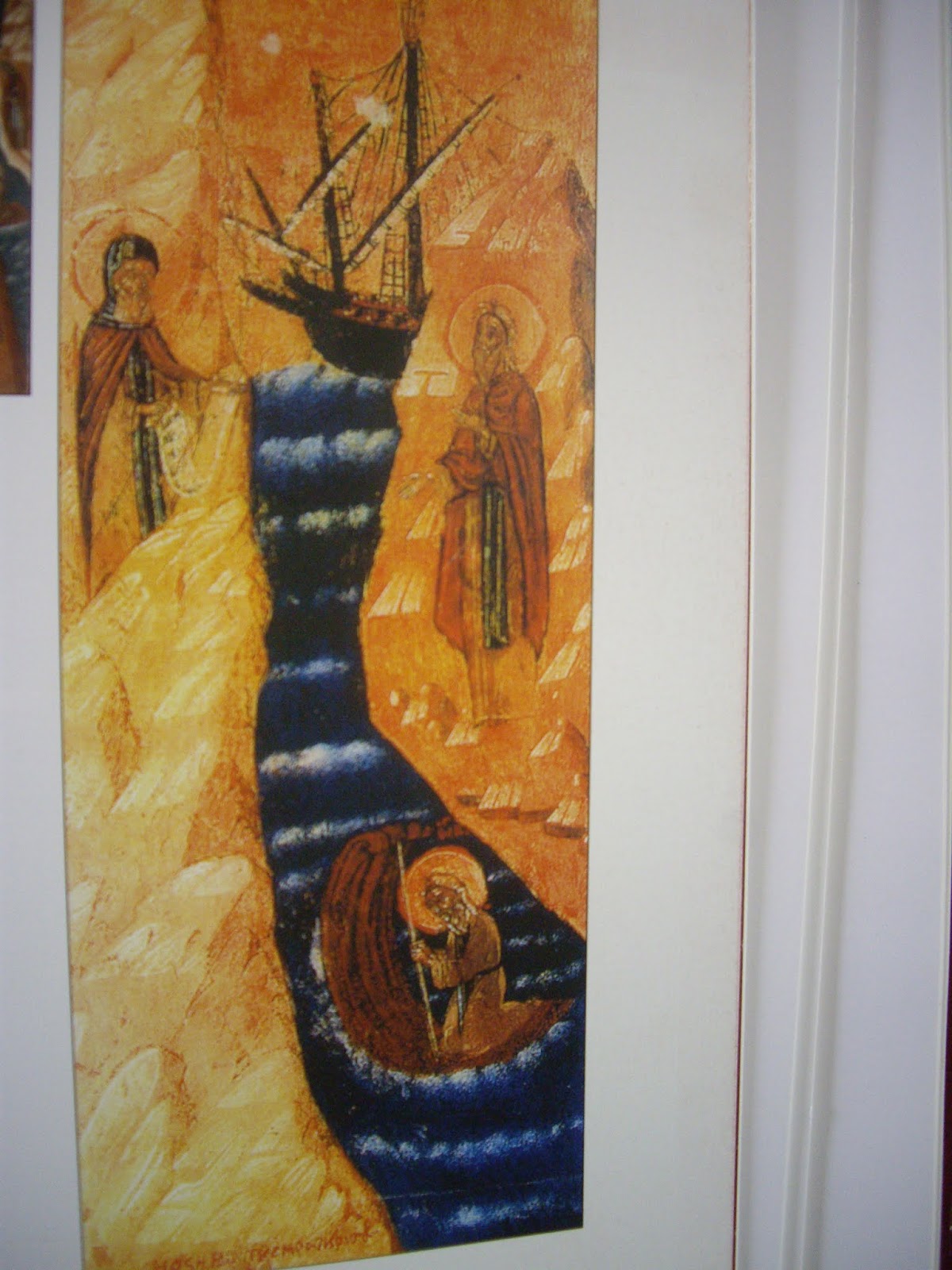
When calm had returned they went aboard again and crossed over to Crete. But God, who wished to glorify John and to show mankind his virtue, “hid him” in sleep; the other ascetics did not notice that they were sailing without him, and so he was left behind on Gavdos. This happened, the Life goes on, by divine providence and dispensation: God wanted to show the Cretans his power and to teach them that he can help his servants better with nothing but a staff and a monk’s habit than the Cretans could help themselves with swords and lances against the Venetian oppressors who ruled over them. This he showed them at once by a miracle.
When John saw that his brethren had left Gavdos, and heard their voices calling from afar, from the Cretan shore opposite, he went down to the water’s edge in firm trust in God. He prayed to the Lord, blessed the sea with the sign of the cross, spread his habit upon the waves, stepped on to it as though it were a boat and began to make for the other shore.
Sailing and singing psalms as he went, he reached Crete unhindered. There the other brothers received him; to the first he held out his hand in greeting, and all together, as a sign of the bond of love, raised a hymn of praise, dedicated themselves to the Lord of all and proclaimed peace to everyone.
Near the village of Azogires in the district of Selino, on the south-west coast between Sougia and Paleochora – where St John Xenos also preached – they withdrew into a cave. Here, at a spot called the “Great Rock of Charakas”, they found the place they had longed for. They lived in silence and prayer; their food was lupins, carob pods and the herbs of the earth. But because the cave was small and could not hold them all at once, they divided into two groups: thirty-six moved to the other bank of the stream into a second cave, while the rest remained in the first until the end of their days. The Cave of the Holy Fathers above Azogires is visited to this day.
The other fathers were content with the communal life they had established at Azogires. John, on the other hand, a passionate adherent of the hermit’s calling in its perfect form, felt even the presence of those venerable brothers to be a hindrance to undivided devotion and to converse with God; he wanted “to pray to God alone”. He disclosed his wish to the fathers, and since they saw that his resolve was unshakeable they let him go, and turned to Christ with the following prayer:
“Lord Jesus Christ, our God, since John, our brother, wishes to depart from us, guide him through life in peace and stillness. And grant us, Lord of all, that on the day when thy grace resolves to bring our earthly course to its end, we may all die on the same day, and unite us with him in thy heavenly kingdom. Amen.”
So John left the brotherhood of Azogires and came to the cape of Kydonia – called Kiamon in antiquity and Melecha under the Venetians – near the monastery of Gouverneto, the old Gderneto. There, at the narrowest point of a great, wild torrent bed, on whose slopes ancient hermitages cling like true eagles’ eyries, one above another in tiers, and which was from time immemorial the gathering place of the hermits of the Kydonia region, lies the old, original monastery of Gderneto, now called Katholiko. Here too is the celebrated cave of St John the Hermit, a beautiful one, with many enormous stalactites and stalagmites, 150 metres long, 40 metres wide and between 3 and 20 metres high.
This old monastery, Katholiko, was later moved, according to tradition, to its present site: a little higher up and not far from the old one, into the embrace and clear light of the quiet upland of Akrotiri. From its foundation it was bound up entirely with St John the Hermit. Although it is dedicated to the Mother of God, the “Lady of the Angels”, it is known to this day as the “Monastery of St John the Hermit”. He is venerated in the left-hand side chapel, where his holy head is kept in an old reliquary.
Here John lived, a hermit in the strict sense of the word and a lover of solitude, after he had parted from his ninety-eight fellow ascetics: withdrawn, “alone with God” and “in the company of the angels”, in the utmost abstinence, in prayer and fasting. In winter he fed on the herbs of the earth, in summer on lupins and wild carob, true to the saying of the author of the “Ladder of Divine Ascent”: “When the body is afflicted, the heart is humbled.” The grinding fast to which he subjected himself left the saint so weak that his strength forsook him altogether. He could no longer stand upright but went bent over like a four-footed creature, and “crawling like a beast and yet leading the life of the angels” he moistened “by night and by day the rocks of his cave with tears of repentance”.
The hunter’s fatal mistake
So the day came – it was the sixth of October – on which God resolved to take John to himself. He had gone out, as he did every day, to gather his accustomed food, when a young shepherd “skilled with the bow”, who was hunting in the neighbourhood, took the figure bent on all fours for game and by mistake shot him clean through the heart. John understood that his end was near and begged God to let him reach his cave in spite of the wound. The hunter ran at once to fetch what he supposed to be his quarry. Only when, following the trail of blood, he found the saint lying in the cave, gravely wounded, bleeding, the deadly arrow still in his heart, did he recognise his disastrous error.
The Life of St John tells of the hunter’s remorse and of the forgiveness the saint granted him. The shepherd fell at his feet, kissed them and said, amid tears and sobbing:
“Woe is me, wretch that I am, what have I done this day! Unhappy man, how have I become blind and the murderer of a just and holy man! What shall I do now? To whom shall I flee, if not to thee, holy servant of God, that thou mayest forgive me my fault and pray to God to lead me to repentance?”
And the saint answered him humbly and calmly:
“Holy is God, my son, who loves the salvation of mankind. May he grant thee repentance and forgive thee the sin thou hast committed this day against me, his unworthy servant, and count thee worthy of his kingdom. Amen.”
Tradition adds that on that day the prayer of the fathers of Azogires was fulfilled as well: all ninety-eight are said to have fallen asleep in the same hour. The Church of Crete commemorates St John and his companions on 7 October; in 1632, when it formally recognised the saint, the Patriarchate moved the feast to that day because the sixth belongs to the Apostle Thomas. Then the faithful, pilgrims in their hundreds, walk down from Gouverneto to the cave and the church of Katholiko – the one day in the year when the silent gorge is full of people.