The most complete guide to Crete: 221 places on the map, 23 routes and 49 articles — with photos, videos and the story behind every place. No sign-up, no trackers.
Routes drawn along real roads
Weather at every stop
Full-text search
“Near me” by geolocation
Create your own printable itinerary
Satellite, terrain, dark mode
Works offline
⌕
Searches 1.7 million characters of descriptions, not just names
—places
4regions
—routes
—with video
Search results
—
Interactive map
Find what is near you
Filters narrow the map and the list at once. Zoom out and pins group together.
Region
Category
Фильтры карты
Landmarks
Featured places
RegionCategory
Routes
Ready-made day trips
Individual places
Articles about landmarks
The unbending Sfakians
Sfakia (Σφακιά) has always been famous for never having bowed completely to any master. Its people, perpetual rebels, are held to be the truest Cretans of all, and the rest of the island tends to speak of them with a mixture of pride and wariness.
Introduction
First, the Sfakians themselves. In traditional Greek usage the word chora denotes the principal settlement of a district, but its literal meaning is “land” or “country” – and in the case of the Sfakians the second sense fits just as well. For Sfakia is a world apart: to the north the wall of the White Mountains, with summits of more than 2,400 metres; to the south the Libyan Sea; and in between a tangle of gorges running from north to south, bare upland plateaux and a coast on which some villages can still be reached only on foot or by boat. The name is usually derived from the ancient Greek “sfax”, a cleft or chasm in the earth – the “land of gorges”, of which the Samaria Gorge is merely the best known. The modern municipality covers some 468 square kilometres, making it one of the largest in Crete, yet the 2021 census counted barely 2,000 inhabitants: a little over four people to the square kilometre, sharing the mountains with griffon vultures, eagles and the wild Cretan goat, the kri-kri. Sfakia had the reputation of submitting to no authority, and its people have kept a marked sense of their own distinctness.
The geographical seclusion of this part of the island has produced a particular regional identity. To this day the Sfakians live in a tightly knit community, by rules of their own, with reverence for their traditions and a strict code of honour. In the eyes of some, the idea of Sfakian independence extends even to the modern Greek state, whose laws – so it is said – are obeyed to the extent that they can be reconciled with local custom. The centuries-old blood feud has left many families without heirs, and that in a country where the private ownership of firearms is tightly restricted: by common account there is, even now, a weapon in every house. Feuds are known to have run on into the middle of the 20th century, and a local priest reckoned that some thirty men had been shot dead in his own village in the course of seventy years. Present-day life in Sfakia cannot, then, be described as free of conflict; the vendetta is regarded as inviolable, even if it has long since become rare. The men traditionally wear black – black shirt, boots, sometimes the fringed headscarf known as the sariki. At the same time the Sfakians are exceedingly hospitable; to decline food or drink that has been offered, however, is to offend one’s host, so it is wise to accept at least a glass. None of this implies the slightest danger for the traveller: strangers are met here with great warmth. The houses of the villages are old, with enclosed, paved courtyards, cisterns and bread ovens. Shepherding – sheep and goats on the high pastures – together with olive oil, fishing and, nowadays, summer visitors is what the district lives on. Only the harbour of Chora Sfakion looks modern, having developed in recent decades as the ferry port for the roadless coast to the west and for the island of Gavdos.
A living legend: Father Georgios
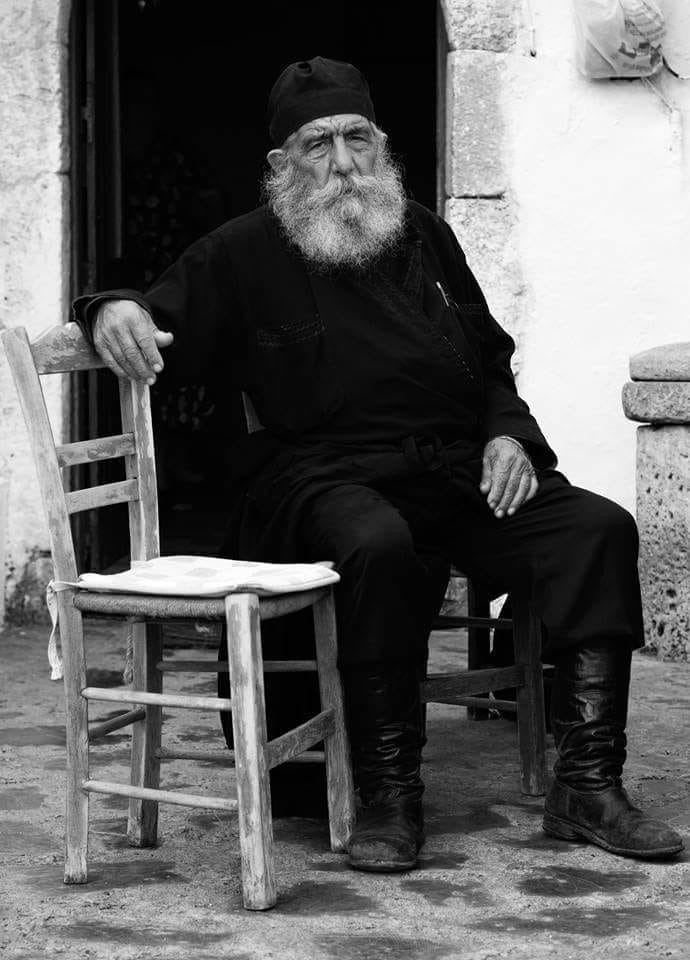
The photograph shows the priest Georgios, who died some years ago – a Sfakian legend. Papa Giorgis Chiotakis, born in 1928 in the hamlet of Nomikiana who died in February 2016, was the best-known cleric in the west of the island. He was buried at Vouvas, in the eastern part of Sfakia, and the Greek press took leave of him as the “rebel priest of Sfakia”.
It is said that even in the years of the German occupation he alone held the services in all the churches of Sfakia – which is hard to square with the year of his birth, although as a boy he does appear to have belonged to a wartime resistance youth organisation. What is certain is that for decades he was often the only priest for widely scattered communities: for Anopoli, Loutro, Agia Roumeli and the hamlets of Livaniana. He walked for hours along mule tracks and through gorges and climbed to the remotest chapels, right up to the summits, so that the candle of prayer should not go out there; on Easter night he carried the light of the Resurrection to two or three villages one after another. Year after year he also celebrated the feast of the Blessed Mary in the Samaria Gorge. People said of him that he did not want to leave any saint feeling slighted. He went on serving until he was nearly eighty. All the while he openly professed communist convictions, as his father had done before him, and he was unsparing about those in power, in the state and in the Church hierarchy alike. He was the father of twelve children and spiritual father to dozens more.
When St Porphyrios once came to Sfakia – the monk of Mount Athos who was canonised by the Ecumenical Patriarchate in 2013 – he conceived a great affection for Father Georgios, and the two became friends. Porphyrios, born on Euboea in 1906, had entered the Athonite skete of Kafsokalyvia as a boy and later served for more than thirty years as chaplain of the Polyclinic hospital in Athens, where his gift of spiritual discernment made him one of the most sought-after confessors in Greece; he died in 1991. One day the two men wanted to reach the far bank of a stream.
Father Georgios hoisted the aged Porphyrios on to his shoulders and carried him across so that he should not get wet. On the way back he took him on his back again – but suddenly both were standing on the opposite bank without understanding how it had come about, and, needless to say, perfectly dry.
Father Georgios once said: “All those who enslave society today hold university degrees and take the people for a stupid mass which the current carries wherever it pleases. Progress does not need much; a little is enough. But it is precisely that little which the many lack.”
“In Orthodoxy there is nothing crooked, though there are crooked people. The official Church and the official state are two colleagues who ought to work together to save the country. But …”
“Property and theft are one and the same offence. A man may be the user of the soil, but not its owner.” In this way Barba Giorgis – “Barba”, uncle, is in Crete the familiar form of address for a revered elder – reminded people of the word of the Lord in the Bible: “The land shall not be sold for ever: for the land is mine; for ye are strangers and sojourners with me” (Leviticus 25:23, King James Version).
Father Georgios did a great deal to bring the vendetta among the Sfakians to a halt, and so preserved many a man from the sin of blood vengeance; he also spoke out publicly against the trade in guns on the island. Another priest reports his words thus: “Let us found a committee. One man from each district, and when we learn that somebody here has fallen out, that two brothers, two neighbours in a village, a husband and wife are heading towards a killing, then we must step in, go to them and reconcile them, help them to find a common language again.”
On the custom of keeping weapons in the family he gave this judgement: “To carry arms is wrong; but to learn the art of handling a weapon is a national duty. He who wants to have calculated victory in advance, before he fights, is a fool. The moment I enter the fight I am already the victor.” So spoke Papa Giorgis Chiotakis of Sfakia – a man who kept his sermons plain and yet moved many to tears, and whom some of his own people compared to Papaflessas, the fighting priest of the War of Independence.
Anopoli and the Russian Count Orlov
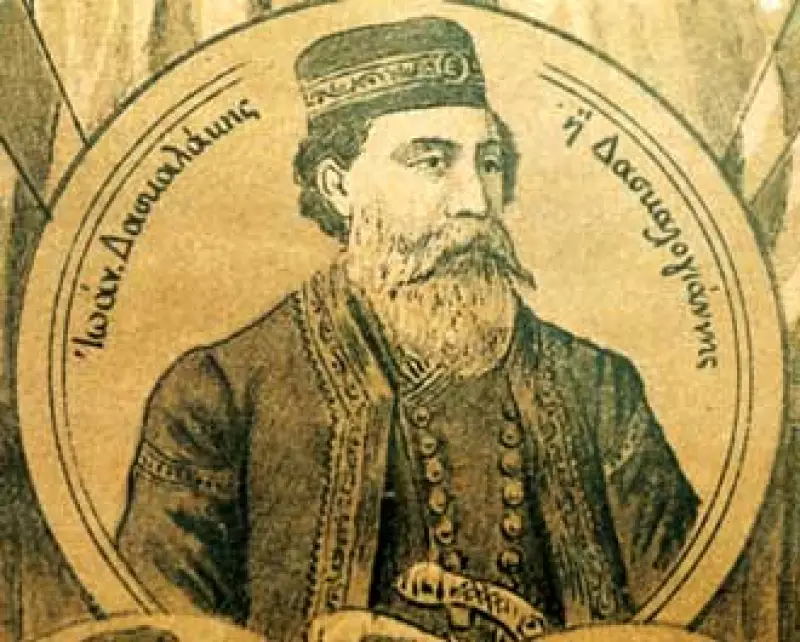
Father Georgios was a descendant – through his grandmother’s family, it is said – of the most famous Sfakian insurgent of the 18th century, Daskalogiannis, after whom the international airport of Chania is named. Daskalogiannis came from the Sfakian village of Anopoli.
Present-day Anopoli (Ανώπολη) lies beside its ancient predecessor on a plateau about 600 metres above the sea, reached from Chora Sfakion by a road that climbs in hairpin bends for twelve kilometres; the drive itself, with the coast dropping away beneath the car, is half the experience. It is a typical Sfakian scattered settlement of eleven hamlets, among them Kambos (“the plain”), Agios Dimitrios, Kambia, Riza and Skala, with a domestic architecture all its own and of great scenic beauty. The whole basin is luxuriantly green – vineyards, olive trees, walnuts, a pine wood to the north – and all around rise the summits of the White Mountains. The village has paid dearly for its temper: the Venetians laid it waste in 1365, after which it is said to have stood empty for a century, the Ottomans burnt it in 1770, and Omer Pasha destroyed it again during the rising of 1866.
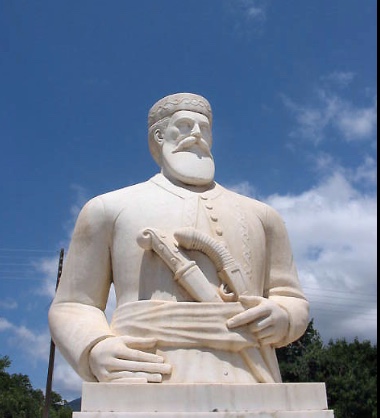
On the village square of Anopoli stands the monument to Daskalogiannis, whose story follows below. Do visit the church of St Catherine (Ekklisia tis Agias Aikaterinis), about 300 metres from the village on the hill once occupied by ancient Anopolis. The city was independent in the Hellenistic period, struck its own coins and was one of the thirty Cretan cities that concluded an alliance with Eumenes II of Pergamon in 183 BC; its port lay directly below, at Phoinix. The English traveller Robert Pashley, who explored Crete in the 1830s, traced the old fortification walls here for some three hundred paces. West of the church, from the edge of the rock by the walls of the old town, a magnificent view opens over the entire south coast of Crete, with Loutro far below. Go late in the afternoon if you can, when the light comes in low off the sea. And be sure to try the famous Sfakian pita, a wafer-thin pancake cooked in the pan, filled with fresh mizithra cheese and trickled with honey, as well as the sweet paximadi rusk with sesame and coriander for which Anopoli is known. The plateau’s honey, walnuts and sheep’s cheeses are equally good. On 15 August the village holds a festival in honour of its graviera cheese.
The rising of Daskalogiannis
Ioannis Vlachos was born at Anopoli in Sfakia, probably in 1725, into a family that had made a name for itself in trade throughout Moldavia and Wallachia; hence the surname Vlachos. His father, who had grown rich through seaborne commerce, enabled him to be educated abroad, probably in Italy. To that schooling he owed the byname Daskalogiannis, “Giannis the teacher”, under which he entered history. His wife is remembered as Sgouromallini; they had two daughters, Anthousa and Maria.
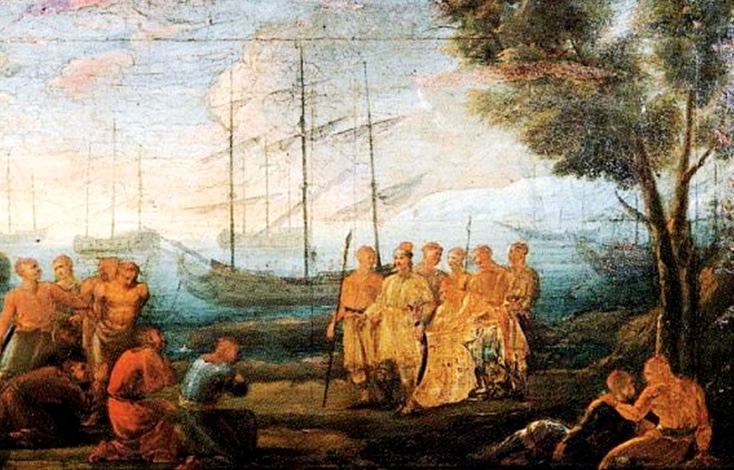
In February 1770, when the Russian fleet appeared off the Mani in the southern Peloponnese, Daskalogiannis sent hundreds of Sfakians to the aid of the insurgents there. Count Orlov had kindled a rising of the Greeks in the rear of the Ottoman Empire during the Russo-Turkish War, and Daskalogiannis was in correspondence with him. The count in question was Alexei Grigoryevich Orlov, who commanded the fleet Catherine the Great had sent round Europe into the Aegean, while his brother Fyodor was charged with co-ordinating the rebels in the Peloponnese. The introduction probably came through Panagiotis Benakis, the leading notable of the Mani, whom Daskalogiannis knew from his voyages. The famous folk song dedicated to him says that on every high feast day he would declare: “I shall bring the Muscovites here.” This song of Barba-Pantzelios, a cheesemaker from Sfakia, was composed in 1786 and runs to more than a thousand lines; it is the principal source for the events and one of the great works of Cretan popular poetry.
In the spring of the same year the rising broke out in Sfakia, and Daskalogiannis placed himself at its head; at Anopoli he is said to have raised the banner of revolt with some 1,300 armed men. The date traditionally given for the outbreak is 25 March. In April, after careful preparation of men, muskets and supplies, the Sfakians under his leadership refused to pay the poll tax, drove off the collectors and attacked the Ottomans, coming down from the mountains into the districts of Kydonia, Apokoronas and Agios Vasilios, seizing their property and forcing them to take refuge in the fortresses. This first assault on the Muslims of Crete is regarded as the opening of the struggle for the island’s freedom.
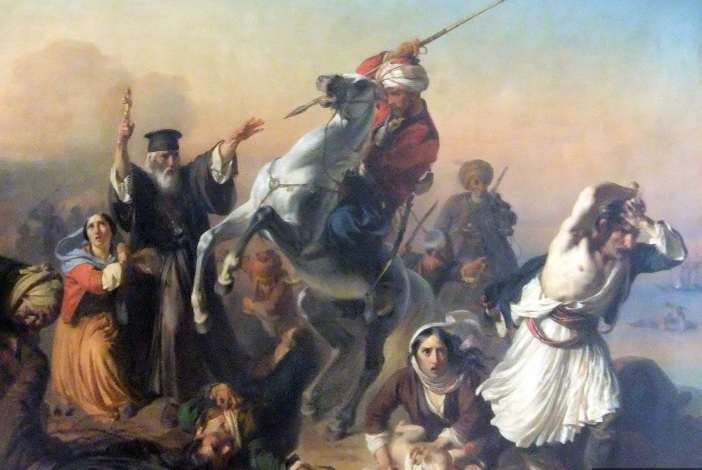
When the Ottoman authorities, on the sultan’s orders, assembled an army of 15,000 men to crush the revolt – it gathered at Vryses, at the foot of the road into the mountains – Daskalogiannis rejected the summons to surrender. The Sfakians were heavily beaten on the plateau of Krapi, which guards the pass into their country, and thanks to their superior artillery the Ottomans took the key positions and villages – Anopoli, Aradena, Imbros, Chora Sfakion – and carried out a massacre there; women and children were carried off into slavery or could save themselves only by ship.
The Sfakians thereupon withdrew into the mountains under Daskalogiannis and began a guerrilla war of ambushes. The bloody struggle lasted into the winter, by which time both sides were on the verge of exhaustion. In March 1771 the Sfakians offered an armistice in return for an amnesty. The Ottomans agreed, but in an ultimatum of twelve articles dated 18 March they laid down their conditions, chief among them that the leaders of the rising be handed over for punishment.
Daskalogiannis decided of his own free will to give himself up, knowing full well that he was going to certain death. Tradition has him surrendering to the pasha at Frangokastello, the Venetian fort on the Sfakian shore. He was imprisoned in Chandax, the present-day Heraklion.
His fate was sealed on 17 June 1771 with a cruel execution: he was flayed alive. His brother, Nikolos Sgouromallis, who according to tradition was made to watch, lost his reason as a result. Yet the deed and the self-sacrifice of Daskalogiannis have engraved themselves indelibly on the memory of the Cretans; he is commemorated every year at Anopoli on the Sunday after 17 June, before his statue on the square.
Loutro
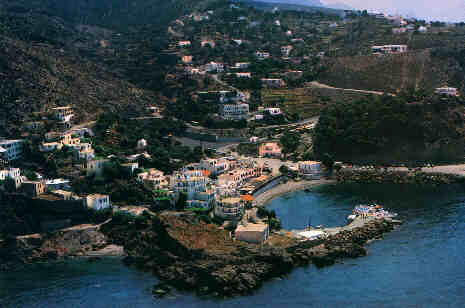
Loutro is a picturesque little place whose houses are painted in the manner of the Cyclades – snow-white, with blue shutters. They are ranged as in an amphitheatre around a bay in the lee of Cape Mouri, sheltered from the wind, which once served the Sfakians as their winter harbour. It is one of the few places in Crete without motor traffic: there is no road, and everything from bread to building materials arrives by sea. A little to the west of Loutro, beyond the fortress, lies the principal sight, the remains of the ancient harbour of Phoinix, the trading gateway of the city of Anopolis on the heights above. Anyone who does not feel equal to the walk through the gorge can reach Loutro by boat from Chora Sfakion in twenty minutes, a crossing of about two nautical miles; on foot the coastal path takes roughly two hours, and the descent from Anopoli a good hour, steep and shadeless, so start early and carry water. Visit the little monastery of the Mother of God (Monastiri tis Panagias); the village keeps the feast of the Dormition on 15 August, and those of St Anthony and the Holy Cross besides. During the rising of 1821 against Ottoman rule Loutro was the seat of the local government, the “chancellery” of the Sfakians, housed in the building that later became the primary school.
Aradena
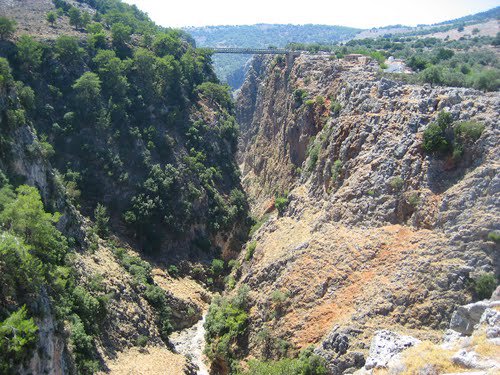
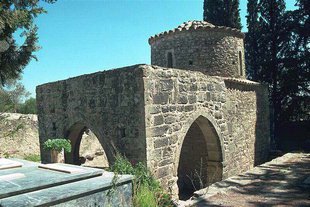
Aradena, three and a half kilometres beyond Anopoli, is a village almost without inhabitants, its houses empty and falling into ruin. At the turn of the 20th century nearly two hundred people lived here; the census of 2011 found four. The cause is a blood feud which according to tradition carried off the male population and induced the remaining families to move away in the 1950s. Even so, the visit is worth making, if only for the well-preserved ruins of the ancient city of Aradin or Iradin at the place called Passopetra; it, too, belonged to the league of Cretan cities of 183 BC, and its burial ground has been located at Xenotafi. Of great charm is the small, now restored church of the Archangel Michael on the edge of the settlement, known locally as the Astratigos. It dates from the 14th century, stands on the nave of an Early Christian basilica that was once the seat of a bishop, and preserves frescoes attributed to the painter Michael Veneris; its feast falls on 8 November. The village lies at an altitude of about 520 metres on the western side of a narrow, deep gorge, more of a cleft, into which only the bold venture – the old mule track winds down the wall in zigzags, and whoever follows it reaches the beach of Marmara after seven kilometres. The descent takes three to four hours and is dry and stony throughout, with an iron ladder to help walkers past one vertical step of about nine metres; from the pebble cove at the bottom a boat or an hour’s walk along the shore leads to Loutro. The other side is reached by a modern iron bridge. It was donated in 1986 by the shipowning Vardinogiannis family, who come from the neighbouring village of Agios Ioannis, as a gift to their homeland, and was inaugurated on 28 December of that year; thus it also bears the Vardinogiannis name. Seventy metres long and 138 metres above the bed of the gorge, it is one of the highest bridges in Greece – in summer it is used for bungee jumping – and its wooden planks rumble under every vehicle.
Agios Ioannis
Five kilometres west of Aradena the road ends at Agios Ioannis, a tiny village at an altitude of around 800 metres and one of the smallest in Sfakia. The way there leads through a pine forest of a kind that has become rare in Crete, with the Libyan Sea on one hand and the White Mountains on the other. The place was destroyed in 1770 and again in 1867; in 1823 thirty-two men of the village are said to have held the mouth of the gorge against Egyptian cavalry and to have fallen in doing so, in order to cover the flight of the women and children. Two Byzantine churches with wall paintings of the 14th century, dedicated to St John and to the Panagia, stand among the houses, and from the ruin of a small watchtower above them the view extends over the whole south coast, from the Asterousia Mountains in the east to Paleochora in the west. An old path descends in a good hour to the sea, to the church of the Apostle Paul on the beach of Agios Pavlos, which tradition ascribes to the hermit St John the Stranger – for walkers one of the finest routes in Sfakia, though the climb back is long and there is no water on the way.