Lake Kournas: Crete’s only natural freshwater lake
The most complete guide to Crete: 221 places on the map, 23 routes and 49 articles — with photos, videos and the story behind every place. No sign-up, no trackers.
Routes drawn along real roads
Weather at every stop
Full-text search
“Near me” by geolocation
Create your own printable itinerary
Satellite, terrain, dark mode
Works offline
⌕
Searches 1.7 million characters of descriptions, not just names
—places
4regions
—routes
—with video
Search results
—
Interactive map
Find what is near you
Filters narrow the map and the list at once. Zoom out and pins group together.
Region
Category
Фильтры карты
Landmarks
Featured places
RegionCategory
Routes
Ready-made day trips
Individual places
Articles about landmarks
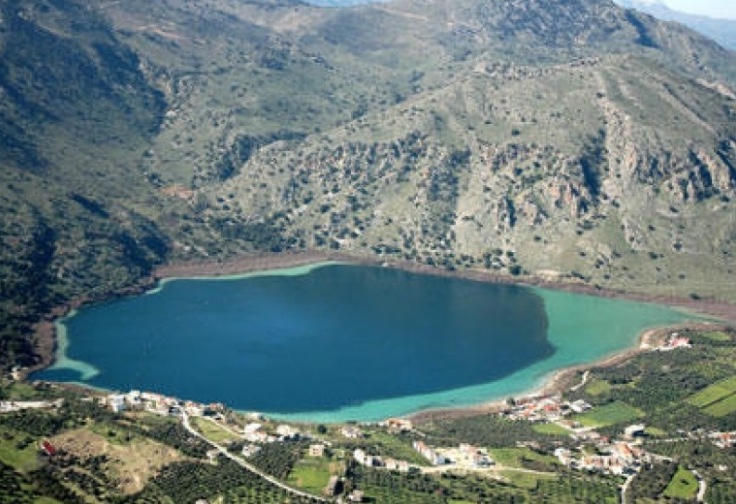
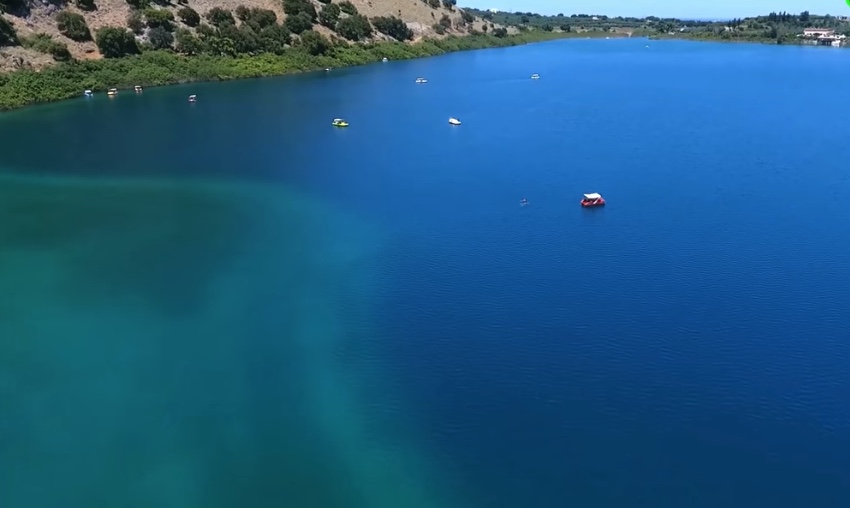
Lake Kournas (Λίμνη Κουρνά) is the only natural freshwater lake on Crete. It lies in the east of the Chania regional unit, in the district of Apokoronas, about four kilometres inland from Georgioupoli, at the foot of the northern outliers of the White Mountains; Chania is some 45 kilometres to the west, Rethymno about 20 to the east. From the coast road there is no hint of it: only beyond the last olive groves does the hollow open, in which the water shifts with the hour and the depth between pale turquoise, emerald and deep blue, the hillsides mirrored on its usually unruffled surface. The darker tones come from the algae growing on the bottom.
The lake at a glance
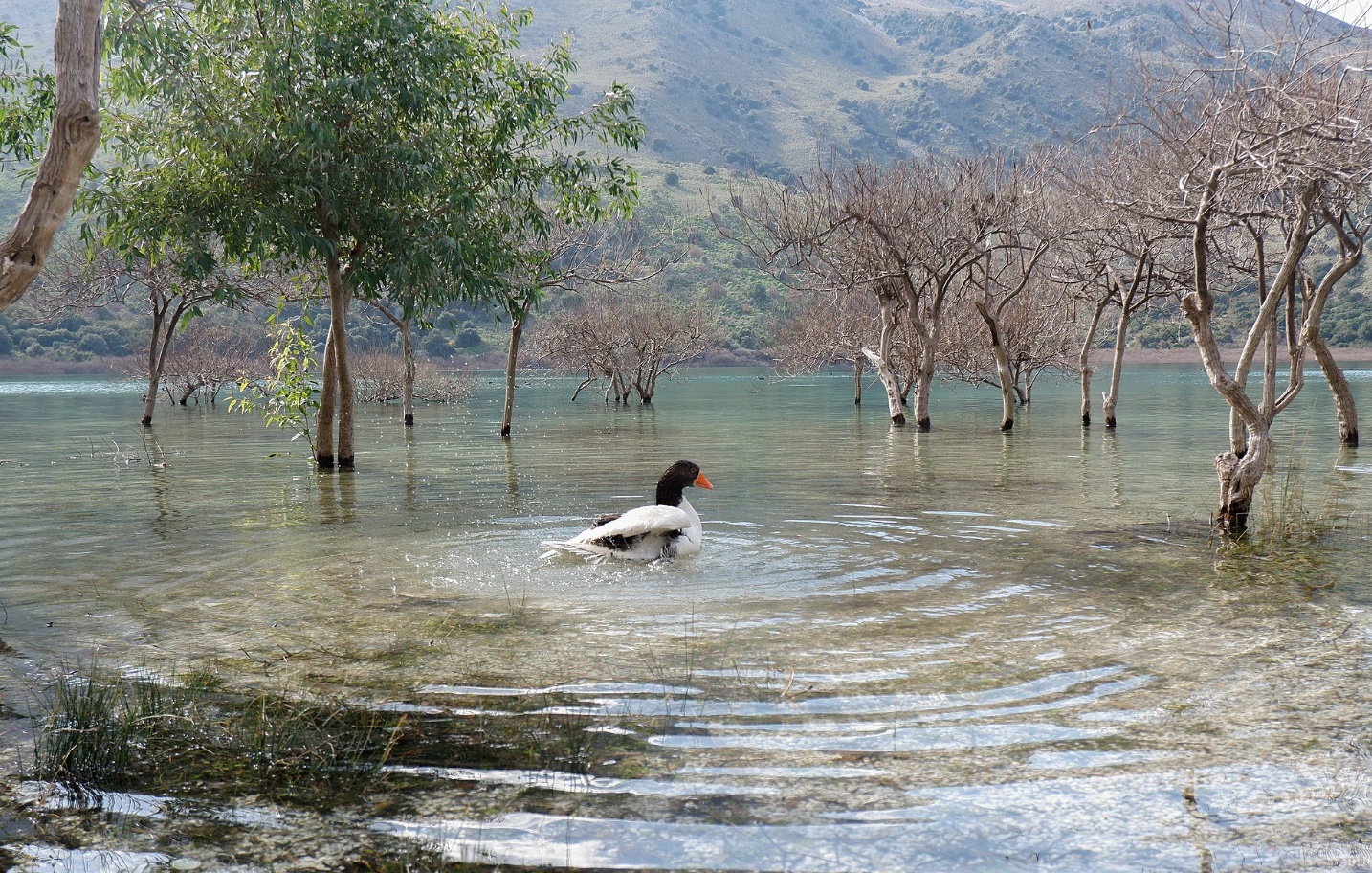
Lake Kournas is comparatively small: its greatest length is about 1,087 metres, its greatest breadth some 880 metres. It covers 579 stremmata, or just under 58 hectares, and its outline is often compared to a pear. For long stretches it is shallow, but at the deepest point 22.5 metres have been measured – the lake bed there lies below sea level, since the surface is only about 20 metres above the sea. In summer the basin holds around 7.5 million cubic metres of water. A narrow path follows the shore for some way; the full circuit, about 3.5 kilometres and rather less than an hour’s walk, can be made only when the water is low, for in winter and spring parts of the bank are under water.
A historical note
The lake was known in antiquity: the lexicographer Stephanus of Byzantium mentions it in the 6th century under the name Korisia. An old sanctuary of Athena Korisia is said to have stood in this neighbourhood; possibly Hippos and Kore were worshipped here as well. From these names the old toponym Hippokorona is supposed to have arisen, later altered to Apokoronas. The lake received its present name in the period of Arab rule over Crete. Some trace it to an Arabic word, kurna, for “lake” or “basin”, “bathing place”, others to a reworking of the Greek “krounos” (spring). Above the lake, about ten minutes’ drive to the south, lies the village of the same name, Kournas, from whose edge the water is seen lying as if in a bowl.
The legends of the drowned village
As so often with still, deep waters, popular belief explains the making of the lake as a judgement. According to one story, the inhabitants of a village that once stood on this spot lived so dissolutely that God sent rain and storm for days on end, until the village sank beneath the flood. Only the priest’s daughter was spared; she is said to sit to this day on a rock in the lake combing her hair, its guardian spirit. The other tale tells of a fair-haired girl who was pressed by her own father and in her distress wished that the earth might open and everything turn to a lake, and she herself become its spirit. The ground shook, and the wish was granted. The old people called the lake “bottomless”, and it is still said that in some places nobody has ever reached the bed.
Wildlife
The lake was formed by karst processes. Its waters hold eels and two rare species of fish: the sand smelt (Greek atherina) and the freshwater blenny, a small bottom-dweller found in only a few places in Greece. More recently the goldfish has arrived as an introduced species – a consequence of human interference that strains the ecological balance. Also alien is the mosquitofish (Gambusia), once released to keep down mosquitoes. Terrapins bask on the banks, harmless water snakes hunt in the shallows and freshwater crabs live among the stones, while in the reeds numerous water birds and migrants rest and winter – ducks, coots, moorhens, herons and cormorants. For that reason the lake belongs to the European network of protected areas, Natura 2000, and is designated a special protection area for birds; the south-western shore is kept as a nature reserve.
Advice for visitors
On the northern shore, where the paved road from Georgioupoli ends, tavernas with terraces above the water stand in a row; pedalos and canoes can be hired here for gliding across to the quieter coves of the southern shore, and there are sunshades and loungers on the sand. Buses also run to the lake in season. Bathing is permitted, and in summer the water is pleasantly fresh. The best time is the morning or late afternoon, when the excursion coaches have gone and the light brings out the colours of the water most strongly; in spring the lake stands highest, in late summer the sandy shores are at their broadest. Anyone who wants to experience the lake as a natural habitat leaves the terrapins and water birds in peace, feeds no fish and takes their litter away with them – the delicate balance of this small body of water suffers enough from the crowds as it is.