The most complete guide to Crete: 221 places on the map, 23 routes and 49 articles — with photos, videos and the story behind every place. No sign-up, no trackers.
Routes drawn along real roads
Weather at every stop
Full-text search
“Near me” by geolocation
Create your own printable itinerary
Satellite, terrain, dark mode
Works offline
⌕
Searches 1.7 million characters of descriptions, not just names
—places
4regions
—routes
—with video
Search results
—
Interactive map
Find what is near you
Filters narrow the map and the list at once. Zoom out and pins group together.
Region
Category
Фильтры карты
Landmarks
Featured places
RegionCategory
Routes
Ready-made day trips
Individual places
Articles about landmarks
Rethymno
Rethymno (Ρέθυμνο) is among the best-preserved historic towns on Crete, and with some 36,000 inhabitants the third largest on the island. The Venetian fortress, the Fortezza, rises above the old quarter, and the lanes around the little harbour make up something like an open-air museum in which Venetian stone doorways, Ottoman timber balconies, fountains and minarets stand cheek by jowl.
Find on the map
History of the town
Rethymno’s story opens in the Late Minoan period, roughly between 1400 and 1100 BC; tombs within the town limits belong to that age. The ancient settlement of Rhithymna governed itself and struck its own coins, but towards the end of Roman times it dwindled in importance. Only under the Venetians, who called the town Retimo, did it rise to become an administrative and commercial centre, a staging post between Chania and Candia and, from about 1250, the seat of a Latin bishop. Young Cretans who had studied in Italy brought the ideas of the Renaissance home with them; in 1562 the scholar Francesco Barozzi founded the Accademia dei Vivi here.
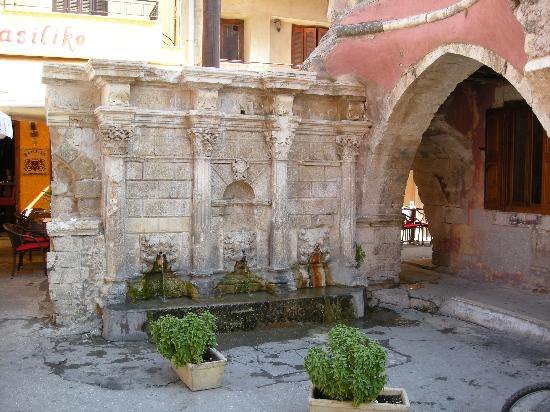
Its position on the sea lanes also left Rethymno exposed. In 1538 the town suffered in a raid by Hayreddin Barbarossa, and in 1571 the corsair Uluç Ali sacked and burnt it. The Venetians then strengthened the defences and built the Fortezza. To their period belong the Loggia, the meeting place of the nobility, a 16th-century building attributed to the Veronese architect Michele Sanmicheli; the Guora Gate, the one surviving fragment of the town wall, put up while Jacomo Guoro was rector in 1566–68; and the Rimondi Fountain of 1626, the gift of the rector A. Rimondi and once the town’s principal water supply, where water still runs from three lions’ heads. For all that, Rethymno fell to the Ottoman Empire in 1646.
Under Ottoman rule
After the Ottoman conquest part of the Christian population left the town, part converted to Islam, and Muslim families settled in Rethymno, which became the centre of a sanjak. This altered the make-up of the population, the administration and the look of the place: Ottoman mansions, fountains, mosques and courtyards joined the Venetian houses, and above the stone ground floors grew the enclosed wooden balconies that remain the hallmark of the old town. The Augustinian church became the Neratze Mosque in 1657; its slender minaret of 1890 is one of the best preserved on Crete, and the building now houses the municipal conservatoire. The Kara Musa Pasha Mosque at the start of Arkadiou Street followed in 1660. At the harbour mouth the lighthouse went up in the 1830s, when Crete was administered from Egypt under Mehmet Ali.
After Cretan autonomy and union with Greece in 1913, Rethymno became the capital of the prefecture of the same name. With the population exchange of the 1920s the last Muslims left the town. In 1973 the University of Crete was founded, with its humanities faculties based in Rethymno; some 8,000 students are enrolled on the campus here, and students and teachers leave a perceptible mark on the town’s cultural life.
Rethymno today
The town is strung out along the north coast. East of the historic core begins a sandy beach several kilometres long, lined with hotels; to the west the shore turns rocky and then gives way to sand once more. Rethymno has remained the administrative, commercial and transport centre of its region, and it combines the seaside resort with the life of a university town and cultural centre. The old quarter is small enough to explore on foot: from the Venetian harbour basin and its fish tavernas, past the Loggia and the Rimondi Fountain, up to the fortress is barely a quarter of an hour’s walk. In summer the Renaissance Festival sets the calendar, with a wine festival at the beginning of July; in winter it is the carnival, reckoned the largest on Crete, preceded a fortnight earlier by a town-wide treasure hunt.
The Archaeological Museum
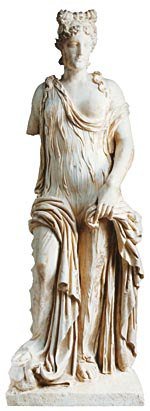
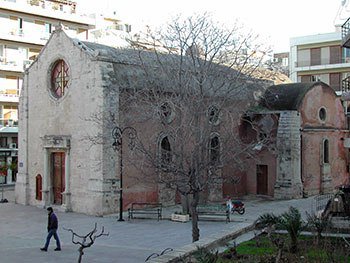
Rethymno’s archaeological collection is housed in the former church of St Francis, the katholikon of a 16th-century Venetian Franciscan friary in the middle of the old town, built by the Barozzi family around 1530; the street outside, Agiou Frangiskou, takes its name from it. For many years the collection was kept in the pentagonal Ottoman outwork – a ravelin – directly in front of the entrance to the Fortezza. On show are finds from the whole region: terracotta figures of the Late Minoan, Geometric, Archaic and Hellenistic periods, pottery, inscriptions and coins, including gold coins from Knossos, as well as the Roman copy of a statue of the “Large Herculaneum Woman” type from Eleutherna and a marble sarcophagus of the 1st to 3rd century AD. Look too for the Minoan clay coffins, or larnakes, one of them painted in the Marine Style, and for an Archaic inscription from Eleutherna, written boustrophedon, that sets out a law against excessive drinking.
The display runs from the Palaeolithic to the Venetian period and presents the history of the region not as a single age but as a succession of cultural layers laid one upon another. The tall, light interior of the church, with its richly worked Renaissance doorway, is an exhibit in its own right. The museum is closed on Tuesdays.
The Fortezza
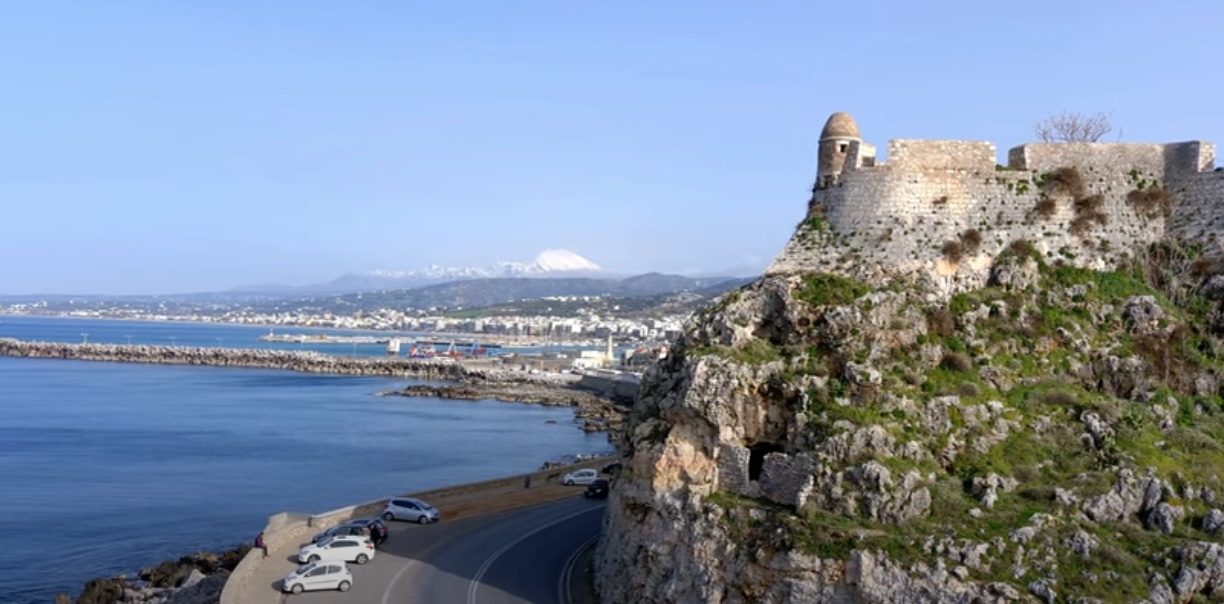
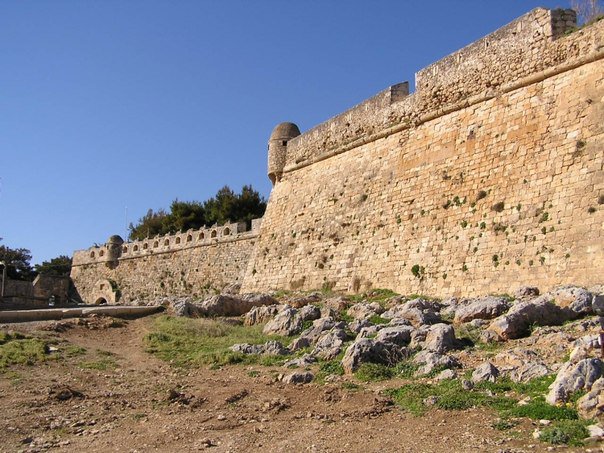
The Fortezza was built by the Republic of Venice between 1573 and 1590 on the rocky headland of Paleokastro, after the corsair raids and the events of 1571. The foundation stone was laid on 13 September 1573; the design, on the Italian bastioned system, was by the military engineer Sforza Pallavicini, the master builder was Giannis Skordilis, and the records count 107,142 Cretans and 40,205 pack animals pressed into the work. The very name of the hill, “old castle”, is a reminder that the acropolis of ancient Rhithymna is thought to have stood here. The fortress was meant to shield the town from attack by sea and from the Ottoman fleet, yet in 1646 the Ottomans took Rethymno from the landward side. The siege began on 29 September; short of food and powder and weakened by disease, the garrison capitulated on favourable terms on 13 November.
The massive battered walls of limestone, 1,307 metres in circuit, the bastions – strictly demi-bastions, four in number, among them those of St Elias, St Luke and St Nicholas – the galleries, embrasures and the main gate on the east side all survive. Inside lie the remains of the Venetian rector’s residence, of which only the prison is left, and of the councillors’ building, together with the armoury, two powder magazines, storerooms and the cisterns that collected rainwater against a siege. There are also two small Orthodox churches of the late 19th century, St Theodore Trichinas and St Catherine, and the former mosque of Sultan Ibrahim Han. The houses that once crowded the interior were cleared after the Second World War, and thorough restoration began in the early 1990s. In summer the open-air Erofili theatre, opened in 1993 inside the St Elias bastion, stages concerts and the performances of the Renaissance Festival, held since 1987. The circuit of the ramparts is at its best in the late afternoon, when the light softens over the old town, the harbour and the White Mountains to the west.
The Mosque of Ibrahim Han
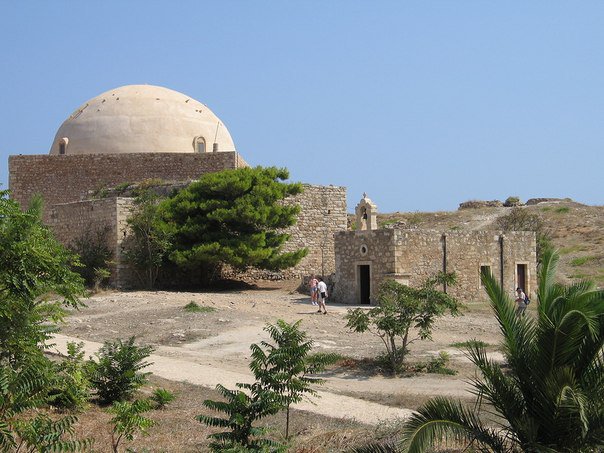
The building known as the Mosque of Sultan Ibrahim Han began as the Venetian cathedral of St Nicholas, of the late 16th century; 1583 is the year given for its construction. It was built inside the fortress after the town’s old episcopal church had been destroyed in the raid of 1571. Following the Ottoman conquest it was turned into a mosque and dedicated to the reigning sultan: a mighty dome some eleven metres across, resting on squinches in the corners, was raised over the square hall, and a richly ornamented prayer niche, the mihrab, facing Mecca, was let into the wall. Of the minaret only the base survives outside. Restored, and with remarkable acoustics, the building now serves for concerts and exhibitions.