The most complete guide to Crete: 221 places on the map, 23 routes and 49 articles — with photos, videos and the story behind every place. No sign-up, no trackers.
Routes drawn along real roads
Weather at every stop
Full-text search
“Near me” by geolocation
Create your own printable itinerary
Satellite, terrain, dark mode
Works offline
⌕
Searches 1.7 million characters of descriptions, not just names
—places
4regions
—routes
—with video
Search results
—
Interactive map
Find what is near you
Filters narrow the map and the list at once. Zoom out and pins group together.
Region
Category
Фильтры карты
Landmarks
Featured places
RegionCategory
Routes
Ready-made day trips
Individual places
Articles about landmarks
The Holy Monastery of Arkadi
Arkadi Monastery (Μονή Αρκαδίου) ranks among the most important Orthodox shrines and historical monuments of Crete. Its name cannot be separated from the tragic defence and self-sacrifice of those who had taken refuge within its walls during the Cretan rising of 1866.
Find on the map
The monastery and its place in the island’s memory
The monastery stands at about 500 metres on a green and fertile plateau at the north-western foot of Psiloritis, some 23 kilometres south-east of Rethymno. The road climbs from the coast through olive groves, vineyards and a small gorge, and an Ottoman bridge of 1685 leads to the monastery. The name is linked either with the Byzantine emperor Arcadius or with a monk called Arkadios, to whom the foundation is ascribed. The beginnings are placed in Byzantine times – an inscription found in 1951 attests a 14th-century church here, dedicated to St Constantine – but the complex as it stands is essentially a creation of the 16th and 17th centuries, the last generations of Venetian rule.
Historical outline
In the 16th century, under Abbot Klimis Chortatzis and the benefactor Matthaios Kallergis, Arkadi grew into a large coenobium, a monastery in which life is strictly communal. Liturgical books were copied here, there was a school, and learning and ecclesiastical art flourished; the vestments embroidered with gold thread in the monastery’s workshop were equally renowned. The library was still remarkable in the early 19th century, when the traveller Franz Wilhelm Sieber counted more than a thousand volumes, Homer, Pindar, Thucydides, Virgil and Dante among them, though he found the manuscripts in a sorry state; most perished in 1866. Arkadi was thus not only a place of prayer but an intellectual and educational centre for the whole island.
The monastery kept a privileged position even after the Ottoman conquest. When Rethymno fell in 1648 it was plundered, and Abbot Simon Chalkiopoulos and his monks fled to Vrontisi Monastery; they were allowed back once they had sworn allegiance to Hussein Pasha. The monks were then permitted to ring their bells, where other houses had to make do with the wooden sounding-board, and the Turks accordingly called Arkadi Çanlı Manastır, the monastery with the bells. The wealth brought in by the oil, wine and grain of its extensive estates allowed building to continue through the 17th century. The French botanist Joseph Pitton de Tournefort, who called it the richest and finest monastery on Crete, found a hundred monks living within the walls and two hundred more out on the land, and a cellar of at least two hundred barrels.
The architectural legacy
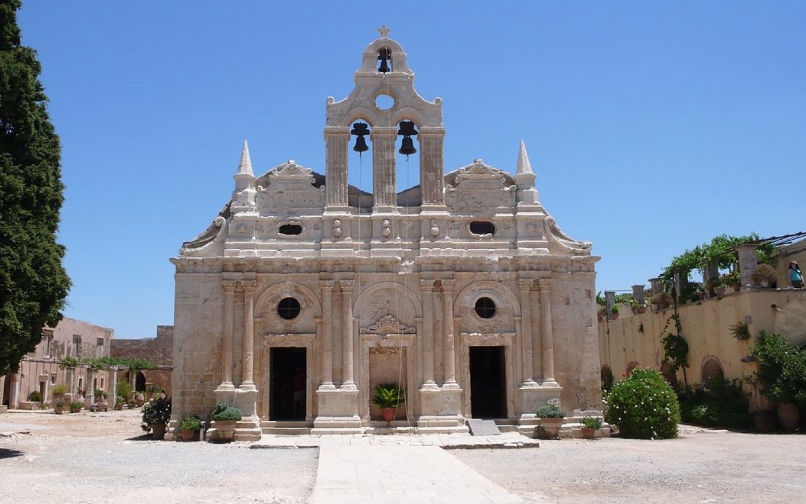
The monastery is laid out as a fortified quadrangle around an inner court; from outside, with its high and almost windowless walls, it looks more like a fortress. The enclosure is not quite regular – the north wall measures 78.5 metres, the west only 67 – and covers some 5,200 square metres. In the middle of the court stands the two-aisled katholikon, dedicated to the Transfiguration of the Lord and to Saints Constantine and Helen, Equal to the Apostles. Building began around 1562 and took a quarter of a century. Its celebrated façade of dressed poros limestone, completed in 1587 – the date appears with the name of Klimis Chortatzis on the bell gable – combines the forms of the Venetian late Renaissance with the tradition of Orthodox church building: four pairs of Corinthian columns on tall pedestals, round arches and a curving bell gable plainly follow the pattern books of the Italian architects of the day, Sebastiano Serlio and Andrea Palladio above all. Chortatzis did not live to see the consecration, which fell to his successor, Mitrofanis Tsyrigos. The interior was burnt out in 1866, and the present iconostasis of cypress wood dates from 1902. In the warm light of late afternoon the stone glows the colour of honey.
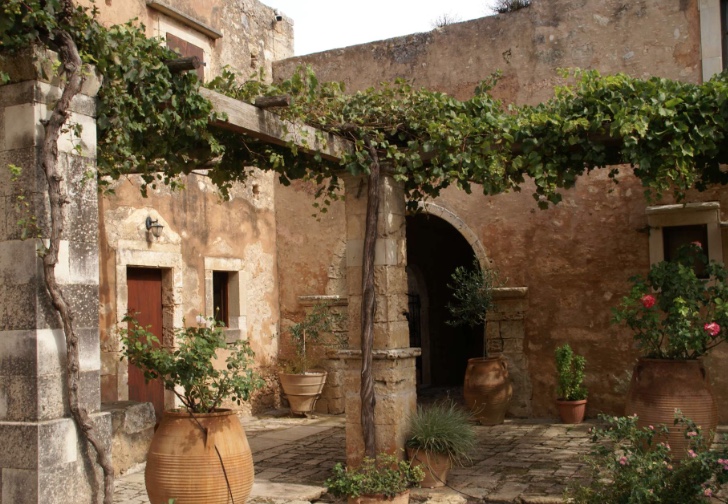
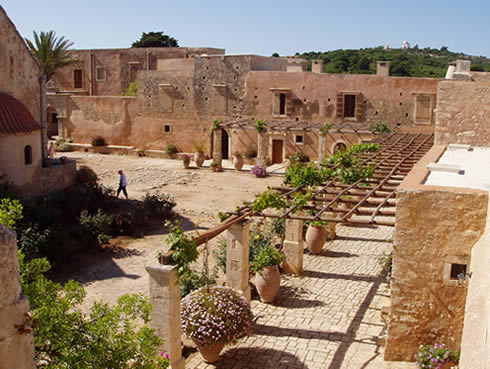
Around the court lie the monks’ cells, the refectory of 1687, storerooms, the bakery, the wine cellar and a cistern. The wine cellar in the north-east wing, a vaulted room 21 metres long and 5.4 wide, served as the powder magazine during the siege of 1866, the powder having been moved there shortly before the attack; it has stood roofless ever since. The west gate, first built in 1693, was destroyed in the fighting and rebuilt in 1870, and the stable block of 1714 stands some fifty metres in front of it.
The siege and sacrifice of 1866
In August 1866 Crete rose against Ottoman rule under the watchword “Union or Death”. Arkadi became the seat of the revolutionary committee of the province of Rethymno, and along with the insurgents the people of the surrounding villages sought shelter behind its walls. Panos Koronaios, sent in September to command the rising in the district, judged the place indefensible but yielded to the abbot and the monks. On 7 November 1866 there were 964 people in the monastery: some 325 men, of whom 259 were armed, and the rest women and children. Command lay with Abbot Gabriel Marinakis and with Lieutenant Ioannis Dimakopoulos, who had come over from the mainland.
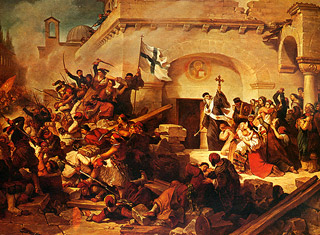
The Ottoman forces under Mustafa Pasha – about 15,000 men of Turkish, Egyptian and Albanian origin, with some thirty guns – surrounded the monastery during the night and on 8 November opened the assault with artillery. The defenders rejected the summons to surrender. They held out for two days; once heavy guns had been brought up from Rethymno on 9 November and set up in the stables, the west gate gave way and the attackers poured into the court. The defenders, their ammunition spent, fought on with bayonets. At that moment the powder magazine, where many women and children had taken refuge, was fired. The explosion destroyed a large part of the east wing and killed those inside together with many of the attackers.
Tradition names Konstantinos Giamboudakis, from the village of Adele, as the man who lit the fuse; other accounts speak of Emmanouil Skoulas. Only a handful got away; 114 survivors were taken prisoner and marched to Rethymno, and Dimakopoulos was executed. The dead among the besieged are put at more than eight hundred – 846 is the figure commonly given – while reports of the besiegers’ losses range from 1,500 to 3,000 men. The “Holocaust of Arkadi”, as Greeks call the sacrifice, became the emblem of the Cretan struggle for freedom. It set off a wave of philhellenic sympathy across Europe: Giuseppe Garibaldi and Victor Hugo took sides in public, Hugo setting Arkadi beside Psara and Missolonghi, and volunteers and donations arrived from many countries.
The monastery today
Today Arkadi is an inhabited patriarchal stauropegial monastery and a museum complex in one. The museum displays vestments, icons, manuscripts, seals, weapons and personal belongings of the insurgents, including the defenders’ banner. Visitors see the powder magazine, where an inscription set into the wall in 1930 recalls the flame in which the Cretans died for freedom; the refectory, 18 metres long, where the last thirty-six fighters fell and where the furniture still bears the marks of blade and bullet; and the restored ranges. In the court stands the stump of an old cypress with a projectile from the siege still lodged in its wood. Outside the monastery, in a former windmill which seven defenders held until it was set alight, and which was converted into an octagonal memorial in 1910, the ossuary holds the skulls of the fallen, many of them scarred by sword cuts and bullets.
The life of worship continues. Each year on 8 November, the day of remembrance, church ceremony and national commemoration come together at Arkadi and in Rethymno; UNESCO has recognised the monastery as a European monument to freedom. Those who want to take in the place quietly should come early in the morning or towards evening, when the coaches have gone.