The most complete guide to Crete: 221 places on the map, 23 routes and 49 articles — with photos, videos and the story behind every place. Everything is open and free: no sign-up, no paid sections and no advertising, open or hidden. You can install the guide on your smartphone as an app.
Routes drawn along real roads
Weather at every stop
Full-text search
“Near me” by geolocation
Create your own printable itinerary
Satellite, terrain, dark mode
Works offline
⌕
Searches 1.7 million characters of descriptions, not just names
—places
4regions
—routes
—with video
Search results
—
Interactive map
Find what is near you
Filters narrow the map and the list at once. Zoom out and pins group together.
Region
Category
Фильтры карты
Landmarks
Featured places
RegionCategory
Routes
Ready-made day trips
Individual places
Articles about landmarks
The Monastery of St John at Preveli
Preveli Monastery (Μονή Πρέβελη) is among the most important Orthodox centres in the south of Crete. Its full style is the Holy Stauropegial and Patriarchal Monastery of St John the Theologian, and it answers to the Ecumenical Patriarchate of Constantinople. Two complexes make up the whole: the Lower Monastery, dedicated to St John the Baptist, and the Upper Monastery, still a working community, whose patron is the Evangelist St John the Theologian.
Find on the map
Foundation and history
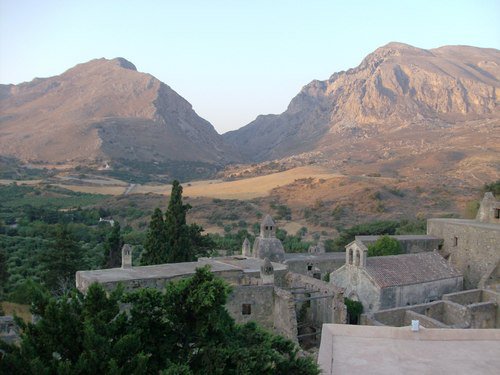
The monastery lies where the Kourtaliotis Gorge opens towards the coast, among bare hills that drop abruptly to the Libyan Sea, about 37 kilometres south of Rethymno. The monks’ own tradition traces it to a priest-monk of the Prevelis family and places the foundation at the end of the 10th or the beginning of the 11th century, in Crete’s second Byzantine period. The written record and the surviving buildings are later, however – the oldest secure date is the year 1594 cast on a bell – and the Upper Monastery is generally assigned to the 16th century. The early foundation is therefore best taken as inherited memory, not as an archaeologically established date. The house was originally known simply as “the monastery of the Great River”; it probably owes its present name to a restorer from the respected Prevelis family of Rethymno, usually identified as Abbot Akakios Prevelis, who was at work in the second half of the 17th century.
Preveli is also the home of the icon of the Panagia Antiphonitria – the epithet means “she who answers” – venerated here for miraculous help. The 18th century brought mixed fortunes: a fountain was built in 1701, and both complexes suffered in the rising of 1770. Then, under the energetic Abbot Ephraim (1769–1803), a sealed letter from Patriarch Gregory V in 1789 raised Preveli to stauropegial rank, placing it directly under the Ecumenical Patriarchate. An earthquake in 1810 did further damage, made good in 1814–16. Ephraim’s successor, Melchisedek Tsouderos (1803–1823), a member of the secret society known as the Filiki Eteria, was among the first on Crete to raise the flag of revolt, on 24 May 1821; he died on 5 February 1823 of wounds received in the fighting at Polemarchi. Nor was that the end of it. Fourteen monks took up arms in the rising of 1866 while the monastery sheltered rebels, and in 1867 Ottoman troops laid the place waste; rebuilding did not begin until 1897. Through all this the monastery kept its own schools and was for generations a mainstay of the surrounding villages.
The Lower Monastery
Kato Moni, dedicated to St John the Baptist (Prodromos), stands beside the Megalopotamos, the “Great River”, below the upper complex. This was where the monks kept their farm buildings, workshops and storerooms, and from here they worked the fields and tended the flocks in the valley. The approach crosses a stone arched bridge of 1850, built under Abbot Neilos Moschovitis and strongly reminiscent of Venetian models; a second bridge, the Bourtzoukos, followed in 1852. According to the monastery’s history the Ottoman conquest brought destruction in 1646, and in the 1670s descendants of the Prevelis family restored the buildings. In the 18th century the seat of the brotherhood was moved uphill to the Upper Monastery of St John the Theologian; the two complexes lie 1.7 kilometres apart, rather more by the winding road. The Lower Monastery was wrecked again by German troops in 1941, vandalised by unknown hands in 1980, and is no longer inhabited. Among the roofless cells and vaults the church survives, with paintings by the 19th-century icon painter Merkourios, a native of Santorini who was working for Preveli in 1841.
The Upper Monastery
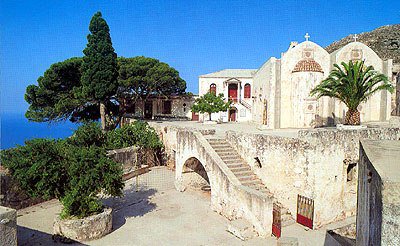
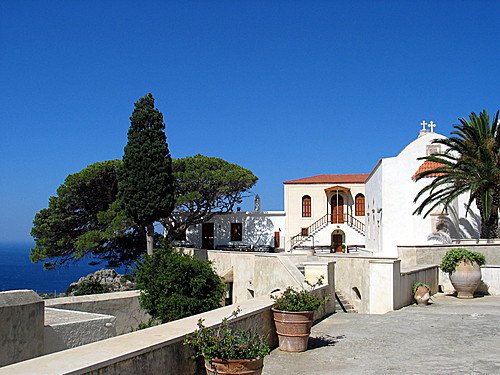
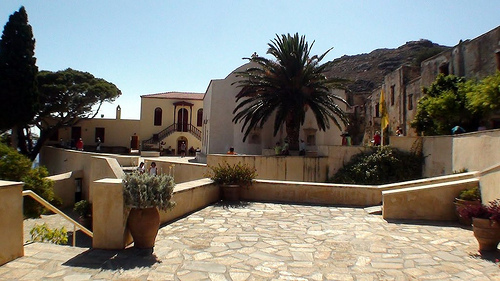
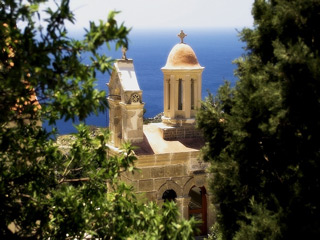
Piso Moni Preveli, today a working community of monks, occupies a rocky slope some 170 metres above the coast, and its terraces command a wide view over the Libyan Sea. Around the courtyard are ranged the cells, the abbot’s quarters, the refectory, the bakery, storerooms and the guest rooms for pilgrims. The katholikon was put up in 1835 under Abbot Neilos, who had begun renovating the monastery in 1823, on the site of an older building: a church of two aisles with a tall bell gable ending in a triangle, and two altars – the left dedicated to the Annunciation of the Panagia, the right to St John the Theologian. Inside, the carved and gilded iconostasis and the pulpit catch the eye. The complex was renovated once more in 1911.
The monastery museum holds portable icons ranging from the 16th to the 20th century, which between them trace the development of the Cretan school of painting, together with liturgical vessels, vestments, books and manuscripts. Among the 19th-century masters represented are Michail Prevelis, Merkourios and Vivilakis. The principal feasts are 8 May, the commemoration of St John the Theologian, and 14 September, the Exaltation of the Cross. The monastery generally closes over the middle of the day.
Preveli in the Second World War
After the German airborne invasion of Crete in May 1941, large numbers of British, Australian and New Zealand soldiers were left behind, cut off from the withdrawing Allied formations. The monks of Preveli and the people of the neighbouring villages hid them, shared their stores with them and led them down to the coast by night. From the beach at the mouth of the gorge – the one now known for its grove of Cretan date palms – the British submarine HMS Thrasher, a T-class boat launched only the previous November, carried them to the Middle East: on a first run at the end of July 1941 she embarked 78 men, and a second operation in August took off roughly 120 more. By the monastery’s own account, several thousand people in all found refuge and food at Preveli in the course of those months; the figure usually given is more than five thousand.
Abbot Agathangelos Lagouvardos and the men of the local resistance acted in full knowledge of what might follow; a high price was put on the abbot’s head. On 25 August 1941 German troops occupied the monastery, wrecked it and plundered it. Part of the brotherhood was arrested and taken to a camp near Chania, and the monks were not able to return until 1943. The abbot himself escaped to Egypt. In memory of the help given to the Allies, the Monument to Resistance and Peace stands above the monastery, showing an armed monk and a soldier side by side, and in the courtyard a fountain presented by Australians in 1991 keeps the story alive. The gratitude reaches to the other side of the world. One of the rescued Australians, Corporal Geoff Edwards, settled after the war near Margaret River in Western Australia and gave the place the name Prevelly; in 1979 he founded a chapel of St John there in thanks for the monks’ hospitality.
The miraculous return of the Cross
The monastery’s greatest treasure is a richly worked silver blessing cross, commissioned by Abbot Ephraim Prevelis, whose base encloses a large fragment of the True Cross; tradition holds that the relic came from Constantinople. Twice the cross was lost, and twice it came back. In August 1823 the monks carried it into the battle at Amourgelles, where it fell into Turkish hands. Genoese merchants bought it and took it aboard their ship. Off the monastery, so the story goes, the vessel lay motionless despite a fair wind – for three days, until the sailors handed the cross back to the monks and were able to continue their voyage.
The second disappearance came with the sack of the monastery at the end of August 1941. The aircraft that was to fly the cross from Maleme airfield to Germany could not get off the ground, monastic tradition relates, however often the attempt was made. The cross was then handed in to the police in Chania and brought back to Preveli on 13 September 1941 – the eve of the feast of the Exaltation of the Cross. Ever since, it has been shown in solemn procession each 14 September, and pilgrims come from all over Crete to venerate it and to pray for healing.