The most complete guide to Crete: 221 places on the map, 23 routes and 49 articles — with photos, videos and the story behind every place. No sign-up, no trackers.
Routes drawn along real roads
Weather at every stop
Full-text search
“Near me” by geolocation
Create your own printable itinerary
Satellite, terrain, dark mode
Works offline
⌕
Searches 1.7 million characters of descriptions, not just names
—places
4regions
—routes
—with video
Search results
—
Interactive map
Find what is near you
Filters narrow the map and the list at once. Zoom out and pins group together.
Region
Category
Фильтры карты
Landmarks
Featured places
RegionCategory
Routes
Ready-made day trips
Individual places
Articles about landmarks
Preveli beach and the lagoon at the mouth of the Kourtaliotis
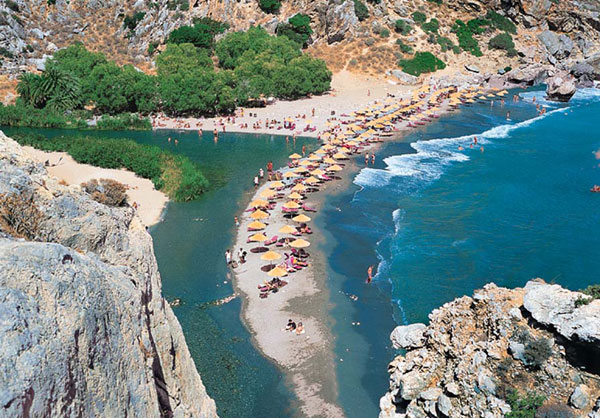
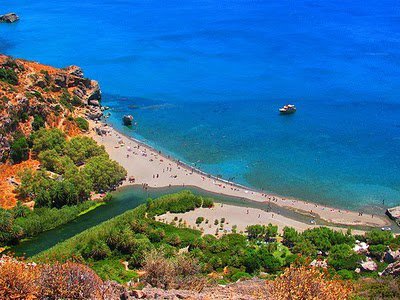
At Preveli the fresh water of the river meets the Libyan Sea. Those who come here can swim in the river lagoon and in the sea without leaving the beach – a combination hardly to be found elsewhere on the dry south coast of Crete.
Find on the map
The palm beach (Finikas) and the lagoon of Preveli
The beach of Limni Preveli lies about 35 kilometres south of Rethymno and some ten kilometres east of Plakias, in the municipality of Agios Vasileios, on the lands of Preveli Monastery between its Lower and Upper houses. The river that created it is called the Kourtaliotis in its upper course, where it breaks through the gorge of the same name between sheer walls; lower down it is known as the Megalopotamos or Megas Potamos, the “Great River”. Shortly before the sea it widens behind the strip of sand into a small lagoon with a green shimmer. Around the mouth natural freshwater pools have formed, which local people call the “little baths”. Legend, never slow to people so striking a spot, has Odysseus put in here on his way home from Troy.
The palm grove
Along both banks of the river a grove of the Cretan date palm (Phoenix theophrasti) runs back into the gorge. The species, named after the ancient naturalist Theophrastus, grows wild almost exclusively in Crete; the stand at Preveli is considered the second largest after that of Vai in the east of the island. Together with oleander, reeds and the clear, cool water it produces a landscape that suggests a North African oasis rather than a Greek coast. Anyone who wades upstream or walks along the bank arrives within a few minutes in the shady, quiet part of the gorge, where small cascades and pools follow one another.
The grove is protected as a biotope and yet vulnerable: on 22 August 2010 it was almost completely burnt in a great fire, which consumed about seventy per cent of the trees. The palms, which proved remarkably resistant, put out new fronds astonishingly quickly – the grove had largely regenerated by the following year – and after a few years hardly anything was to be seen of the damage. In the summer of 2026 a fire from the Kourtaliotis Gorge again reached the trees. All the more reason to observe what ought to go without saying here – no open fires, no cigarette ends, no litter.
Beach and sea
The beach itself consists of coarse sand and fine shingle, and the sea bed is stony in places. At the eastern end a conspicuous rock rises out of the water, its outline reminiscent of a heart or of a ship’s mast – the “lovers’ stone”, as it is sometimes called; beyond the cape small sea caves open. Even in high summer the river water is noticeably colder than the sea, so that warm and cool currents can be felt mingling at the mouth. There are no sunbeds or permanent buildings in the protected area; a simple refreshment stall supplies visitors in season. In the 1960s and 1970s the remote bay was a favourite haunt of the hippies; today it is the best-known beach on the south coast of Crete and correspondingly busy in summer – those in search of quiet come early in the morning or out of season.
Getting there
A steep path leads down from the road to the coast. The usual approach starts from a car park high above the cliffs west of the bay, shortly before the Upper Monastery: a well-made stepped path brings you to the beach in fifteen to twenty minutes and gives the finest view of river mouth, palms and sea on the way. The return in the midday heat is strenuous; water and a hat are essential. Access is easier from the east, where a road runs as far as the adjoining beach of Drymiskiano Ammoudi and a short path leads over the rocky spur in a few minutes. In season, moreover, excursion boats from Plakias and Agia Galini call at the beach.
A place of history
Peaceful as the bay seems today, it has its place in the history of the Second World War: in the summer of 1941 stragglers from the British, Australian and New Zealand forces, who had been hidden and fed by the monks of Preveli Monastery under Abbot Agathangelos Lagouvardos and by the farmers of the district, waited here for the submarines that took them to Egypt by night. The Germans sacked the Lower Monastery in reprisal. One of the Australians sheltered here, Corporal Geoff Edwards, later founded a settlement in Western Australia and named it Prevelly in gratitude, and several of the memorials at the monastery were paid for by rescued soldiers. The district has been inhabited for far longer than was once supposed – around Preveli and Plakias stone tools have been found whose age is estimated at more than a hundred thousand years. A survey in 2008 led by Thomas Strasser and Eleni Panagopoulou recorded 29 sites by caves and rock shelters along this coast and collected some 2,000 implements, mostly of quartz, among them hand axes and cleavers of Lower Palaeolithic type from deposits about 130,000 years old; one hand axe lay on the western flank of the Preveli gorge itself. As Crete has been an island throughout that time, the finds count as evidence of very early seafaring in the Mediterranean. A visit to the beach therefore combines well with one to the monastery and to the Venetian-looking arched bridge over the Megalopotamos.