The most complete guide to Crete: 221 places on the map, 23 routes and 49 articles — with photos, videos and the story behind every place. No sign-up, no trackers.
Routes drawn along real roads
Weather at every stop
Full-text search
“Near me” by geolocation
Create your own printable itinerary
Satellite, terrain, dark mode
Works offline
⌕
Searches 1.7 million characters of descriptions, not just names
—places
4regions
—routes
—with video
Search results
—
Interactive map
Find what is near you
Filters narrow the map and the list at once. Zoom out and pins group together.
Region
Category
Фильтры карты
Landmarks
Featured places
RegionCategory
Routes
Ready-made day trips
Individual places
Articles about landmarks
Eleutherna
Eleutherna (Ελεύθερνα) ranks among the most important archaeological sites in Crete. The history of the city can be traced without a break from the Geometric period in the 9th century BC, when Dorian settlers established themselves on its naturally fortified ridge, down to the early Byzantine age, and since 2016 the Museum of Ancient Eleutherna has stood right beside the excavations, showing the finds in the place where they came out of the ground.
Find on the map
Introduction
About 25 kilometres south-east of Rethymno, some 380 metres up on a narrow northern spur of Psiloritis, lay the city of Eleutherna; Arkadi Monastery is only about eight kilometres away to the south-west. Its position between the coast and the mountainous interior of the island was strategically favourable: protected by the mountains at its back yet with access to the sea to the north, whoever held this place commanded the routes linking central Crete with the north coast. Two long ridges with streams flowing round them – Pyrgi, the northern end of the hill of Prines, and Nisi to the west – carried the two nuclei of the city; today olive trees, carobs and holm oaks grow on their slopes among the remains of walls.
Ancient tradition knows several names for the place, among them Apollonia as well as Eleutherna. It is said to have taken its usual name from Eleuther, one of the Curetes, those mythical warriors who drowned the cries of the newborn Zeus with the clash of their bronze shields so that Cronus should not find the child. It remains striking, all the same, that a magnificent bronze shield should be among the most famous finds from the city.
History of the excavations
Isolated investigations and chance finds are known from earlier times – the English naval surveyor T.A.B. Spratt described the ancient bridge after a visit in 1853, and Humfry Payne of the British School dug briefly here in 1929 – but the systematic exploration of Eleutherna began in 1985 and has been in the hands of the University of Crete ever since. The work extends over several sectors of the ancient city and its necropolis, led from the outset by Petros Themelis, Thanasis Kalpaxis and Nikolaos Stampolidis; the western sector and the cemetery of Orthi Petra are associated above all with the name of Stampolidis, who has dug here for more than three decades. Scholars from Greek universities and numerous foreign institutes now take part in the project.
Architecture and historical features
The city comprised the acropoleis on the hills of Pyrgi and Nisi, fortifications with a mighty defensive tower, public buildings, quarries and large reservoirs. The tower, which gave Pyrgi its name, was kept in repair from Hellenistic to Byzantine times. Particularly impressive are the two cisterns hewn into the soft limestone below and to the west of it, on the western slope of Pyrgi, whose roof is carried by pillars of living rock left standing. The limestone for the city’s buildings was cut at a quarry at Peristere. Its position on the routes between central Crete and the north coast encouraged trade; the finds attest links with the Aegean, Asia Minor, Cyprus and Egypt, and from the 4th century BC the city struck its own coins. To describe Eleutherna solely as a nest of pirates, as is sometimes done, would therefore be a gross simplification.
Heyday and decline
Eleutherna lived through the Geometric, Archaic, Classical, Hellenistic, Roman and early Byzantine periods; traces of human presence go back as far as the late 4th millennium BC, and Late Bronze Age buildings have been found on Pyrgi. The city enjoyed its most brilliant age in the Early Iron Age, between about 900 and 500 BC. In 220 BC it helped to set off the Lyttian War by accusing the Rhodians of having murdered its leader Timarchus. In 67 BC the campaign of Quintus Caecilius Metellus, who subdued Crete for Rome, brought it under Roman control – by treachery, the story went, for traitors within are said to have soaked a brick tower with vinegar so that it could be broken down. Under the emperors houses, baths and paved streets were built; three of the houses at Katsivelos were wrecked by the great earthquake of AD 365. Later Eleutherna was the seat of a Christian bishop; the see is attested from the early 5th century.
The decline was gradual. It was connected with changes in political conditions and trade routes, and from the late 7th century also with the insecurity caused by Arab raids – attacks in the time of the caliph Harun al-Rashid and another earthquake in 796 are named as the final blows – and it cannot be put down to one single catastrophe. The inhabitants withdrew little by little to smaller settlements in the surrounding country, and the maquis closed over the ruins.
Late Geometric and Archaic tombs: Orthi Petra
On the western slope of the city hill, in the area called Orthi Petra (Ορθή Πέτρα, “standing stone”), the archaeologists came upon burials of the Late Geometric period (870–850 BC) and of the Archaic period (around 600 BC). The necropolis was left largely undisturbed by later building, since only its edges were overlaid by Hellenistic and Roman structures and the ground was otherwise never built on within the later city. For that reason the development of funerary customs and the changes in the social fabric of early Cretan society can be read here with particular clarity.
What came to light here reads like a commentary on Homer: the pyres of warriors, whose ashes were laid to rest with weapons and spoils, recall in detail the funeral of Patroclus in the Iliad. The showpieces include a richly decorated bronze shield of the 8th century BC, which now greets the visitor at the entrance to the museum, and the limestone “Kore of Eleutherna”, a good half metre high, made around 650 BC and closely related to the famous “Lady of Auxerre” in the Louvre. Great excitement was caused by a tomb containing four women of high rank who had been given costly gold jewellery; the physical anthropologist Anagnostis Agelarakis showed from their teeth that they were related through the female line, and they have been called a “dynasty of priestesses”. Vessels, jewellery and implements of clay, stone, gold, silver, bronze and iron come from Crete as well as from the Aegean, Asia Minor and Cyprus. The cemetery is now covered by a wide-spanning, curved protective roof.
The hill of Nisi
On the hill of Nisi (Lofos Nisi), the western of the two city ridges, where the modern village of Eleftherna stands, a Hellenistic residential quarter has been uncovered, together with a sanctuary enclosure entered through a Doric porch of five columns, built around 400 BC. The houses had their own installations for collecting and storing rainwater – a vivid testimony to everyday engineering skill and at the same time an indication of how carefully late Hellenistic Eleutherna was organised as a city.
Present condition and tour
The whole area is now under state protection, divided into a zone of absolute protection and a zone of controlled development, and the research of the University of Crete continues. On the hill of Pyrgi there are Hellenistic walls, the cisterns, a bridge and residential complexes to be seen. An archaeological park, the “Eleuthernian Grove”, links the widely separated excavation areas by paths, steps, resting places and bilingual information panels. Anyone who wants to see everything should bring stout footwear and plenty of time, for the paths lead over hillsides and through stream valleys; the best way in is a visit to the museum, which puts the scattered remains together into a single picture.
Christian monuments and tombs
On the eastern slope of the hill of Pyrgi, in the area called Katsivelos, a three-aisled Early Christian basilica dedicated to the Archangel Michael has been investigated. An inscription names Bishop Euphratas as its builder; its construction is placed around the middle of the 5th century, between about 420 and 450. The aisles were separated by arcades on piers, the floors adorned with mosaics in vegetal and geometric patterns, and in the sanctuary lay a pavement of coloured marble. The church rose over an older sanctuary of Hellenistic date – the holy place remained, only the cult changed. Close by are a stone-paved street and a large public building of the 2nd century BC that was reused in Roman times, and a bathhouse with two furnaces. The basilica was destroyed in the 7th century; the mosaic floors and 42 Christian burials, in tile-covered and cist graves, belong to the 5th to 7th centuries.
The village of Archea Eleftherna
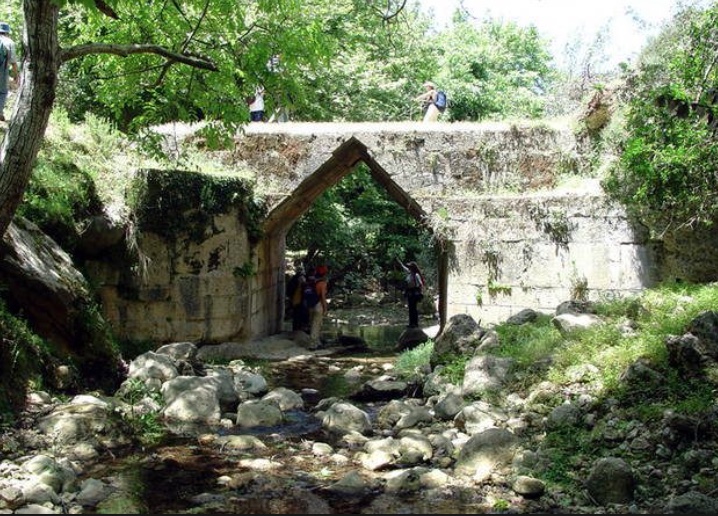
Three kilometres from the archaeological area lies the village of Archea Eleftherna (Αρχαία Ελεύθερνα), formerly Prines. Among its stone houses and gardens a Hellenistic bridge survives in a stream valley, at the meeting of the Pharangitis and Chalopota brooks north of the hill; its opening is spanned not by a true arch but by courses of stone corbelled out to a point. Built of limestone blocks without mortar, it is 9.35 metres long, about five metres wide and some four metres high, with a triangular opening 3.95 metres across. It is associated with the road network of the ancient city and probably dates from the end of the 4th or the beginning of the 3rd century BC; it can still be crossed today. A second bridge of the same kind, a few hundred metres off, was destroyed before 1893. The routes of the archaeological park run close by.
The village of Margarites
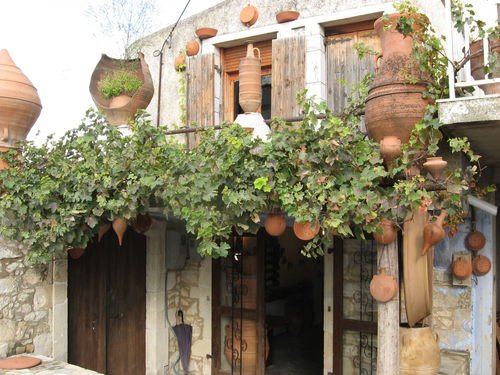
Only a few kilometres to the north lies Margarites (Μαργαρίτες), one of the traditional pottery villages of Crete and, with Thrapsano near Heraklion, one of the island’s two great centres of the craft. In the workshops along the village street jugs, bowls and the large storage jars that recall the ancient pithoi are still made today; the clay was traditionally dug in the immediate vicinity. Among the houses with their Venetian door frames stand several old churches, among them that of the Transfiguration of Christ (Metamorfosi), St John the Theologian with frescoes dated 1383, the 15th-century St John the Baptist and the Dormition of the Virgin with its fine bell tower. The village has a turbulent past: the Venetians burnt it in 1333 to punish its rebellious inhabitants, under the Ottomans it was the chief place of the province of Mylopotamos, and in 1829 the Cretan Council met here. A visit combines well with Eleutherna – and Abbot Gabriel, who defended Arkadi Monastery in 1866, also came from this village.