From Rabd al-Khandaq to Iraklio
Heraklion (Ηράκλειο, Iraklio) is a city where history does not retreat behind museum glass but lies about in the middle of everyday life. Venetian bastions enclose residential quarters loud with the horns of scooters; an Ottoman fountain house serves coffee and pastries; a building that was once a mosque is an Orthodox cathedral again. The layers of the past do not stand side by side here as in a textbook – they interlock, and it is from this that the largest city in Crete draws its peculiar appeal. The municipality counted 179,302 inhabitants at the census of 2021, and the wider urban area rather more than 200,000. The district has been lived in without a break since about 7000 BC, which makes it one of the oldest continuously inhabited corners of Europe. Anyone who knows Heraklion only as a staging post on the way to Knossos, whose palace stands on the city’s southern edge, misses one of the most many-layered towns of the eastern Mediterranean.
Introduction: the names of the city
Few Greek cities have changed their name so often. In antiquity a small settlement stood here and served as the port of Knossos, a role the anchorage had played since Early Minoan times; the geographer Strabo calls it Herakleion, and tradition linked the name with the hero Heracles. In the 9th century Arab conquerors founded a fortified town on the same spot and called it Rabd al-Khandaq, the “castle of the moat”, after the deep ditch that ran round its walls. The Byzantines Hellenised this to Chandax (Χάνδαξ) or Chandakas, and the Venetians turned it into Candia. The Italian form soon passed to the island as a whole: in the documents of the Serenissima, Crete is for centuries simply the Regno di Candia, the Kingdom of Candia, and the same word travelled into French as Candie and into English as Candy. The Ottomans, in their turn, said Kandiye. Among the Greeks themselves a popular name held its ground alongside all of these – Megalo Kastro, the “Great Castle”. Only in the 19th century did the ancient name Iraklio return in written modern Greek; it was in local use by 1867, was taken up in the years after 1898 when the town lay in the British zone of the autonomous Cretan State, and has been the official form since the union of Crete with Greece in 1913.
Background: the Siege of Candia
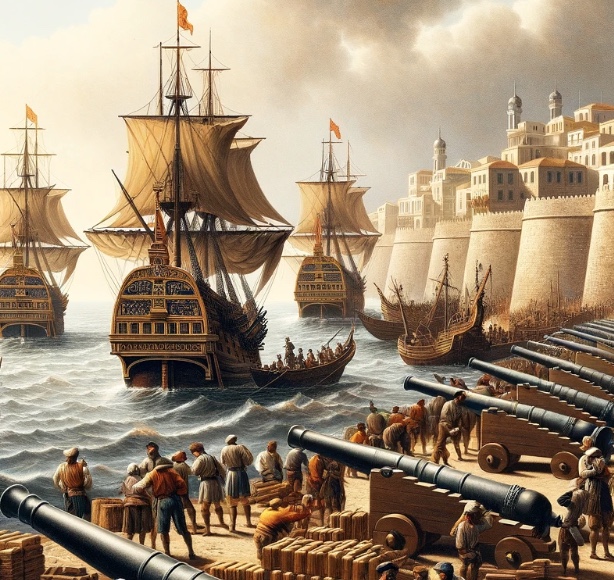
The Siege of Candia lasted from 1 May 1648 to 27 September 1669, a little over twenty-one years, and ranks among the longest sieges in European history; at the time it was the longest on record. For more than two decades the Venetian fortress held out against the Ottoman armies, until the supplies, the men and finally the money of the Republic were exhausted. The Venetians capitulated only when all hope of relief had gone, yet the terms of surrender were remarkably favourable for the period: the garrison was allowed to march out with the honours of war, Venice paid neither indemnity nor tribute, and the defenders took with them part of the city’s sacred treasures and its archives. That explains two things the visitor notices today. Heraklion has kept buildings from the most varied regimes, which have survived a great deal; but many relics, icons and documents of the Venetian period are still far from Crete, above all in Venice.
The hill on which the centre of Heraklion now stands has been settled since at least the 1st millennium BC. Greeks and Romans knew the place as Herakleion, a modest harbour in the shadow of great Knossos and later of Gortyn, the capital of the Roman province. It became important only in the Middle Ages. In 823 the then Byzantine settlement fell to Arab conquerors, who within a year or so were raising their first defences here, a wall of unbaked brick inside a ditch. And with that the real history of the city begins.
The history of Heraklion
Background: the Church of St Titus
After Nikephoros Phokas had won Crete back for Byzantium in 961, the seat of the Cretan Church was moved from ruined Gortyn to Chandax. Here a church was built in honour of the Apostle Titus, disciple of St Paul and first bishop of the island. Under Venetian rule the building became the church of the Latin archbishop; the Ottomans turned it into a mosque. After the severe earthquake of 12 October 1856, which left only eighteen of the town’s 3,600 or so houses undamaged and killed 538 people, the building rose again from its foundations; in 1925 it became an Orthodox place of worship once more, and in 1966 the venerable skull of the Apostle Titus came back to Heraklion from Venice.
Arab Chandax and the Byzantine reconquest
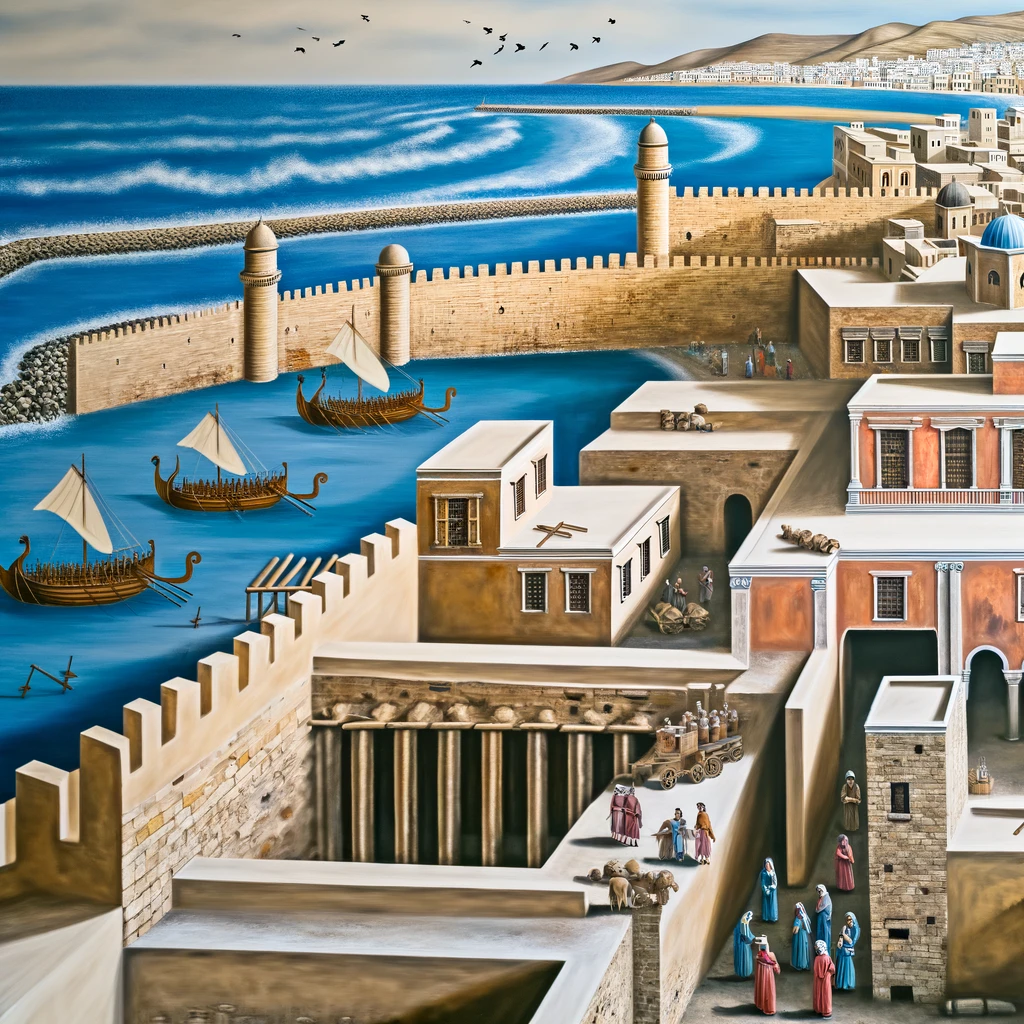
The conquerors were Arabs from Andalusia. They were the survivors of a failed rising against the emir al-Hakam I in 818, centred on the suburb of Córdoba called al-Rabad, and had reached Crete by way of Alexandria, which they had held until Abbasid forces expelled them. Their leader, Abu Hafs Umar, is said to have sailed with forty ships and some 12,000 people, of whom about 3,000 were fighting men. They made the settlement the capital of the island – the Emirate of Crete, which was to last about 135 years – and developed it into a fortified harbour from which their fleets raided the Aegean. In these decades Chandax became a dreaded market, where captives from the coastlands of the Byzantine Empire were among the goods sold. The Arabs called the town Rabd al-Khandaq, the “castle of the moat”, and surrounded it with strong walls and a deep ditch.
Several Byzantine attempts at reconquest failed. One early commander, Krateros, was captured and crucified; an expedition under Theoktistos in 842–843 occupied much of the island for a time and then withdrew. Only in 961 did the general and future emperor Nikephoros Phokas succeed. He landed in the summer of 960, kept up a long and costly siege through the winter and stormed the city on 6 March 961; the inhabitants were put to the sword, the town was sacked and burnt, and the last emir, Abd al-Aziz ibn Shuayb, was carried off to Constantinople. Crete was once more part of the empire and would remain Byzantine for the next 243 years. Phokas then tried to move the island’s capital to Temenos, a newly laid-out hill fortress in the hinterland that seemed better protected against attack from the sea. The plan foundered on geography and on the habits of the inhabitants: Chandax, with its harbour, kept its rank as capital, and new Byzantine walls went up on the line of the Arab ones.
Candia under Venetian rule
When Constantinople fell to the Crusaders in 1204, the Byzantine Empire was carved up. Crete went first to Boniface of Montferrat, who sold his claim to Venice; after fighting with the Genoese the Republic prevailed for good around 1210. Candia, as the town was now called, became the seat of the Venetian Duca di Candia and capital of the whole Regno, and from 1212 families from the mother city were settled on the island as colonists. A new chapter opened: the Venetians gave the town new walls and adorned it with palaces, fountains, loggias and churches – the Dominican church of St Peter, built between 1248 and 1253, is among the earliest that survive. Trade and crafts flourished, and gradually an educated upper class emerged, Greek as well as Venetian. Schools were founded from the 14th century onwards, and towards the end of the 16th the learned Accademia degli Stravaganti came into being, around 1590–91.
The 16th and 17th centuries brought a unique fusion of Greek and Italian culture that has gone down in history as the Cretan Renaissance. It shows most plainly in painting. The Cretan School of icon painters combined the Byzantine pictorial tradition with the achievements of Western art – perspective, spatial depth, animated groups of figures. Its great masters include Theophanis Strelitzas, known as Theophanes the Cretan, whose first dated work is of 1527 and who made his career as a wall painter on the mainland; Michail Damaskinos, who spent some three years in Venice and then came home for the rest of his life; and Domenikos Theotokopoulos, born in Candia about 1541. He is recorded as a master painter in the town in 1563, at the age of twenty-two, left for Venice a few years later and never came back; the world knows him as El Greco.
The Cretan Renaissance reached its height, however, in the literature of the late 16th and early 17th centuries. For the first time it became clear what the spoken Greek language could do in poetry of the highest ambition. Among the pioneers were Georgios Chortatzis, author of the tragedy Erofili; Vitsentzos Kornaros, to whom the verse romance Erotokritos is attributed – it is still recited by heart and sung in Crete today; and Marcantonio Foscolo, a native of Candia, who wrote the comedy Fortounatos.
The age left its mark on architecture too. The teachings of the great Renaissance masters of the West, such as Sebastiano Serlio and Andrea Palladio, found an echo in Crete, where building reached its peak in the first half of the 17th century, in the passage from High Renaissance to Baroque. Particular care went into the fortifications of Candia. Work on a new circuit began in 1462 and went on for more than a century, and it was to designs by the celebrated military architect Michele Sanmicheli, later revised by Giulio Savorgnan, that the defences were adapted to the demands of gunpowder artillery. The result was the huge ring of walls with its seven bastions on the landward side – St Andrew, Pantokrator, Bethlehem, Martinengo, Jesus, Vitturi and Sabbionara – in places as much as forty metres thick, fronted by a deep ditch and pierced by four main gates and three military ones, of which two main gates stand intact. It still encloses the old town and is among the most impressive fortresses of the Mediterranean; the damage done by German bombing in 1941 has been made good.
Two decades of siege and the long road to the present
The Ottomans landed in the west of the island in 1645 and took Chania; in the summer of 1647 they brought heavy siege guns up to Candia and began to dig entrenchments – the prelude to the great siege, which opened in earnest in May 1648 under Gazi Hüseyin Pasha. The city withstood countless assaults and proved impregnable, but it was completely cut off by land and could be supplied only by sea. In 1660 Louis XIV and the Duke of Savoy sent substantial help, a force of 4,000 foot and 200 horse under Prince Almerigo d’Este, who withdrew that September and died on Paros on the way home. In 1667 Venice sent Francesco Morosini to Candia as commander-in-chief, at a moment when the garrison stood at its peak of about 11,000 men and the grand vizier Köprülü Fazıl Ahmed had taken charge of the besiegers in person; further reinforcements from the French king followed in 1668 and 1669. The last of them, more than 6,000 men under the Duke of Beaufort, arrived in June 1669; Beaufort was killed within days, and on 21 August the Duke of Navailles took most of the French home. Despite heroic efforts the city fell in September 1669 after more than twenty years of siege and with appalling loss of life on both sides: the last twenty-two months alone are reckoned to have cost some 70,000 Ottoman dead, 38,000 Cretans and slaves, and 29,088 of the Christian defenders. Morosini, left with 3,754 soldiers fit to march, managed to negotiate with the Ottomans a safe withdrawal for his troops, along with some 4,000 civilians, and the removal of the city’s historic archive.
After the devastating siege Candia decayed and its population shrank drastically. The harbour silted up, shipping moved to Chania, and in 1849 the seat of government followed. A modest recovery began in the 18th century, but the earthquake of 1856 destroyed most of the buildings. The town suffered a further catastrophe in August 1898. When the British, acting for the protecting powers of Crete, set about enforcing the handover of the customs house in the harbour, a massacre of the Christian population broke out on 25 August – 6 September by the modern calendar. It lasted more than four hours. Between 500 and 800 Christians were killed, together with fourteen British servicemen, most of them from a detachment of the Highland Light Infantry, and the British vice-consul, Lysimachos Kalokairinos, who died with his family in his burning house; large parts of the town went up in flames. The violence, directed at the defenceless and at the city itself, horrified international opinion and proved the turning point: the ringleaders were hanged on the walls, and the Great Powers forced the Ottoman troops to leave the island, the last of them embarking that November. The main street from the harbour up to the old town is still called Odos 25is Avgoustou, 25 August Street, in memory of the dead.
From then on Heraklion grew fast and spread beyond the old walls. After the Asia Minor Catastrophe of 1922 and the exchange of populations, large numbers of refugees from Asia Minor came to the town and gave it a new and unmistakable character; the new harbour, built by the British firm of Sir Robert McAlpine, was completed in 1928. The bombing of May 1941, during the German invasion, did severe damage, and the occupation lasted until 1945. Since 1971 Heraklion has again been the capital of the island, in place of Chania, and its economic and administrative centre. The University of Crete and the Foundation for Research and Technology (FORTH, in Greek ITE) are both based here and do much to shape the modern city.
The Koules fortress
The Venetians’ labour of Sisyphus
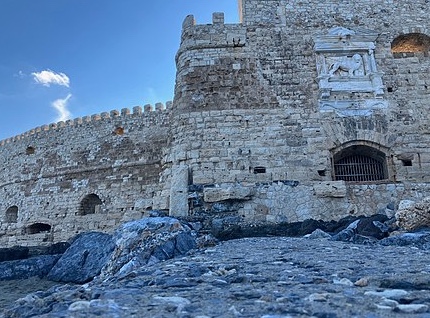
A harbour grew up in the sheltered bay of Heraklion as early as antiquity. Its northern limit was a chain of rocks and reefs, as though nature herself had raised a rampart here against storms and enemy attack. The Arabs were the first to recognise the value of the position and fortified it in the 9th or 10th century, though not yet on any great scale. The Venetians, who took control of the island around 1210, finally crowned the rocks with a substantial fortress meant to hold off the next conquerors – the Ottomans. An older round tower on the spot, a Byzantine work known to the Venetians as the Castellum Comunis, had been badly damaged in the great earthquake of 1303 and patched up; in 1429 Cristoforo Buondelmonti drew a square tower here, and in 1486 a further work was added. The major rebuilding that produced the present fortress began in 1523, when the old tower was pulled down. The Venetians called their building the Rocca a Mare or Castello a Mare, the “sea castle”; the modern Greek name Koules comes from the Turkish Su Kulesi, “water tower”.
Who designed it is not known; either Antonio Saracini or Giovanni da Como is thought to have been behind the plans. Building began with a formidable undertaking, the laying of an underwater foundation, and for this the Venetians used a curious method. They filled worn-out ships and boats with stone and sank them on the spot; the material, huge blocks and rubble alike, was brought over from the offshore island of Dia and from the Fraskia district. By November 1530 the foundation went sixteen metres down. Three weeks after work on the walls had started, Alessandro Contarini was already reporting considerable progress on the outer walls and announcing that work on the interior was about to begin. The stone throughout is local limestone.
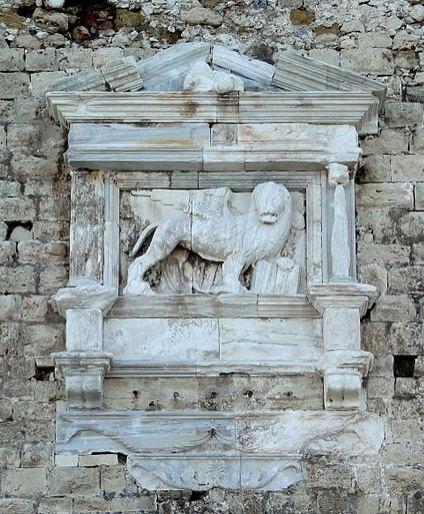
In the winter months building stopped because of the weather. In 1533 a monumental relief of the Lion of St Mark, the emblem of the Republic of Venice, was set above the entrance. Three such marble reliefs of the winged lion survive on the fortress in all, one on each of the faces that had a gate, the best seen being the one on the seaward north wall – mute witnesses to Venice’s claim to rule.
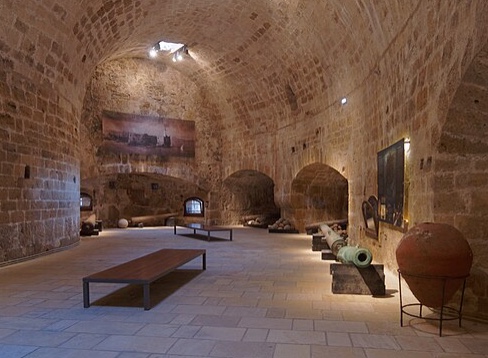
By 1539 a commemorative tablet had been fixed above the stair to the upper level to record the completion of the works; the building was finally finished in 1540. The fortress covers some 3,600 square metres and consists of a tall rectangular block with a pronounced, slightly lower, half-rounded projection on the north-east side. Its outer walls are up to 8.70 metres thick at the base. There are two storeys and twenty-six rooms in all. On the ground floor lie vaulted chambers with large openings for light and air, gun rooms with embrasures, a cistern, a prison, and magazines for provisions and ammunition. A mill and a bakery supplied the garrison, and there were also a chapel, quarters for the men and lodgings for the officers. In 1630 the armament was listed as eighteen cannon on the ground floor and twenty-five on the upper platform. On the roof terrace, the former parade ground, a lighthouse stood at the northern end; the tower seen there now goes back to the years of Egyptian rule between 1830 and 1840.
Over the years the fortress needed constant repair because the surf battered it. The Venetians tirelessly reinforced the north-west side in particular with fresh boulders and breakwaters against erosion. In 1552 part of the mole that protected the castle from storms collapsed. On top of that came the silting of the harbour. Gianmatteo Bembo proposed rebuilding the fortress and extending it north-eastwards towards the shoals. By September 1556 the restoration of the mole was almost complete; its base consisted of blocks weighing eight to ten tonnes each, held together with metal clamps. Yet only two years later the structure was damaged again.
In 1566 Giulio Savorgnan – the engineer who also worked on the town walls – suggested giving the outer walls a batter, so that they would stand up better to the winter seas. In 1570, during work on the roof, a breach opened in the mole that could no longer be closed. Until the end of the 16th century proposal after proposal was put forward for protecting the fortress from the elements, but the mole was almost wholly destroyed, the walls were cracked, and the foundations were so undermined that sea water was getting into the freshwater cistern. Venice voted considerable sums for the repairs – a true labour of Sisyphus.
For all the cost of its upkeep, the fortress played only a minor part in the Ottoman siege of Candia. Towards the end of the siege the Ottomans managed to silence its guns with the heaviest artillery, which they had placed in the Tripiti area, and with siege engines at the Sabbionara bastion, the easternmost of the seven, and so gained control of the harbour. After years of siege the city was handed over to the Ottomans on 27 September 1669; the Venetians had negotiated acceptable terms for their own departure.
The Ottoman period
Ottoman rule over the fortress began with making good the damage done by the artillery. Within the walls the new masters built a mosque, attributed to Kaplan Mustafa Pasha, and gave the parapet of the roof terrace its battlements and some additional embrasures. On the landward side they later put up a second, smaller fort, the so-called Little Koules, which was pulled down in 1936. The Ottoman traveller Evliya Çelebi described the building as Su Kalesi or Su Kulesi, the sea fortress, and noted that repairs were still going on years after the fall of Candia in 1669. A partial collapse of the walls in 1719 was quickly put right; together with other improvements in the harbour the bill came to 5,000 kuruş. At times the fortress served as a prison. The travellers Bonval and Dumas, who visited towards the end of the 18th century, reported its neglected state and two rows of cannon. In the end the fortress could not help the Ottomans to hold the island either. After a series of Cretan uprisings and the intervention of the Great Powers in the late 19th century they had to give up Koules – and, like the Venetians before them, negotiated honourable terms for their withdrawal. The age of the modern Greek state began, and in it too the stability of the old masonry was soon causing concern: between 1922 and 1937 an industrial railway even ran from Koules along the shore to the quarries at Xiropotamos to serve the building of the new harbour.
The present day
Restoration began in 1959; later it was coordinated by specialists of the Archaeological Service and included the renewal of the Ottoman parts of the defences and the removal of more recent additions – the lighthouse on the roof, which had been propped up on concrete pillars in 1930, wrecked in the Second World War and rebuilt, went out of service in 1960 and was afterwards freed of its pillars. From 1972 to 1975 the fortress was converted into a museum complex: parts of the defensive works were reconstructed, a promenade was laid out and the surroundings were planted. In 2000 the walls damaged by winter storms were made safe, and a further thorough restoration followed in the 2010s. Today Koules, the property of the Ministry of Culture, is open again and counts among the best-known landmarks in Greece. Exhibitions are held in the vaulted halls, concerts and plays are staged on the roof terrace in summer, and from the top the view takes in the Venetian harbour, the city and, on clear days, the island of Dia. The ramps and the old paving are worn smooth, so shoes with a grip are wise. A walk along the long mole to the little lighthouse at its end is, especially in the evening, one of the most agreeable things Heraklion has to offer, though it is no place to be when a northerly is throwing spray over the breakwater.
The Church of St Titus: Orthodox cathedral, Latin church and mosque
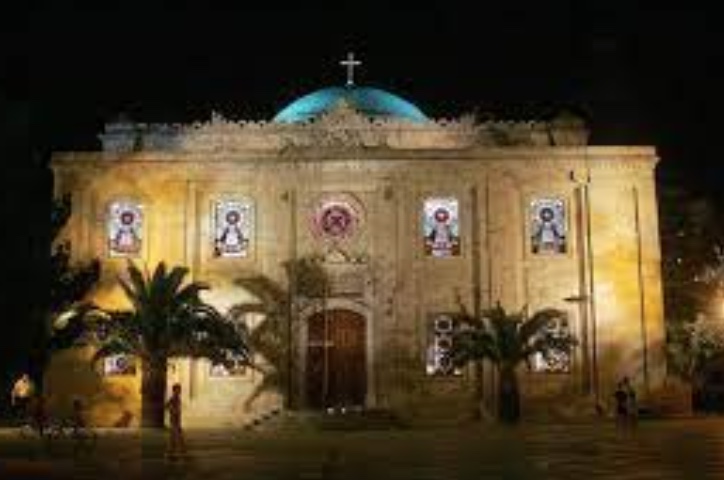
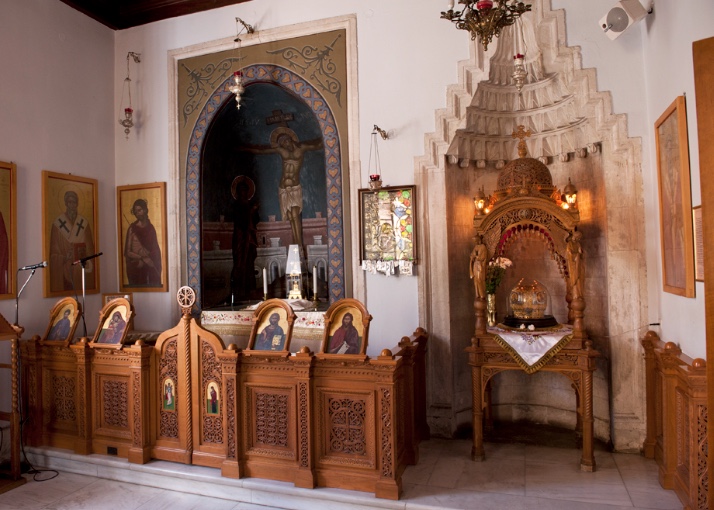
In the history of Crete, marked as it is by changes of era and blows of fate, the Church of St Titus (Agios Titos) stands as a monument to an unbroken faith. Its predecessor was the episcopal church at ancient Gortyn, which perished through an earthquake and the Arab conquest. The first church of St Titus in Chandax was built in 961, after the Byzantine reconquest, when the metropolitan see was transferred to the town, and was dedicated to the apostle who had established the Christian faith on the island. The originally modest, single-aisled church became the repository of important relics: the skull of the apostle was kept here, and so was the icon of the Mother of God known as the Mesopantitissa, venerated as miracle-working.
With the arrival of the Venetian conquerors around 1210 the church underwent its first transformation: it became the seat of the Latin archbishop of Crete and thus the principal church of Catholic Candia. From then on it witnessed countless turns of history. The Byzantine building did not survive into the mid-15th century; in its place rose a three-aisled basilica, consecrated on 3 January 1446 by the archbishop Fantino Dandolo. That church was shaken by the earthquake of 1508 and burnt out on 3 April 1544, and was put up again in 1557 on the same basilican plan. When the Venetians left the city in 1669 they took the skull of Titus and the icon with them to Venice. The centuries of Ottoman rule brought a further break: the church was made over to the grand vizier Köprülü Fazıl Ahmed Pasha, the conqueror of Candia, and turned into a mosque that became known as the Vezir Camii, the Vizier’s Mosque.
The pitiless earthquake of 1856 left nothing of the former splendour but rubble. On the ruins a new mosque – the Yeni Cami, or New Mosque – was begun in 1869 to plans by the architect Athanasios Mousis, the same man who designed the cathedral of St Minas. This is the building that stands today, and its ground plan, with the great dome, makes no secret of its Ottoman origin. Yet this building too was to return to the original purpose of the site. After the union of Crete with Greece and the departure of the Muslim population in the exchange of populations, the minaret was taken down, and on 3 May 1925 the building was consecrated for Orthodox worship. On 15 May 1966 the skull of the Apostle Titus came back to Heraklion from Venice; it has rested ever since in a small chapel to the left of the narthex, in a costly reliquary. The church was renovated between 1974 and 1988.
The transformations of St Titus, its restorations and repairs over the centuries, have only strengthened its standing as the spiritual centre of the islanders. In 2013 its historical and religious rank was crowned when Archbishop Irenaios raised it to the status of a cathedral of the Archdiocese of Crete.
The feast of St Titus is kept with great solemnity every year on 25 August, with a procession of the relic through the streets of the old town. The church stands on a small, tree-shaded square beside 25 August Street, only a few steps from the Loggia, and invites a quiet visit between services as well.
A walk through the old town
The Venetian Loggia
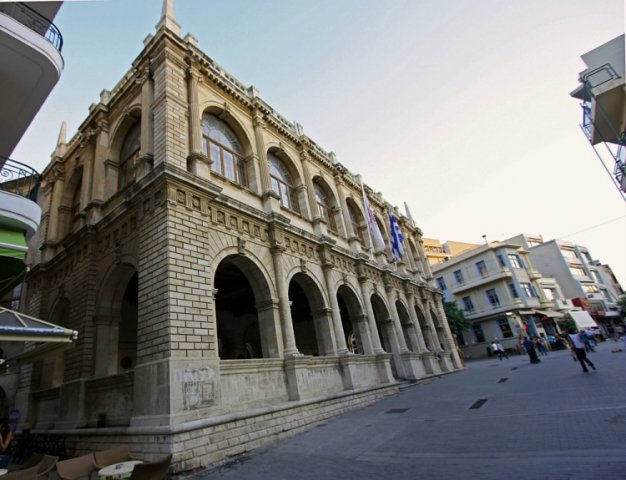
From the old Venetian harbour, 25 August Street climbs into the old town, where the elegant arcaded Venetian Loggia rises, a building in the Palladian manner. It was put up between 1626 and 1628 by the provveditore generale Francesco Morosini. This was already the fourth loggia the Venetians built in Candia. The first had stood by the sea and suffered from the winter storms; the second, approved by Venice in 1325, was set further inland; the third, of 1541, stood on this very spot but was smaller, and Morosini had it pulled down. The Loggia was the meeting place of the Venetian nobility and the feudal lords, who deliberated here on matters of trade and finance and passed sociable hours at the same time; from its balcony heralds proclaimed decrees, and processions were watched.
The rectangular, two-storeyed building is modelled on Palladio’s Basilica in Vicenza: on the open ground floor Doric columns carry the arches, on the upper floor Ionic ones, and the frieze is decorated with triglyphs and metopes carved in relief. Morosini extended the scheme eastwards and added at the back the Armeria, the armoury. In the course of its history the Loggia suffered severe damage. In Ottoman times it was the office of the defterdar, the chief financial official, and housed the treasury of Crete; in 1905 it was handed to the municipality for use as a town hall, but at the beginning of the 20th century it was declared unsafe and partly dismantled. Rebuilding started in 1915 under the Venetian engineer Ongaro, was broken off by the war in 1940 – when bombs hit the fabric – and was resumed afterwards. The Loggia was reconstructed in full, using all the surviving parts, its arcades and its sculptural ornament. Today it is the seat of the city administration and the municipal council sits on the upper floor; in 1987 it received the first prize of Europa Nostra as one of the best-restored historic monuments in Europe.
On the square stands the Basilica
of St Mark (Agios Markos)
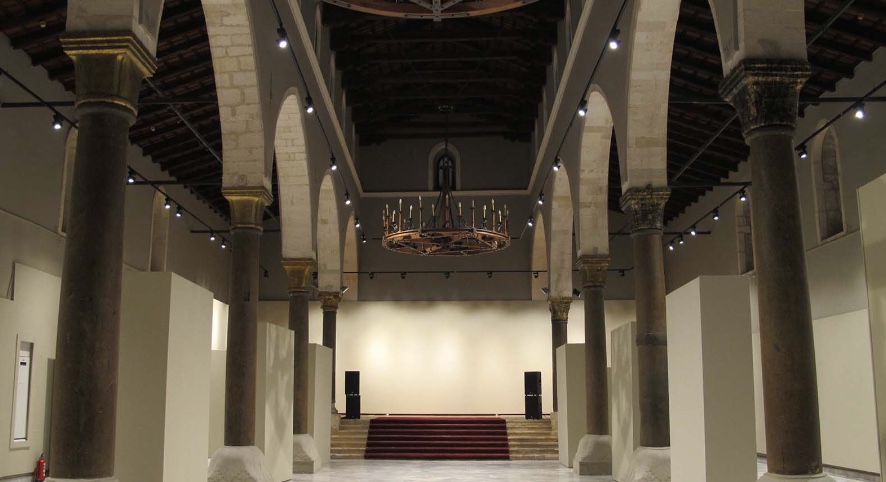
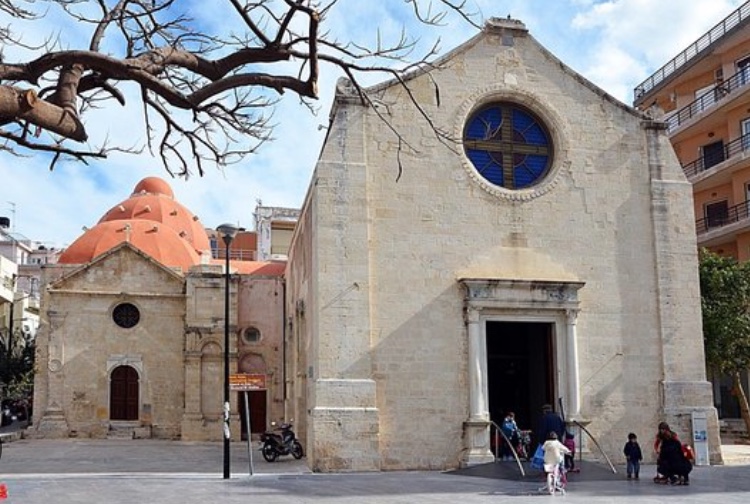
– one of the characteristic monuments of Heraklion. It was built in 1239, in the first decades of Venetian rule, as a statement that the Republic meant to stay, and was the principal church of the Venetians, where the Duke of Candia and the dignitaries of the Republic held their state services and where the nobility were buried; its tall bell tower, which carried a clock and stood at the south-west corner, was modelled on the campanile of San Marco in Venice. Earthquakes – the great one of about 1303 was especially severe – partly destroyed it; it was rebuilt in 1508. The church is a basilica with a portico on six columns; outside it shows Renaissance elements, inside Gothic features. In Ottoman times it was converted into a mosque and named after the defterdar Ahmed Pasha; the bell tower was demolished and a minaret raised in its place, which the townspeople in turn pulled down after liberation. The Society of Cretan Historical Studies restored the building to its original form in 1956, and it now serves as the municipal art gallery and exhibition hall, where works by Greek and Cretan artists are regularly shown.
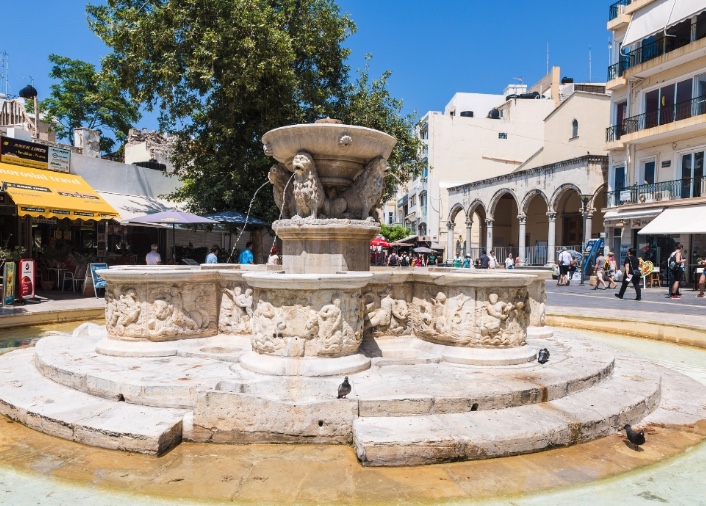
Opposite, in the heart of the square – officially Plateia Eleftheriou Venizelou, and in Venetian times the Piazza delle Biade, the grain market, overlooked by the ducal palace – plays the Morosini Fountain, which locals call simply Ta Liontaria, “the Lions”. Francesco Morosini had it inaugurated on 25 April 1628, the feast of St Mark, after fourteen months’ work, as the terminus of an aqueduct some fifteen kilometres long that for the first time brought plentiful spring water from Mount Juktas near Archanes into the middle of the town, the fall in height alone driving the flow – about a thousand barrels a day. Four lions on an octagonal pedestal carry the marble bowl, and the eight-lobed basin, with reliefs from the world of marine myth – tritons, nymphs and dolphins – was laid out so that up to forty people could draw water at once, five to a lobe. A colossal marble Poseidon that once crowned the whole has been lost. In 1847 the Ottomans added marble columns and an inscription renaming it the fountain of Abdülmecid; the municipal council stripped these away in 1900. Today the square is the liveliest meeting place in the city, busy at every hour and ringed by cafés and pastry shops, where one should try the Cretan speciality bougatsa.
1866 Street leads to the square
of Vitsentzos Kornaros (Plateia Kornarou)
. Odos 1866, named after the year of the great Cretan uprising, is the traditional market street of Heraklion: among stalls of herbs, honey, olives, cheese and raki a colourful crush prevails from the morning until early afternoon, and the morning is the time to come. At its end Kornaros Square opens out, named after the poet of the Erotokritos; a modern sculpture recalls the lovers Erotokritos and Aretousa. Here too stands the fountain
Bembo
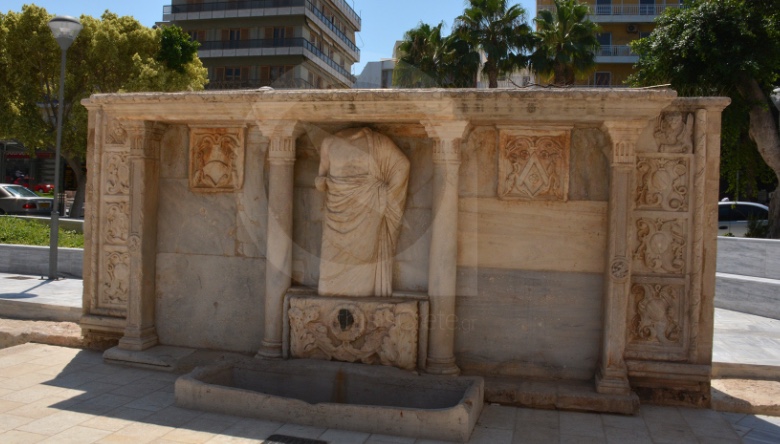
, named after its builder, the Venetian captain Gianmatteo Bembo – the same official who concerned himself with the sea fortress – who was the first to pipe running drinking water into the town by aqueduct. It is the oldest of the city’s Venetian fountains. To make it he used fragments of a Roman sarcophagus and a headless Roman statue that had been brought from Ierapetra. Two columns flank the niche, and above are displayed the arms of Bembo, of the duke Alvise Gritti and of his counsellors; Renaissance elements mingle with Gothic ones. It was built in the years 1552 to 1554. Right beside it stands an Ottoman sebil, a small domed fountain house put up after 1669 and endowed by Hadji Ibrahim Aga. According to tradition he meant to have snow brought down from Psiloritis in summer so as to offer the inhabitants cool drinking water; today the building houses a small café.
The Cathedral of St Minas
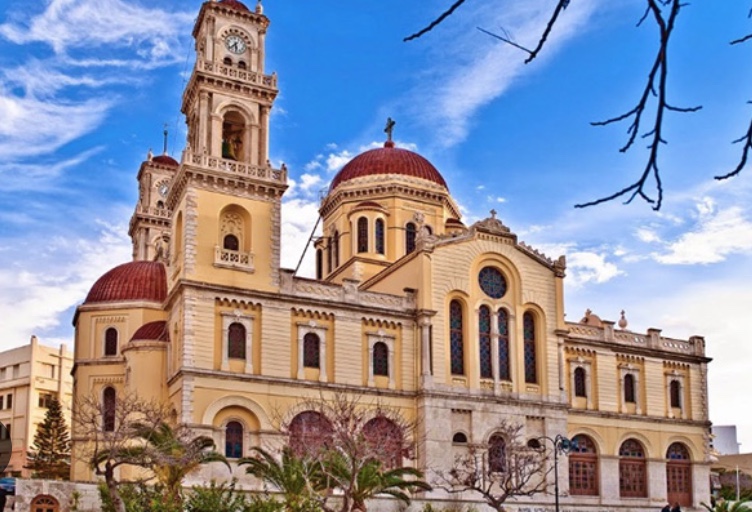
On St Catherine’s Square (Plateia Agias Aikaterinis) rises the Cathedral of St Minas (Agios Minas), dedicated to the martyr who is patron saint of the city. The old, small church of St Minas, built in 1735 and still standing alongside – “little Agios Minas” to the locals – was no longer adequate for the growing Christian community, and so in 1862 the foundation stone of a new building was laid, to plans by Athanasios Mousis. The uprising of 1866–69 interrupted the work, which was not resumed until 1883 and was completed in 1895. It is the largest church in Crete and one of the largest in Greece: 43.2 metres long and 29.5 metres wide, with some 1,350 square metres of floor. In the architecture of the cathedral, motifs from the traditional church buildings of Crete are deliberately combined with elements of the Renaissance, of Neoclassicism and of the Orient: a cross-in-square church with a dome on a high drum is joined to features of a three-aisled basilica, and two bell towers stand at the corners. The right-hand aisle is dedicated to St Titus, the left to the Ten Martyrs of Crete. The marble iconostasis and bishop’s throne, made to designs by the architect Anastasios Orlandos, and the wall paintings in a strict Byzantine style by Stefanos Kartakis, with Christ Pantokrator in the dome, came later.
According to local tradition St Minas, a soldier saint, appeared several times as a rider on a white horse to protect the Christians of the town in times of persecution – which is why the people of Heraklion affectionately call him the “horseman of the Great Castle”. His feast on 11 November is a public holiday in the city, with a procession and a festal liturgy.
The Church of St Catherine
Immediately beside the cathedral, to its north-east, stands the Church of St Catherine (Agia Aikaterini ton Sinaiton). The foundation goes back to the second Byzantine period; the church was built in its present form – a basilica with a transept, with the chapel of the Holy Ten on its north side – in the 16th century, in 1555, and was the katholikon of a metochion, a dependency of St Catherine’s Monastery on Mount Sinai, to whose monks it belonged. From the 15th to the 17th century the monastery was an intellectual and artistic centre of Candia. Its school taught grammar, logic, rhetoric, mathematics, painting and music; its pupils included the later patriarchs Kyrillos Loukaris and Meletios Pigas, and according to a widespread but undocumented belief Michail Damaskinos and the young El Greco also studied here. In Ottoman times, from 1669 to 1922, the church was a mosque bearing the name of a pasha, Zulfikar Ali; in 1924 the Archbishopric of Sinai made it over to the Archbishop of Crete.
The icons of Michail Damaskinos
Today the graceful church is a museum of Christian art in the care of the Archdiocese of Crete, founded by Archbishop Eugenios. Its most precious possession is a group of six icons by the great Cretan painter Michail Damaskinos: The Burning Bush, The Divine Liturgy, Noli me tangere, The Adoration of the Magi, The Last Supper and The First Ecumenical Council. In them Byzantine austerity and Venetian colour are combined to perfection. The museum also shows liturgical vessels and altar furnishings, manuscripts and printed books, vestments, later icons of the 18th and 19th centuries, and 14th-century frescoes detached from churches around the island – a concentrated survey of the Cretan Renaissance in the space of a few square metres. The building is accessible to visitors with disabilities.
North of Freedom Square
On the eastern edge of the old town the spacious Freedom Square (Plateia Eleftherias) opens out, one of the city’s great meeting places. On its north side lies the Heraklion Archaeological Museum, which holds the most important collection of Minoan art in the world – from the Phaistos Disc to the frescoes from Knossos, by way of the snake goddesses, the bull’s-head rhyton, the Harvester Vase and the Agia Triada sarcophagus – and may be regarded as the crowning conclusion of any tour of the city. The collection began in 1883; the present modernist building, by the architect Patroklos Karantinos, was put up between 1937 and 1940 on the site of the Catholic monastery of St Francis, destroyed in the earthquake of 1856, and reopened in May 2013 after seven years of renovation. Anyone with energy left can then follow the Venetian walls south to the Martinengo bastion, the highest point of the circuit, where Nikos Kazantzakis lies buried. Born in the town in 1883, he died at Freiburg im Breisgau on 26 October 1957, and his grave looks out to the mountains and the sea. On the plain tombstone stand the famous words: “I hope for nothing. I fear nothing. I am free.”