Gortyn: the ancient city, its law code and the Basilica of St Titus
The most complete guide to Crete: 221 places on the map, 23 routes and 49 articles — with photos, videos and the story behind every place. No sign-up, no trackers.
Routes drawn along real roads
Weather at every stop
Full-text search
“Near me” by geolocation
Create your own printable itinerary
Satellite, terrain, dark mode
Works offline
⌕
Searches 1.7 million characters of descriptions, not just names
—places
4regions
—routes
—with video
Search results
—
Interactive map
Find what is near you
Filters narrow the map and the list at once. Zoom out and pins group together.
Region
Category
Фильтры карты
Landmarks
Featured places
RegionCategory
Routes
Ready-made day trips
Individual places
Articles about landmarks
Gortyn – the city of Sarpedon and St Titus
Anyone driving to Phaistos should stop at Gortyn; anyone bound for Gortyn should not leave out Phaistos. And even travellers with no business in the south at all ought to see Gortyn once. Hardly anywhere else on Crete brings myth, legal history, Roman power and early Christianity together in so small a compass. The ruins lie about 45 kilometres south of Heraklion in the fertile Messara Plain, south of the Psiloritis massif and not far from the Libyan Sea, on both sides of the road to Mires. They are spread between the villages of Agii Deka (Άγιοι Δέκα), Mitropoli (Μητρόπολη) and Ambelouzos (Αμπελούζος), parts of which stand directly on the ancient city; in Agii Deka in particular a good many houses incorporate blocks and column drums taken from the ruins. By car the journey from Heraklion takes around 50 minutes.
Where it is on the map
The fenced main area, with the Odeon, the church of St Titus and the plane tree, lies north of the main road; the ticket office, car park, a small café and lavatories are here too. South of the road, scattered among olive groves, is the Roman lower town with the Praetorium, the sanctuary of Pythian Apollo – some 600 metres from the agora – and the temple of the Egyptian gods, where cult statues of Isis, Serapis and Anubis were found. Opening times follow the season – in summer usually into the evening, in winter only until early afternoon; admission charges and hours are best checked on the website of the Greek Ministry of Culture before setting out. The plain is hot: the mean July temperature here is about 28.5°C, so in high summer an early start or a late-afternoon visit is the sensible choice.
Overview: an introduction
The sections that follow first give a brief survey of the main themes – the size of the city, its celebrated law, the Basilica of St Titus and what the visitor actually sees today. After that come fuller accounts of myth and history, of the church of Titus and of the life of the apostle himself.
The historical scale of Gortyn
In its early prime Gortyn covered some 4,000 stremmata – the stremma being the old Greek unit of area, roughly 1,000 square metres – and took in an acropolis, public buildings, sanctuaries, residential quarters and cemeteries. Its greatest prosperity as an independent state came in the Hellenistic period, when it grew into one of the largest cities on Crete and outstripped its old rival Phaistos. After the Roman conquest it became capital of the province of Creta et Cyrenaica, which joined Crete to the coast of what is now eastern Libya.
The Great Inscription and the law of Gortyn
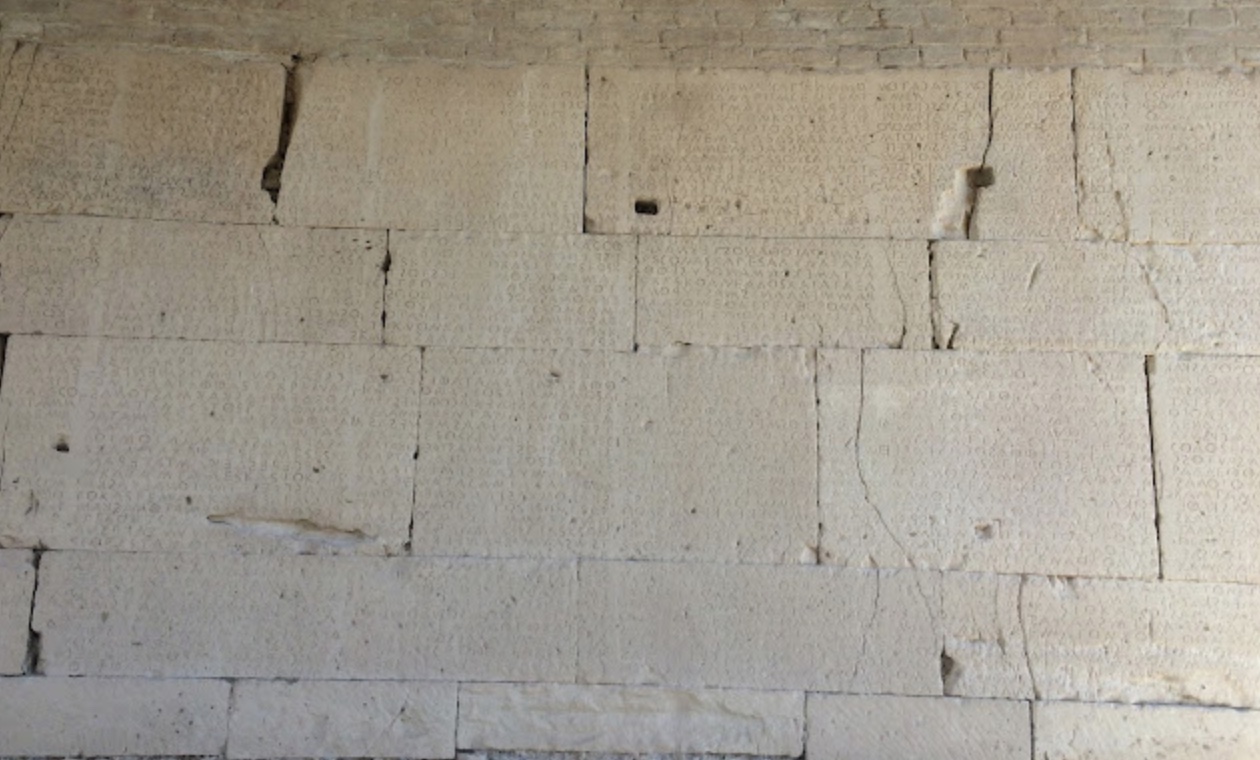
The Great Inscription of Gortyn was cut into the stone in the Dorian dialect around the middle of the 5th century BC; some scholars place it a little earlier, between 480 and 460 BC. It is written in what is called boustrophedon (βουστροφηδόν, “as the ox ploughs”): the lines run alternately from right to left and from left to right. The law governs inheritance, marriage and divorce, the status of the unfree, adoption and disputes over property; penalties for rape and adultery are graded according to the standing of offender and victim, a divorced wife keeps certain property of her own, and an adopted child inherits on equal terms with children born to the family. It is one of the oldest surviving bodies of Greek law, and the most complete – not a bundle of isolated rulings but a considered system. The text was set out in twelve columns, which is why Greeks also speak of the “Twelve-Tablet Inscription” (Δωδεκάδελτος); of an original 630 to 640 lines some 605 survive, on a curved wall about ten metres long and a metre and a half high that once belonged to a circular building some 30 metres across. Among Greek inscriptions only that of Diogenes of Oenoanda is longer. The first fragment was spotted in 1857 by the Frenchmen Georges Perrot and Louis Thenon; in 1884 Federico Halbherr found four columns near a local mill, and with the German Ernst Fabricius he then uncovered the remaining eight. Parts of the inscription are now in the Louvre. The Cretan alphabet of the day had no phi, chi or psi and neither eta nor omega, which makes the reading harder still for modern philologists.
The Basilica of St Titus
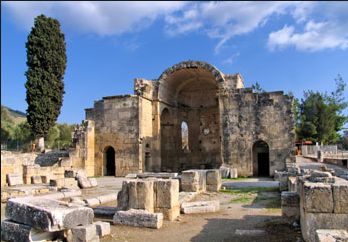
The early Christian Basilica of St Titus was the metropolitan church of the Cretan capital. It is associated with the apostle Titus, the disciple of St Paul who, according to church tradition, was the island’s first bishop and died at Gortyn in old age. Scholars today, however, distinguish carefully between two buildings that must on no account be confused: the great five-aisled basilica by the village of Mitropoli, and the domed church inside the fenced archaeological zone. The Mitropoli basilica, discovered only in 1978, measured about 67 by 33 metres without its atrium and was thus the largest church on the island. It was built in the 6th century under the emperor Justinian I (527–565) as the cathedral of Bishop Theodoros, over an older building of the 5th century; it was given floors of mosaic and opus sectile, and was abandoned after a severe earthquake around 670. Immediately to its north stands a circular baptistery with eight columns of Karystos marble – the only building of its kind on Crete.
What there is to see today
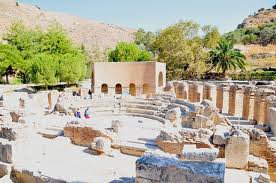
The circuit begins at the Roman Odeon, in whose masonry the Great Inscription can be seen beneath a protective shelter, and goes on to the Praetorium – the seat of the Roman governor, first built in the 1st century AD and altered again and again over the following eight hundred years – then to the temples, the baths that lie between the agora and the temple of Apollo, the plane tree and the Basilica of St Titus. The Greek Ministry of Culture is also carrying out extensive work on the site: the Great Theatre on the slope of the acropolis hill is being excavated and restored, the slopes are being stabilised, flood defences put in place and access improved – with step-free paths, bilingual signs and labels in Braille.
Gortyn’s history runs from Minoan times to late antiquity, and its oldest traces reach back to the Neolithic. The laws of Gortyn are discussed at length further down; first, though, to myth and history.
From Sarpedon, son of Zeus, to Octavian Augustus
Myth and foundation
Of the two mythical brothers of Minos, Rhadamanthys and Sarpedon, the story goes that Rhadamanthys was given rule over Phaistos, while Gortyn fell to Sarpedon, son of Zeus and Europa. All three brothers were held to be the children of the union which Zeus, having carried the Phoenician princess across the sea in the shape of a bull, is said to have consummated with her beneath the plane tree of Gortyn. Among the gifts he left her were the bronze guardian Talos, the hound Laelaps that never lost its quarry and a javelin that never missed. It is no accident that in early times the city is said to have been called Hellotis (Ελλωτίς) – an epithet under which Europa was worshipped on Crete, where the festival of the Hellotia was held in her honour.
A different version of the myth is handed down by the geographer Strabo: according to this the city was founded by, and named after, a certain Gortys, who was regarded as a son of Sarpedon; other ancient authors make him a son of Rhadamanthys. The city’s coinage later took up these traditions quite deliberately, showing Europa and the head of Minos. Homer knows the place too: in Book III of the Odyssey part of Menelaus’ fleet, on its way home from Troy, is driven by a storm on to a reef off the territory of Gortyn and wrecked.
The Minoan and the Greek city
Be that as it may, Gortyn was a powerful Minoan town with labyrinthine, tightly interlocking buildings, akin in its architecture to Knossos and Phaistos; Minoan finds from the site span the centuries from about 2600 to 1100 BC. Traces of settlement on the acropolis hill go back much further, to the 6th millennium BC and perhaps earlier. In the First Palace period the town was unfortified – a sign that for centuries it had no outside enemy to fear and lived at peace alongside the other towns of Crete. After the devastating earthquake of about 1700 BC it was quickly rebuilt, went on flourishing and spread ever further. It recovered just as swiftly as Knossos and Phaistos after the eruption of the Santorini volcano and the tidal wave that followed.
After the end of Minoan civilisation and the arrival of the Dorians the acropolis was fortified, around 1100 BC, with polygonal walls and corner towers; the settlement on the citadel lasted until the 7th century BC, when a temple was built there and the population moved down into the plain. In the 7th century Gortyn also produced the musician Thaletas. Over the following centuries the city grew so powerful that in the 5th century BC it subjected Phaistos and took over its trading ports; by the 3rd century BC at the latest it controlled Matala and the harbour of Lebena near modern Lentas. Yet neither in Minoan nor in classical Greek times was Gortyn the capital of Crete – though it was always an important regional centre, contending with Knossos for supremacy in the endless power struggles of the Cretan cities, among them the Lyttian War of 220 BC, which split Gortyn itself into warring factions.
Gortyn as capital of Crete (the Roman period)
Gortyn had cultivated friendly relations with Rome even during the civil wars among the Cretan cities, and so took no part in their common resistance to the Roman conquest (69–67 BC) carried out by the general Quintus Caecilius Metellus, later honoured with the surname Creticus; as an ally it was spared the destruction that befell others. As a reward – or, more probably, on geopolitical grounds – it was Gortyn that
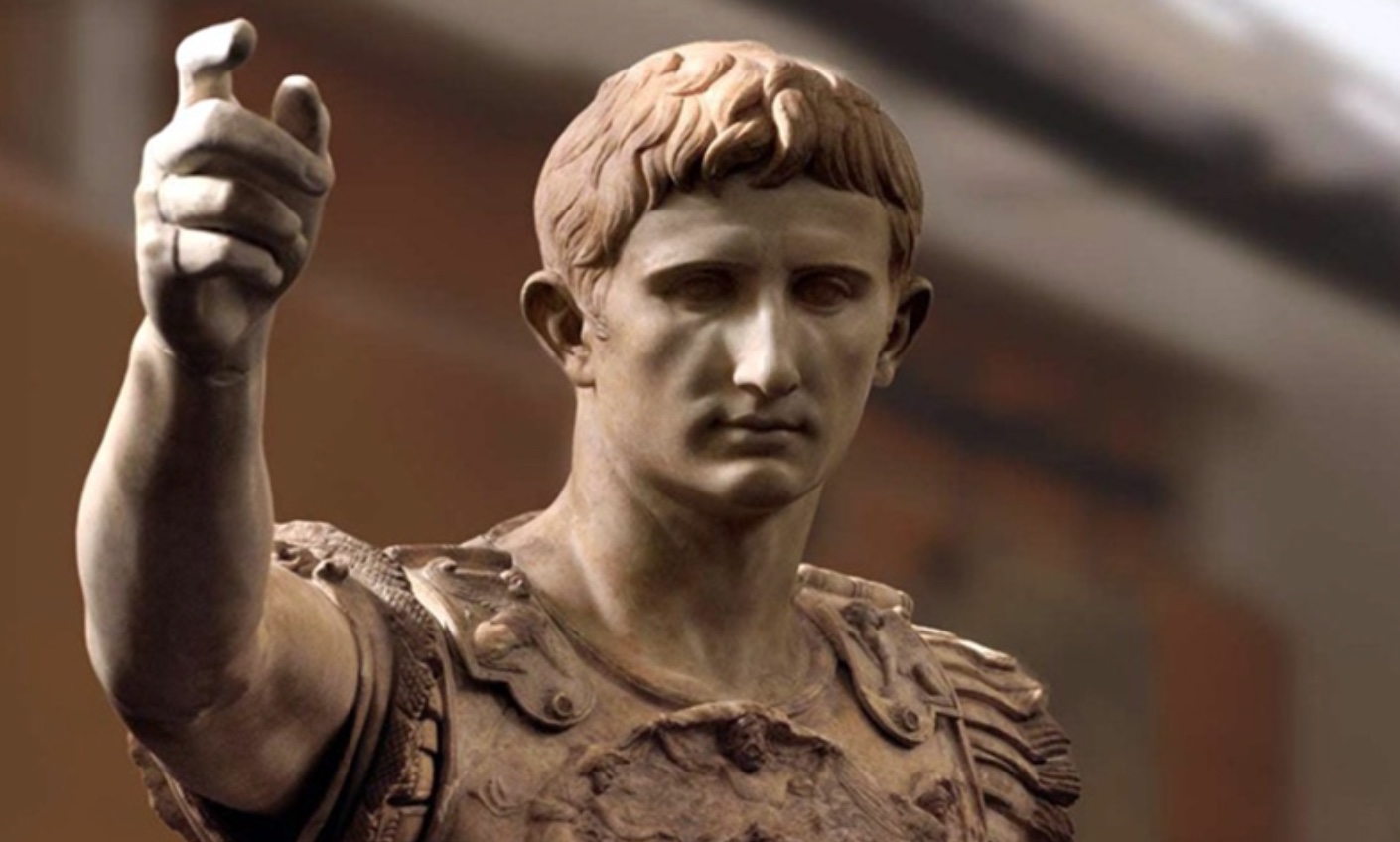
the emperor Octavian Augustus chose in 27 BC as capital of the senatorial province of Creta et Cyrenaica. This arrangement lasted until AD 295; after Diocletian’s reform of the empire Gortyn became capital of a separate province of Crete, headed by a quaestor and, above all, a proconsul. At the same time the city remained the seat of the league of Cretan cities, the Koinon of the Cretans (Κοινόν των Κρηταιέων).
The ports on the Libyan Sea and Romanisation
The coastal towns on the Libyan Sea – Matala, Lasea and Lebena (today Lentas) – became hubs of trade between the East, North Africa and Rome. Gortyn enjoyed a new economic and urban flowering as a result, and drew merchants and wealthy landowners from every part of the empire. It was thus the first city on Crete to be Romanised, quickly and thoroughly: Latin became an official language alongside Greek, Roman citizens settled here, and the townscape took on the forms of an Italian metropolis.
The new requirements led to a reordering of the city on the Roman model. Gortyn reached its peak between the reign of Hadrian and the early Severan period (2nd and 3rd centuries AD): the urban area grew to about 40,000 stremmata, and the population is estimated at 50,000 to 60,000. The city expanded to the east and south; a new street grid, temples, theatres, baths, an aqueduct, an amphitheatre and a hippodrome gave it the character of a great Roman city, and an honorific arch stood in its central quarter. Monumental public buildings such as the complex known as the Praetorium – which has a section of its own on this page – not only served the administration but were meant above all to display the greatness of Rome. The Odeon by the agora was rebuilt under Trajan. Water came by a long conduit from the springs near Zaros on the southern slope of Psiloritis and was distributed through fountain houses, nymphaea and cisterns.
Gortyn, “mother of the Cretan cities” (the age of the New Rome)
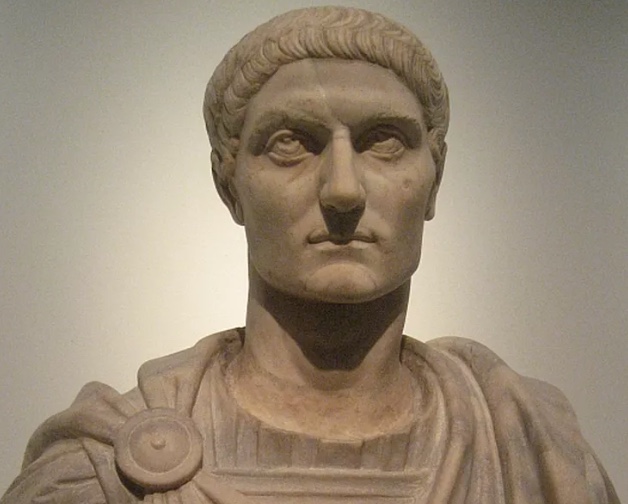
The Edict of Milan of AD 313, which put an end to the persecution of Christians and cleared the way for the spread of the faith, and the decision of Constantine the Great to move the capital of the empire from Rome to Byzantion – an old Greek colony on the Bosphorus, renamed Constantinople in his honour and solemnly dedicated in 330 – mark the beginning of the process by which the Roman Empire changed from a pagan to a Christian civilisation. For Gortyn the years of persecution had left a bloody memory only a short time before: according to tradition ten Christians suffered martyrdom here in 250 under the emperor Decius – Theodulus, Saturninus, Euporus, Gelasius, Eunician, Zoticus, Agathopus, Basilides, Evaristus and a tenth whose name is given variously – and the neighbouring village of Agii Deka, “the Holy Ten”, is called after them to this day. A 12th-century church stands on the spot where they are said to have died, and their tombs are shown in the village. The city had had a notable bishop even earlier, St Philip of Gortyn, who died about 180.
The Christian phase of the Roman Empire is what modern historians call Byzantium – a term the people of the Middle Ages never used themselves: they went on calling themselves Romans (Ῥωμαῖοι) and their state the empire of the Romans.
Crete’s privileged position at the centre of the eastern Mediterranean made the island an important entrepôt for trade with the new capital. After Diocletian’s reform at the end of the 3rd century Gortyn remained capital of Crete, and evidently kept that position until the Arab conquest (823–828). At the same time church tradition secured its precedence: according to this, St Paul preached the Gospel here, and his disciple, the apostle Titus, is regarded as founder and first bishop of the Church of Crete.
This tradition made Gortyn the metropolis – the Greek word means “mother of cities” – of the Church of Crete, the seat of its metropolitan. The bishops of the other Cretan cities were subordinate to him; in the 8th century the see was held by Andrew of Crete, one of the most important hymnographers of Byzantium. Born in Damascus around 650, a monk of St Sabbas near Jerusalem and a delegate to the Sixth Ecumenical Council before he came to Crete, he wrote the Great Canon of repentance, a poem of 250 strophes that is still chanted in Orthodox churches during Lent; he died on Lesbos on 4 July, on his way back to the island from Constantinople. To this day the bishop responsible bears the title of Metropolitan of Gortyn and Arkadia, with his seat in nearby Mires.
Rebuilding after the earthquake of 365
The colossal earthquake that shook Crete at dawn on 21 July AD 365 – its magnitude is put at 8.5 or more, and it lifted the west of the island by about nine metres – sent a tidal wave across much of the eastern Mediterranean, which the historian Ammianus Marcellinus describes breaking over Alexandria. It caused great destruction in most of the island’s ancient cities, Gortyn among them.
To secure the survival and rebuilding of the city, imperial aid was granted in the form of food and money. The work of reconstruction was interrupted in the course of the 5th century, however, by fresh disasters. Together with the reorganisation of the imperial administration from the 4th century onwards and the new religious needs that arose from the gradual establishment and organisation of Christian worship, these events brought profound changes to the townscape. The traditional places of cult, the theatres and the agora were given up one by one, residential quarters grew up on open public ground, and parts of the old street plan were taken over by Christian buildings. Little by little the heart of the city shifted westwards, to the area where the great Christian monuments were raised.
The 6th century, and above all the reign of Justinian the Great, was a time of prosperity and thorough renewal for Crete; the great basilicas of Gortyn belong to these decades. Despite repeated earthquakes in the 7th and 8th centuries, despite outbreaks of plague and social and economic upheaval, most of the ancient cities managed to survive.
The finds from the Byzantine quarter show that even after the destructive earthquake at the beginning of the 7th century the city still had strength enough to carry on its craft production and to import goods from Carthage, Alexandria, Syria and Palestine, North Africa, Asia Minor and Cyprus. Italian archaeologists have uncovered workshops, shops and dwellings here that remained in use into the 8th century.
The imports from North Africa included luxurious tableware, often of large size, with a glossy red surface and stamped decoration of the kind typical of the North African workshops, together with amphorae dating from the 5th to the 8th century. They bear witness to a continuing exchange of goods even at a time when the Byzantine provinces of North Africa had already passed into Arab hands.
Decline and the transfer of the capital to Chandax (Heraklion)
The economic and demographic consequences of the earthquakes, and the insecurity caused by Arab raids, which began around the middle of the 7th century and grew worse in the 8th, forced the townspeople to seek refuge in fortified places that were hard to reach. A further severe earthquake, which laid waste the lower town at the end of the 8th century – probably in 795 – hastened the process. The part of Gortyn in the plain was abandoned, and the few remaining inhabitants withdrew to the fortified acropolis, where a Byzantine basilica had been built over a temple of Athena of the 7th century BC – the same temple that had marked the end of the early citadel settlement, and from which embossed bronze plaques and sculpture have been recovered.
In AD 823 the Arabs – Saracens driven out of Andalusia, who had for some years held Alexandria and now sailed from Egypt in about forty ships under Abu Hafs Umar – landed in the area of Keratokambos on the south coast and by 828 had conquered the island step by step.
When the Byzantine general and future emperor Nikephoros Phokas won Crete back in AD 961 – he had landed in the summer of 960 and stormed the Arab capital on 6 March after a siege that lasted the whole winter – the former greatness of Gortyn was long gone.
The Arab interlude had laid bare the strategic vulnerability of Crete’s south coast – and the better position of another town: Chandax (Χάνδαξ), today’s Heraklion, which the Arabs had laid out on the north coast as their fortified capital and named after its defensive ditch, the “Castle of the Moat”. The capital of the island was now established there for good, in place of the inland city. So ended the age, almost a thousand years long, in which Gortyn had been the capital of Crete. Over the following centuries fields, olive trees and the houses of the surrounding villages crept over the ruins; stones and columns of the ancient city found their way into farmhouses, mills and churches.
Today Gortyn is one of the most interesting excavation sites on the island, for nearly every period of Cretan history is represented here, from the Neolithic to the Byzantine. Systematic investigation began in 1884 with the Italian archaeologist Federico Halbherr, whose first great prize was the law code; since 1898 the Italian Archaeological School at Athens has been digging here, together with the Greek authorities, almost without interruption to the present day. What there is to see in detail is described further down.
The church of St Titus at Gortyn
In brief
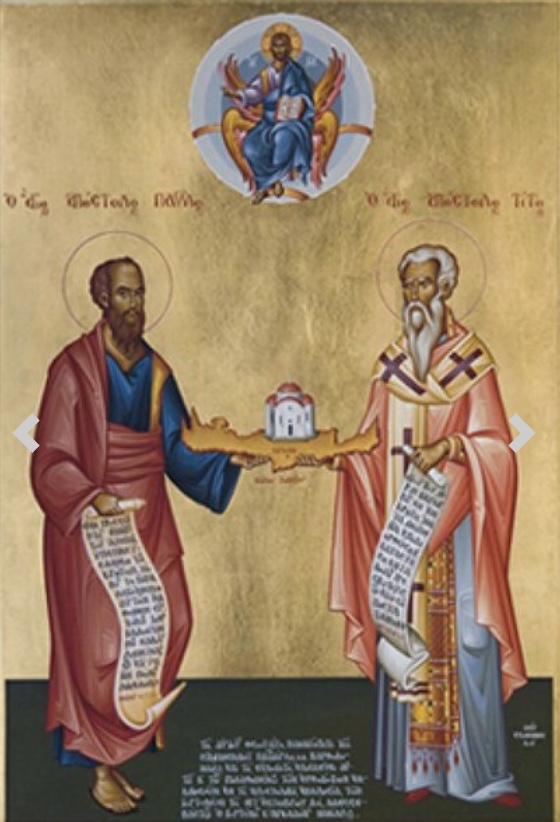
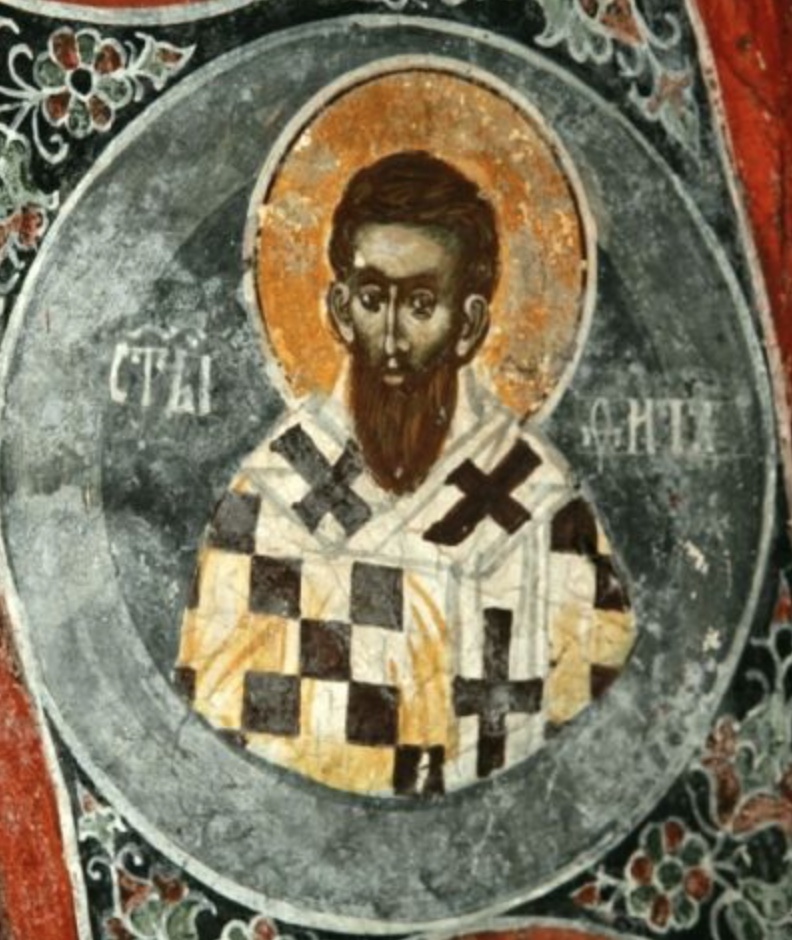
The Basilica of St Titus is a church of the 6th century that was built anew after an earthquake in the late 8th century. St Titus is counted among the Seventy Apostles, was a disciple of St Paul and the first bishop of Crete. He was born on the island and died here too, at Gortyn, at a great age. It is to him that the Epistle to Titus is addressed, a short letter of three chapters and 46 verses that forms part of the New Testament. Locally the church is also called Panagia Kera (Παναγία Κερά), because in Venetian times the Virgin Mary was venerated in its surviving eastern part.
In the courtyard of the basilica stand marble sarcophagi that were intended for the burial of the city’s clergy.
The church in rather more detail
The church of St Titus lies in the part of the Gortyn excavations that is open to the public, on the ground of the Hellenistic and Roman agora and not far from the remains of the Roman Odeon. It was excavated in 1900 by Giuseppe Gerola and in 1901 by Stefanos Xanthoudidis; the results were published in 1926 by Anastasios Orlandos. The unusual architecture of the building – a cross-shaped church whose dome rested on four piers, faced with large squared blocks – and the lack of adequate stratigraphic evidence from the first digs led to its being regarded as an architectural special case and dated in widely different ways: to the age of Justinian, to the end of the 6th century, to the 7th, the 8th or even the 10th. Even the connection of the building with the apostle Titus was disputed; it was proposed instead that this was the katholikon of a monastery of the Virgin of Blachernae (Βλαχέρνα) founded by Archbishop Andrew of Crete in the first half of the 8th century.
Fresh archaeological investigation, carried out as part of a project to restore the monument and open it up to visitors by the 13th Ephorate of Byzantine Antiquities in Heraklion (2013–2015) under its director Vasiliki Sythiakaki, has largely settled the questions of interpretation. It turned out that the domed church of St Titus was built on the foundations of an early Byzantine three-aisled basilica of the 6th century, which remained in use into the 8th. The position of this basilica on the ancient agora, where according to tradition Titus may first have preached, and at a marked distance from the city’s other Christian buildings, argues for seeing in it the site of the martyrion – that is, of the witness and preaching – of Titus at Gortyn.
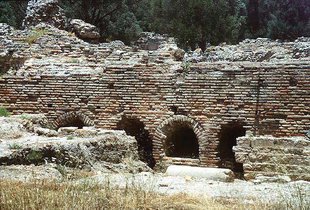
The successor was raised on the foundations of the first after the devastating earthquake of 795, which had levelled the city, and was already in use before the Arab conquest (823–828). That it was the only building in the lower town to be rebuilt from the ground up underlines what it meant to the inhabitants. For building material they used whatever could be salvaged from the city’s ruined Roman and Christian monuments – even the marble of the nearby Great Theatre was burnt to mortar in lime kilns. Yet the church was carefully planned and worthy of its importance. This is shown by its transitional architectural type, which tries to fit a cruciform domed church into the ground plan of a three-aisled basilica, and by the dignity of its façades, whose pseudo-isodomic masonry imitates the splendid Roman buildings of the city, the ruins of which were still standing at the time. The dome and the galleries lay only in the western part, and the north and south arms of the transept end in conches; the eastern part, preserved in its entirety, is built of brick and to this day rises above the plain as an impressive ruin – the first thing a visitor sees on entering the site.
The complexity of the construction, the features of its design that point to a martyrs’ or memorial church (a triconch sanctuary and a triconch cruciform core), its use as a place of burial, several layers of wall painting, the rich architectural decoration, numerous Byzantine votive offerings, the alterations of the Venetian period and unbroken use for worship since early Byzantine times are weighty evidence for the monument’s connection with the founder of the Cretan Church, the apostle Titus. A whole hoard of liturgical vessels was found buried in the floor, moreover, and is now on display in the Historical Museum of Heraklion. After the Arab conquest the church fell into decay; in Venetian times its eastern part, with the sanctuary, was restored as a smaller place of worship. Services are still held here on special occasions: when the saint’s head, the relic kept in Heraklion, was brought to the Messara in 1988, it was received on 17 May in the Panagia Kera amid the ruins; in August 2026, to mark the 60th anniversary of its return to Crete, it was carried for the first time into the five-aisled basilica at Mitropoli.
The life and Vita of the apostle Titus
The biography in brief
Tradition links Gortyn with St Paul. He came to know the island when the ship carrying him in chains to Rome around AD 59 had to seek shelter at Kali Limenes – the place the Acts of the Apostles calls “The fair havens; nigh whereunto was the city of Lasea” (Acts 27:8, King James Version) – not far from Gortyn. According to the Epistle to Titus in the New Testament, Paul later returned to Crete to preach the word of God and left his disciple Titus behind at Gortyn to set the local church in order and “ordain elders in every city” (Titus 1:5, King James Version). So the apostle Titus is regarded as the first bishop of the Church of Crete. According to tradition he was buried at Gortyn; his relics were later translated to Chandax (Heraklion). The link with the apostolic tradition was the reason why Gortyn was later raised to a metropolitan see, the “mother of cities”.
The Epistle of St Paul to Titus
From the Epistle to Titus: “For the grace of God that bringeth salvation hath appeared to all men, teaching us that, denying ungodliness and worldly lusts, we should live soberly, righteously, and godly, in this present world; looking for that blessed hope, and the glorious appearing of the great God and our Saviour Jesus Christ; who gave himself for us, that he might redeem us from all iniquity, and purify unto himself a peculiar people, zealous of good works. … But after that the kindness and love of God our Saviour toward man appeared, not by works of righteousness which we have done, but according to his mercy he saved us, by the washing of regeneration, and renewing of the Holy Ghost; which he shed on us abundantly through Jesus Christ our Saviour; that being justified by his grace, we should be made heirs according to the hope of eternal life.” (Titus 2:11–14; 3:4–7, King James Version)
The same letter contains the famous saying about the Cretans, which Paul attributes to one of their own poets, Epimenides of Knossos: “The Cretians are alway liars, evil beasts, slow bellies” (Titus 1:12, King James Version) – a verse that later exercised philosophers as the so-called liar paradox, since the man who calls all Cretans liars is himself a Cretan.
At greater length: the Vita of the apostle Titus
Titus, one of the Seventy Apostles, came from the island of Crete and was the son of noble pagan parents. In his youth he devoted himself eagerly to Greek philosophy and the ancient poets. Alongside his studies he led a virtuous life and did not give himself up to the vices and passions that were common among most pagans. He preserved his virginity, as the holy martyr Ignatius the God-bearer testifies of him. For such a life the Lord did not leave him without help. At the age of twenty Titus heard a voice in a dream urging him to abandon Hellenic wisdom, which brings the soul no salvation, and to seek the wisdom that saves. After this dream he waited another year to see whether a similar instruction would be given him – and indeed he was told to acquaint himself with the teaching of the prophets of God. The first book that came into his hands was that of the prophet Isaiah. He opened it at the 41st chapter and was moved by words that seemed to have been spoken about his own inner state.
When word of a great prophet who had appeared in Palestine, and of the miracles he worked, reached as far as Crete, the governor of the island, an uncle of Titus by blood, sent the young man there. This prophet was – so the Vita has it – the Lord Jesus Christ himself, made man of the all-holy Virgin Mary and come into the world to redeem the human race from the original sin that weighed upon it. In Jerusalem Titus saw the Lord, heard his preaching and came to believe in him. He witnessed the Saviour’s passion and death on the cross, his glorious resurrection and his ascension. On the day of Pentecost the future apostle, standing in the midst of the crowd, heard the twelve apostles speaking in many tongues after the descent of the Holy Spirit – including the language of the Cretans, who are expressly named among the listeners in the Acts of the Apostles (Acts 2:11).
Pentecost in Jerusalem (Acts 2:11)
Among the people who on the day of Pentecost in Jerusalem heard the apostles speaking in their own languages, the Acts of the Apostles expressly names “Cretes and Arabians” (Acts 2:11, King James Version), at the end of a list that runs from the Parthians and Medes to Egypt and the parts of Libya about Cyrene. The Cretan Church has always seen in this verse a first sign of the island’s early encounter with the Gospel – and the Vita of Titus places its hero in the very midst of those listeners.
Titus received baptism from St Paul and became his closest disciple. He accompanied Paul on his missionary journeys and repeatedly undertook commissions for the newly founded communities: in about 55–56 Paul sent him from Ephesus to Corinth to settle disputes there, and afterwards had him organise the collection of alms for the Christians of Jerusalem; it was Titus who carried the Second Epistle to the Corinthians to its recipients. He was with Paul in Jerusalem, too, when the position of Gentile Christians was debated there at what is known as the Council of the Apostles. Titus, himself a Greek, was not compelled to be circumcised there, a circumstance to which Paul draws particular attention in the Epistle to the Galatians (Galatians 2:3). He was numbered among the Seventy Apostles and consecrated bishop of Crete by Paul. Around the year 65, shortly before his second imprisonment, Paul addressed a pastoral letter to his trusted companion:
the Epistle to Titus (Titus 1–3), in which he gives him instructions for appointing elders in every city, for teaching and for the life of the communities on Crete, and asks him to join him for the winter at Nicopolis.
When Paul was taken as a prisoner to Rome to stand trial before the emperor, Titus left his Cretan flock for a time and went to Rome to stand by his spiritual father; the Second Epistle to Timothy mentions that he travelled on from there to Dalmatia (2 Timothy 4:10). After Paul’s martyrdom Titus returned to the capital of Crete, to Gortyn.
The apostle Titus guided his community with wisdom and laboured to enlighten the pagans with the light of the Christian faith. The Lord, the Vita says, had granted him the gift of working miracles. During a pagan festival in honour of the goddess Diana – the Greek Artemis, that is – Titus preached before a great crowd. When he saw that no one was listening to him, he asked God himself to show those in error the emptiness of idols. At his prayer the statue of Diana fell down before the eyes of all and was shattered. On another occasion Titus prayed that God would not allow a temple of Zeus then under construction to be completed – and the building collapsed. By such miracles the apostle brought many to faith in Christ. Having enlightened the neighbouring lands, too, with the light of the faith, Titus fell asleep peacefully at the great age of 94; before his death his face is said to have shone like the sun.
The venerable head of the apostle is kept today in the capital of Crete, Heraklion, in the church of St Titus. Before the Turkish conquest the Venetians took the relic to Venice in 1669, where it rested for almost three centuries in St Mark’s. Only on 15 May 1966 did it return home – a day that Heraklion still celebrates every year. The saint’s feast day proper is 25 August in the Orthodox calendar (the Catholic Church keeps his memory on 26 January); processions then make their way through the old town of Heraklion, and in the Messara too this day counts as the high point of the church year. The relic has been brought to the Messara several times since: in 1966 immediately after its arrival, in 1988, in the jubilee year 2000 and again in August 2026.
Odeon and theatre
The Odeon of Gortyn
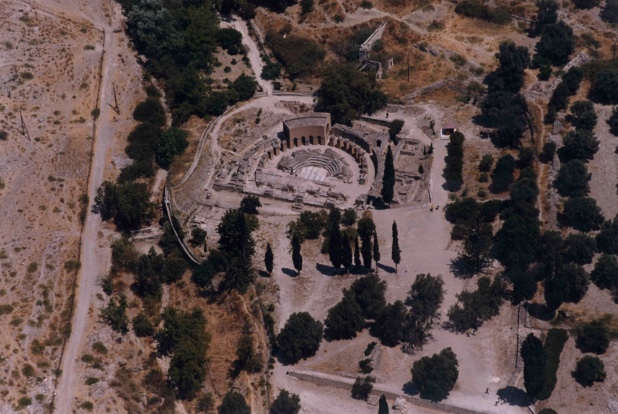
To the right of the church of St Titus lies the well-preserved Roman Odeon, a roofed theatre for musical performances, recitations and assemblies. The building dates from the 1st century BC; in its present form it goes back to a renewal under the Roman emperors, probably under Trajan at the beginning of the 2nd century. The Odeon has marble rows of seats, an almost semicircular orchestra, two entrances from the north and a rectangular stage building, once roofed, with three doors on to the stage. The orchestra is paved with slabs of white and bluish marble, and the stage building was adorned with statues. The Odeon was put up on the site of an older structure, circular in plan and about 30 metres across – taken either for a Late Minoan administrative building or for a Greek assembly building – whose stones were reused as building material.
It is to precisely this circumstance that posterity owes the famous Great Inscription: the Roman builders set the inscribed blocks of the old law into the curved northern outer wall of the Odeon. There they can still be seen, protected by a small building with a tiled roof, in whose shade the twelve columns of lines, running to and fro across a wall a metre and a half high, can be studied at close quarters. Not far away lay the city’s agora and a sanctuary of Asklepios.
The Great Theatre of Gortyn
The Great Theatre of Gortyn lies on the south-eastern slope of the hill of Agios Ioannis – the acropolis – to the west of the fenced area that visitors normally see. Until recently it had never been systematically excavated. The first steps came in 2009, when a geophysical survey was made of the hillside at the prompting of Diazoma, the Greek association for the care of ancient theatres; digging proper began in the summer of 2011 under a programme agreement for cultural development between the Ministry of Culture and Sport and the Region of Crete, which pays for the research. Some 400,000 euros were available for the campaigns of 2011 to 2015. The monument had been known to European travellers since the 16th century – Onorio Belli described it, with a stage building that has since vanished – though their accounts differ considerably from the picture now emerging trench by trench. Before work started, the outline of the upper seating could barely be made out; everything else lay under several metres of fill. Three intensive campaigns (2011, 2012 and 2014–2015) uncovered most of the auditorium and the orchestra, a substantial part of the stage building and part of a structure east of the stage whose purpose, and possible connection with the theatre, remain to be investigated. Since 2020 the effort has been directed at clearing the southern entrance: on 15 May 2020 a new agreement for further excavation and restoration was signed, with another 240,000 euros from the Region of Crete for a two-year programme, and in June of that year the restoration studies were approved by the Central Archaeological Council.
Construction and form of the theatre
The building belongs with the large Roman theatres: its greatest diameter is about 93 metres and its capacity is put at roughly 7,500 spectators. It was partly cut into the rock of the hill and partly raised in Roman concrete faced with brickwork, behind an outer wall more than two metres thick. In later centuries it was thoroughly quarried, which explains the almost complete absence of seats and stair treads in the middle and upper parts of the auditorium and of the original stone paving of the orchestra. Two corridors divide the auditorium into three tiers – upper, middle and lower – and at the rim of the highest tier there are traces of a roofed gallery. The substructure consists of arches and of radial and concentric walls forming vaulted chambers on which the rows of seats rested. In the lowest tier a few seats still sit where the Roman masons placed them.
The two surviving corridors were originally roofed and brought the audience to their respective tiers. Above them ran open walkways, the diazomata, from which the higher rows were reached. That the side entrances leading from outside into the orchestra were vaulted as well is shown by voussoirs found at the spot where the northern entrance is thought to have been. The orchestra is slightly horseshoe-shaped and about 20 metres across. Along its edge the excavators found a strip of marble flooring some 0.90 metres wide, laid in rectangular slabs alternating with square ones, several of them reused from elsewhere.
The front of the stage is formed by a row of arched niches, alternately rectangular and semicircular and coated with plaster, whose greatest height is estimated at 1.5 metres. Of the stage itself only part of the central section has so far been exposed. The proscenium has collapsed; it originally rested on cross vaults, which in turn stood on stone piers dressed to a prismatic shape. In the middle of the structure, beneath the proscenium, a vaulted chamber came to light that may have linked the space under the stage with the stage building behind.
On the stage lay a broad destruction layer containing numerous architectural members in several kinds of marble and in grey granite, together with sculpture fallen from the stage building. Their quantity and variety point to a façade of at least two storeys, pierced by three doorways; white marble Ionic columns more than five metres high have been recorded here. In the southern part of the stage a lime kiln was built at a later date, and in and around it were found pieces of statues and of architectural ornament already stacked for burning. The making of lime from the theatre’s marble is probably connected with the rebuilding of the neighbouring church of St Titus at the end of the 8th century.
Later use and the altar of Domitian
The excavation shows that the site of the theatre was occupied again at the end of the early Byzantine period (7th–8th century): there are remains of buildings, pottery and coins of Byzantine emperors. In the vaulted chamber beneath the stage stood a four-sided marble altar or base, visible to a height of up to 1.20 metres, carved with Erotes at the corners and a garland in relief on each face. It carries a dedication to the emperor Domitian (AD 81–96), whose name has been chiselled out, because soon after his assassination in 96 the Senate formally condemned his memory (damnatio memoriae). The inscription proves that the theatre was already in use in the last quarter of the 1st century AD; alterations were still being made to it in the 3rd.
A similar but smaller piece was found in the orchestra of the so-called Roman Theatre of Gortyn, in the locality of Kasinedes, and has been interpreted as a thymele, the sacrificial or cult altar of the orchestra. Fragments of sculpture have turned up in every part of the Great Theatre examined so far, and their number and the types recognised make it plain that both stage and auditorium were lavishly furnished with statuary. Some are already on display in the Archaeological Museum of the Messara. A theatre of this size in the capital of the province may well have served for more than plays – festivals, religious ceremonies and perhaps the gatherings of the Cretan league have all been suggested. It is now counted among the most impressive of the little-known ancient theatres of Greece, and anyone visiting Gortyn can look across its tiers from the path that climbs to the acropolis.
The plane tree of Zeus and Europa
Behind the Odeon grows a massive plane tree, centuries old, around which one of the island’s best-known myths has gathered. In its shade Zeus, who had turned himself into a magnificent bull and carried the Phoenician princess Europa across the sea to Crete, is said to have lain with her; she afterwards bore him three sons, Minos, Rhadamanthys and Sarpedon, whom Cretan tradition makes the kings of Knossos, Phaistos and Malia. Since that day, the story goes, the tree has never again shed its leaves.
And the tree is indeed evergreen, unlike any ordinary plane: it keeps its foliage through the winter. Botanically it is a variety of the oriental plane native to Crete (Platanus orientalis var. cretica), of which only about fifty specimens have been recorded on the whole island – others stand at Azogires in Selino, at Vori, Vryses and Fodele and at Monastiraki in the Amari valley. Ancient naturalists already knew of the evergreen plane of Gortyn. Such trees renew themselves vigorously from their roots, so that what looks like a single immortal trunk may in fact be the latest growth of a far older plant. Today the tree is protected as a natural monument and fenced; in recent years, however, it has suffered from a disease that causes branches to die back, and measures have been taken to protect it.
Cretans hold that the leaves of this tree can help childless couples to a son, and people used to pick them for that purpose. The plane also appears on the coinage of Gortyn: silver staters show Europa seated among its branches, sometimes with the eagle of Zeus beside her. How deeply the myth was rooted in the city is shown, too, by a colossal statue of Europa found in the ruins of the amphitheatre in the 19th century and now in the British Museum.
The sanctuaries of Pythian Apollo and of the Egyptian gods
The sanctuary of Pythian Apollo
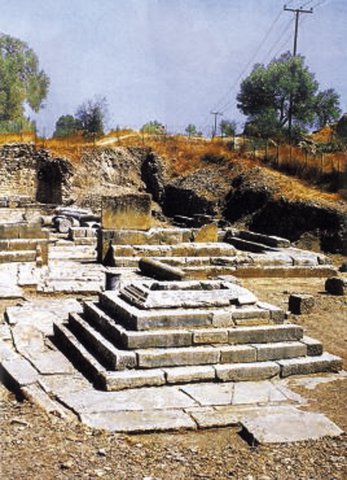
The Pythion, discovered in 1887, was the most important pre-Christian sanctuary of Gortyn and the religious centre of the city before the Romans came; it lies in the lower town some 600 metres from the agora. Archaeologists date the first temple to the 7th century BC. It was a rectangular building with a treasury; over the centuries it was repeatedly enlarged and remodelled, acquiring a porch (pronaos) in the Hellenistic period and an apse inside in Roman times. As early as the Archaic period laws of the city were cut into its walls – forerunners of the Great Inscription. In the 6th century AD its marble was carried off as building material for the church of St Titus. What chiefly survives of the pagan sanctuary is the imposing stepped altar that stands in front of the porch, together with the inscriptions carved in its marble. Close by are a small theatre, remains of the aqueduct and private houses.
The sanctuary of the Egyptian gods
This sanctuary, excavated in 1914 between the agora and the Pythion, was dedicated to Isis, Serapis and Anubis – the last worshipped in his Hellenised form as Hermanubis. The surviving building dates from the 1st to 2nd century AD and may stand over predecessors going back to the 4th century BC. An inscription on the architrave records that it was founded by a certain Flavia Philyra and her children. It is the only sanctuary of its kind on the whole island, although the cult of the Egyptian gods was widespread in Crete from the 4th century BC to the 1st century AD – evidence of the cosmopolitan character of a city frequented by merchants from Alexandria and the entire eastern Mediterranean. The architecture is unusual: a small rectangular cella entered from the west through a porch of Ionic columns, with a podium and arched niches for the cult images – Serapis in the centre, Isis and Anubis to either side; on the south side hidden underground rooms reached by a staircase, which probably served for ritual purification; and on the east, behind the walls of the cella, a large cistern, for water – as an image of the Nile – played a central part in the worship of Isis. Marble statues of the three gods were recovered beside the podium, together with a life-size female figure thought to portray the foundress, but nothing of them remains on the site. By the 4th century AD the sanctuary had been abandoned.
The Roman baths
The excavations have brought several bathing establishments to light, with pools of differing temperature – from the hot caldarium through the lukewarm tepidarium to the cold frigidarium – along with rooms for company and entertainment and service rooms for the furnaces, the latrines and the running of the place. For the Romans the baths were far more than somewhere to wash: here one met friends, did business, took exercise and kept up acquaintances. The high technical standard of the baths in the provincial capital makes them in a sense the spas of their age. Part of the complex near the Praetorium has still not been excavated.
The Praetorium (seat of the administration)
The complex known as the Praetorium grew up in the city block bounded by the West Street and the North Street. It probably served as the office and residence of the Roman governor, the proconsul of the joint province of Crete and Cyrenaica, and was remodelled again and again over some eight centuries – first laid out in the 1st century AD, it was largely rebuilt under Trajan in the early 2nd, around a colonnaded court of about 1,000 square metres opening on to large halls. Marble floors, porticoes and statues proclaimed the rank of the master of the house. The western part, between the Hellenistic stadium and the West Street, was given over to administration and included a large basilica for court hearings. The stadium, later converted into a gymnasium, remained in use until the 3rd century AD and was then turned into a bath complex. On the open ground to the east a temple for the deified Augusti – that is, for the imperial cult – was built in the 1st century AD. It incorporated an older monumental altar, possibly of the 4th century BC, which according to a surviving inscription was dedicated to the Highest God. After the earthquake of 365 the Praetorium was restored, and in Byzantine times a monastery was installed among its halls. To the north lie a large water reservoir and a nymphaeum, a splendid fountain house supplied by the aqueduct.
The acropolis
The acropolis occupied the hill of Agios Ioannis, north-west of the city centre. Excavation has shown that the earliest traces of human presence go back to the 6th millennium BC. The successive layers span many thousands of years and have yielded numerous valuable finds, now kept in the archaeological museum near Agii Deka. After the arrival of the Dorians, around 1100 BC, the hill was fortified with walls of polygonal masonry and corner towers; a temple of Athena of the 7th century BC and a Byzantine basilica of the 6th century AD built over it testify to its long use. The buildings survive only in fragments. All the more impressive is the view from the top across the Messara Plain, to the peaks of Psiloritis and as far as the bay that shares the plain’s name.
And finally: the laws of Gortyn
A slab covered with carved letters was built into the wall of the Odeon. When scholars deciphered it, the text proved to consist of individual laws of the city of Gortyn from the 5th century BC. The decades-long hunt for the missing slabs of this code would furnish the plot of a detective novel. Greek lettering among the ruins had been noticed as early as 1577 by Francesco Barozzi, a Venetian nobleman born in Candia who collected the island’s inscriptions. In the middle of the 19th century the first fragments surfaced: in 1857 the Frenchmen Georges Perrot and Louis Thenon found one built into the wall of a watermill, and it went to the Louvre, where it was later recognised as dealing with adoption; another turned up in a mill in the village of Agii Deka. In 1879 the Frenchman Bernard Haussoullier discovered further pieces, on the law of inheritance, and in 1884 Federico Halbherr, sent to Crete by his teacher Domenico Comparetti, came upon the main body of the inscription in the water of a mill channel that ran through the ruins of the Odeon; he had the stream diverted and, together with the German Ernst Fabricius, copied the text, which was published the following year. The Cretan scholars Iosif Chatzidakis and Stefanos Xanthoudidis also helped to secure the stones. Greek and foreign archaeologists alike have had their share in the exploration of Gortyn.
In the end, after some two decades, twelve columns had been assembled, spread over 42 stone blocks laid in four courses, with provisions on family and property law and a few articles on the political order of the city-state. The inscribed wall is about ten metres long and a metre and a half high and carries some 600 lines in the Dorian dialect of Crete, written in an archaic local alphabet of only eighteen letters. The blocks first belonged to a round building about thirty metres across beside the agora – perhaps a council house or law court – before the Romans reused them in the Odeon, where they now stand in a vaulted gallery. It is remarkable that these laws know neither the death penalty nor imprisonment; prisons evidently did not exist, and the penalties were fines, reckoned in staters and drachmas. But then again, perhaps we have simply not yet found the relevant slabs. A full-scale cast of the Great Inscription has also stood, since 2012, in the Greek Parliament in Athens; older casts are to be seen in the Museum of Classical Archaeology at Cambridge, at Cornell Law School and at the Accademia dei Lincei in Rome.
Some provisions of the law of Gortyn
If there is a dispute as to whether a person is free or unfree, those witnesses shall prevail who testify that he is free.
If a man is caught in adultery with a free woman in the house of her father, her brother or her husband, he shall pay a hundred staters; if it happens in any other place, fifty.
If husband and wife separate, the wife shall keep her own property which she brought into the marriage, together with half of the produce, if her property has yielded any, and half of whatever she has woven in the house; if the husband is to blame for the divorce, she shall receive five staters besides.
If a young woman who has been given in marriage by her father or her brother becomes an heiress, and does not wish to remain married to the man to whom she was given although he wishes the marriage to continue, then, if she has children, she shall receive her lawful share of the property and may marry another.
For those who would like to go deeper, the laws follow here, arranged by field of law. The rendering follows the sense of the Doric original; additions in square brackets are there to make the meaning clear.
Lawsuits concerning the unfree
1. Whoever intends to bring a suit concerning a free man or an unfree person shall not carry him off by force before the judgment.
2. If he carries him off nonetheless, [the judge] shall condemn him to pay ten staters for a free man and five for an unfree person, because he has carried him off, and shall order him to release him within three days.
3. If he does not release him, [the judge] shall condemn him to pay one stater for a free man and one drachma for an unfree person for each day until he releases him. As to the length of time, the judge shall decide under oath.
4. If he denies having carried him off, the judge shall decide under oath, unless a witness gives evidence.
5. If there is a dispute as to whether a person is free or unfree, those witnesses shall prevail who testify that he is free.
6. If two men contend over an unfree person, each claiming that he is his, judgment shall be given according to the testimony of the witness, if a witness gives evidence.
7. If they claim that the unfree person belongs to both of them or to neither, the judge shall decide under oath.
8. If the man who has held him loses the suit, he shall set the free man at liberty within five days and hand over the unfree person.
9. If he does not set him at liberty or does not hand him over, the judge shall condemn him to pay fifty staters for a free man and one stater for each day until he sets him at liberty, and ten staters for an unfree person and one drachma for each day until he hands him over.
10. If the judge orders the sum to be exacted after a year has passed, three times the fine shall be exacted, or less, but not more. As to the length of time, the judge shall decide under oath.
11. If an unfree person over whom the suit has been lost takes refuge in a temple, the plaintiff shall summon [his opponent] and, before two free witnesses of full age, point out the temple in which the unfree person himself, or another in his stead, is seeking sanctuary.
12. If he does not summon him and does not point out the temple, he shall pay what is prescribed.
13. If he does not give him up within a year, he shall pay the simple fine.
14. If [the unfree person] dies while the suit is in progress, [the condemned party] shall pay the simple fine.
15. If a member of the board of kosmoi – the chief magistrates of the city – carries off [an unfree person], or another man carries one off from a kosmos, [the injured party] shall bring the suit when the term of office has expired; if [the defendant] loses the suit, he shall pay what is prescribed from the day of the seizure. But whoever carries off an unfree person from the man who has lost the suit, or from one who holds him as a pledge, shall go unpunished.
Offences
16. If anyone rapes a free man or a free woman, he shall pay a hundred staters.
17. If the victim is the son or the daughter of an apetairos – a free man who belongs to no hetaireia, that is, to none of the citizen brotherhoods – he shall pay ten [staters].
18. If an unfree person commits the offence against a free man or a free woman, he shall pay double.
Violence, adultery and ransom
The section that follows continues the rendering of the Great Inscription of Gortyn. The numbering follows the division into separate provisions adopted here; in the original the sentences run on without paragraphs and without punctuation across twelve columns and some 600 lines, each line turning back on the one before, alternately from right to left and from left to right – the manner of writing known as boustrophedon, “as the ox turns in ploughing”. The letters themselves belong to an archaic Cretan alphabet of only eighteen signs, and the language is the Dorian dialect of the island. Additions in square brackets are the translators’; they make the terse and often elliptical Doric wording intelligible without altering it. Readers who wish to compare may like to know that the text was first published in 1885 by Federico Halbherr, Ernst Fabricius and Domenico Comparetti under the title Leggi antiche della città di Gortyna in Creta.
19. If a free man does violence to a woikeus or a woikea, he shall pay five drachmas.
20. If a woikeus does violence to a woikeus or a woikea, he shall pay five staters.
21. If anyone rapes a slave woman who lives in the house, he shall pay two staters.
22. If he has [intercourse] with one who has already been dishonoured, he shall pay one obol if it is by day and two obols if it is by night. The oath of the slave woman shall prevail.
23. If anyone attempts to approach a free woman against the will of her kinsmen, he shall pay ten staters, provided a witness confirms it.
24. If a man is caught in adultery with a free woman in the house of her father, her brother or her husband, he shall pay a hundred staters; if it happens in any other place, fifty.
25. If she is the wife of an apetairos, ten.
26. A slave with a free woman – he shall pay double.
27. A slave with [the wife] of a slave – five.
28. Whoever has seized [the adulterer] shall announce it before the kinsmen of the man seized and before three witnesses, so that they may ransom him within five days.
29. If the man seized is a slave, he shall give notice to his master before two witnesses.
30. If he is not ransomed, the captor may deal with him as he pleases.
31. If the man seized claims that he was overpowered by a trick and not caught in adultery, the captor shall take the oath as in a matter of fifty staters or more, together with four [oath-helpers], each of them calling down the curses upon himself.
32. If the matter concerns an apetairos, with three.
33. If it concerns a woikeus, his master shall swear that he was caught in adultery and not overpowered by a trick.
Divorce: the property rights of the wife
34. If husband and wife separate, the wife shall keep her own property which she brought with her to her husband at marriage, together with half of the produce, if her property has yielded anything, and half of whatever she has woven, if there is any, and five staters besides if the husband is to blame for the divorce.
35. If the husband denies that he is to blame, the judge shall decide under oath.
36. If she carries off anything else from her husband’s possessions, she shall pay five staters, give back what she has taken and make good whatever she has purloined from him.
37. If she denies anything [of what is alleged against her], the judge shall have her swear by Artemis, at the Amyklaion, before the Archeress.
38. If anyone takes anything away from her after she has sworn, he shall pay five staters and [the value of] the thing itself.
39. If a stranger helps [in carrying things off], he shall pay ten staters and twice the value of whatever the judge has established under oath that he helped to remove.
40. If the husband dies leaving children, the wife may marry again if she wishes; she keeps her own property and whatever her husband has given her in the prescribed manner in the presence of three free witnesses of full age.
41. If she takes away anything belonging to the children, she shall answer for it in court.
42. If the husband leaves his wife childless, she shall keep her own property, half of whatever she has woven and, together with the relatives entitled to inherit, a fixed share of the produce of the household, as well as whatever her husband has given her in the prescribed manner.
43. If she takes away anything else, she shall answer for it in court.
44. If the wife dies childless, her property shall go back to her relatives entitled to inherit, and likewise half of whatever she has woven and half of the produce of her property, if there was any.
45. If the husband or the wife wishes to make a gift [to the other], let it be a garment, twelve staters or an object worth twelve staters, but not more.
46. If a woikea separates from a woikeus, whether in his lifetime or after his death, she shall keep her own property.
47. If she takes away anything else, she shall answer for it in court.
The divorced wife and children born out of wedlock
48. If a divorced wife gives birth to a child, she shall carry it to the house of her [former] husband before three witnesses.
49. If he does not accept it, the mother is free either to rear the child or to expose it. The oath of the relatives and of the witnesses who brought [the child] shall prevail.
50. If a divorced woikea gives birth to a child, she shall carry it before two witnesses to the master of the man to whom she was married.
51. If he does not accept it, [the child] shall belong to the master of the woikea.
52. If she marries the same man again within the first year, the child shall belong to the master of the woikeus. The oath of those who brought [the child] and of the witnesses shall prevail.
53. If a divorced wife exposes her child before she has presented it [to the husband] as prescribed, she shall pay, if she loses the suit, fifty staters for a free child and twenty-five for an unfree one.
54. If she has no house to which she could bring [the child], or cannot get sight of the man, she incurs no blame if she exposes the child.
55. If an unmarried woikea conceives and gives birth, the child shall belong to the master of her father; if the father is no longer living, to the master of her brothers.
Division of property and the law of inheritance
56. The father shall have authority over the children and the right to divide the property, the mother authority over her own property.
57. As long as they are alive, there is no obligation to divide.
58. If anyone is condemned to pay a fine, [his share] shall be set apart for the condemned man as prescribed.
59. If a man dies, the houses in the city and everything in them – except where a woikeus living in the country dwells in one – and also the sheep and goats and the larger cattle, so far as they do not belong to a woikeus, shall belong to the sons.
60. All the rest of the property shall be fairly divided, and the sons, however many there may be, shall each receive two parts.
61. The property of the mother shall be divided after her death in the same way as is prescribed [for that of the father].
62. If she has no property but does have a house, the daughters shall receive [their share] as prescribed.
63. If the father wishes in his lifetime to give something to a daughter on her marriage, let him give it as prescribed, but not more.
64. If he has already given or promised her something earlier, she shall keep that, but shall receive nothing further.
65. A woman who has no property – neither given nor promised by her father or brother, nor inherited, nor allotted to her at the time when the Aithaleis provided the commanders and Kyllos presided over the board of kosmoi – shall receive [her portion] by lot. But against those who have received [something] earlier there shall be no claims.
66. If the husband or the wife dies and there are children, children’s children or their children, these shall have the property.
67. If there is none of these, but there are brothers of the deceased, their children or their children’s children, these shall have the property.
68. If there is none of these either, but there are sisters of the deceased, their children or their children’s children, these shall have the property.
69. If there is none of these, the property shall go to whoever is entitled to it under the law of succession; and if there are none such either, it shall go to those who make up the klaros of the house.
70. If some of those entitled to inherit wish to divide the property and others do not, the judge shall award the whole of the property to those who desire the division, until the division has been carried out.
71. If anyone, after the judgment, enters [the house] by force and drives or carries anything away, he shall pay ten staters and twice the value of the thing.
72. As regards livestock, crops, clothing, ornaments and movable goods: if they are unwilling to divide them among themselves [as prescribed], the judge shall decide under oath in accordance with the pleadings.
73. If they cannot agree on the division of the property, the estate shall be sold and knocked down to whoever offers most; each shall then be paid out his share.
74. The division shall be made in the presence of three or more free witnesses of full age.
75. If anyone gives [anything] to a daughter, it shall be done according to the same [rule].
Sale and pledging of property
76. As long as the father is alive, none of the sons may sell or pledge anything from his property.
77. Whatever [a son] has acquired himself or has inherited he may sell, if he wishes.
78. The father may neither sell nor promise the property of his children which they have themselves acquired or inherited; nor may the husband do so with the property of his wife, nor the son with that of his mother.
79. If anyone buys, takes in pledge or accepts a promise of such property otherwise than the law prescribes, the property shall remain with the mother or with the wife; and whoever has sold, pledged or promised it shall pay the buyer, the pledgee or the person to whom the promise was made double the amount and, if he is answerable for any further wrong, the simple amount in addition. For what was done before, he shall not be liable.
80. If, in a disputed case, the opposing party denies that the thing belongs to the mother or to the wife, the suit shall be heard where it properly belongs: before the judge who is competent under the law for the case in question.
81. If the mother dies leaving children, the father shall administer the mother’s property; but he may not sell or pledge it without the consent of the children who are of full age.
82. If anyone buys it or takes it in pledge otherwise [than as prescribed], the property shall remain with the children; the seller or pledger shall pay the buyer or pledgee twice the value and, if there is any further wrong, the simple value in addition.
83. If [the father] marries another woman, the children shall have control of their mother’s property.
Ransom from abroad
84. If a man is sold [into slavery] in a foreign land and someone, at his own request, buys him free, he shall belong to the one who ransomed him until he has repaid what he owes.
85. If they cannot agree on the sum, or if he was ransomed without having asked for it, the judge shall decide under oath, having regard to the pleas.
Children of unions between slaves and free women
86. If a [slave] goes to a free woman and marries her, the children shall be free.
87. If a free woman goes to a slave, the children shall be slaves.
88. If the same mother has both free and unfree children and she dies, her property, if there is any, shall belong to the free children.
89. If there are no free children, the property shall pass to the relatives entitled to inherit.
90. If a man who has bought a slave in the market-place does not return him within sixty days, he shall answer in court for him if the slave has wronged anyone, whether before or afterwards.
The legal position of heiresses
91. The heiress shall marry the eldest brother of her father.
92. If there are several heiresses and several brothers of the father, the next eldest daughter shall marry the next eldest brother of the father.
93. If there are no brothers of the father but there are sons of the father’s brothers, she shall marry the son of the eldest brother [of the father].
94. If there are several heiresses and several sons of the father’s brothers, the next eldest daughter shall marry the son of the next eldest brother [of the father].
95. The kinsman entitled to marry the heiress shall marry one only, and not more.
96. If the entitled kinsman and the heiress have not yet reached marriageable age, the house, if there is one, shall belong to the heiress; but the entitled kinsman shall receive half of all the revenues.
97. If the entitled kinsman, having been a minor, does not wish to marry the marriageable [heiress] once he has himself come of marriageable age, the relatives of the heiress shall bring an action, and the judge shall sentence him [to marry within two months].
98. If the entitled kinsman, being of full age, does not wish to marry the [heiress], who is of full age and wishes to marry, the relatives of the heiress shall bring an action, and the judge shall sentence him [to marry within two months].
99. If he does not marry as prescribed, the heiress shall have the whole of the property; and if there is another kinsman who may marry her, she shall marry him.
100. If there is no entitled kinsman, she shall marry, as she chooses, one of the tribe who asks for her.
101. If the marriageable [heiress] does not wish to marry the entitled kinsman, or if he has not yet reached marriageable age and she does not wish to wait, the house shall be hers, provided it stands in the town; of everything else she shall receive half, and she shall marry, as she chooses, one of the tribe who asks for her.
102. To him [the entitled kinsman] a share of the property is to be given.
103. If the heiress has no kinsmen entitled under the rules, she shall have the whole of the property and marry whomever she wishes from the tribe.
104. If no one from the tribe wishes to marry her, the relatives of the heiress shall proclaim throughout the tribe, asking whether anyone is willing to marry her.
105. If someone is willing to marry her, it shall be done within thirty days of the proclamation.
106. If this does not happen, she shall marry another, whomever she can.
107. If a woman who was given in marriage by her father or her brother turns out to be an heiress, and she does not wish to remain married to the man to whom she was given, although he wishes the marriage to continue, then, if she has children, she shall marry another man of the tribe, after receiving [her share] of the property as prescribed.
108. If she has no children, she shall receive the whole of the property and marry the entitled kinsman, if there is one.
109. If there is no [entitled kinsman], she shall proceed as prescribed.
110. If the husband of the heiress dies and leaves children, she shall, if she wishes, marry one of the tribe, whomever she can; but she is not to be compelled.
111. If the dead man leaves no children, [the widow] shall marry the kinsman entitled under the rules.
112. If the entitled kinsman is not in the country and the heiress is of marriageable age, she shall marry [the next] kinsman entitled under the rules.
113. An heiress is a woman who has no father and no brother by the same father.
114. The estate is to be managed by the relatives on the father’s side; they shall receive half of the revenue until she reaches marriageable age.
The heiress who is a minor
115. If an heiress who has not yet reached marriageable age has no kinsman who may marry her, the heiress herself shall have control of the property and of the revenues; until she is of marriageable age she shall be brought up with her mother.
116. If there is no mother, she shall be brought up with a relative on the mother’s side.
117. If anyone marries the heiress otherwise than as [the law] prescribes, the relatives shall lay a complaint before the board of the kosmoi.
118. If the father dies and leaves an heiress, mortgage and sale shall be valid if she herself, or someone on her behalf, mortgages or sells something from the paternal or the maternal property.
119. If anyone sells or mortgages part of the heiress’s property in any other way, the property shall remain with the heiress; and the one who sold or mortgaged shall, if he loses the case, pay the buyer or the mortgagee double its value and, if some further wrong is laid to his charge, the simple value in addition, as [the laws] prescribe.
120. For what was done before this, he shall not be liable to action.
121. If, in the matter in dispute, the opposing party denies that the thing belongs to the heiress, the judge shall decide under oath.
122. If the one who denied [that the thing belongs to the heiress] wins, he shall take the case to the place where it properly belongs, where provisions are laid down [in the law] for each case.
Surety, pledge and debt
123. If a man dies who has stood surety, has lost a lawsuit, was in debt, was slandered, has broken a contract or was otherwise [in a similar position], the action shall be brought within the first year. The judge shall decide having regard to the pleas.
124. If the matter concerns a lawsuit that was won, the judge and the mnamon, provided they are alive and in possession of their rights as citizens, and also the witnesses and the relatives entitled to inherit, shall [testify to it].
125. If the matter concerns surety, debt, slander or breach of contract, the witnesses and the relatives entitled to inherit shall give evidence.
126. If they give evidence, [the judge] shall decide, after administering the oath to the [defendant] himself and to the witnesses, that the simple amount is to be paid.
127. If a son stands surety while his father is alive, he himself shall be liable, together with the property he has acquired.
128. If a man has business dealings abroad, or does not give back to a foreigner what the latter has entrusted to him as a pledge, the matter shall be decided according to the statements of the witnesses, if witnesses of full age confirm it: three where the sum in dispute is a hundred staters or more, two where it is less, down to ten staters, and one where it is less still.
129. If the witnesses do not testify and the surety appears [in court], he shall take the oath if the plaintiffs demand it.
130. A son may give his mother, and a husband his wife, a hundred staters or less, but not more.
131. If he gives more, the relatives entitled to inherit may, if they wish, pay back the money and take the property for themselves.
Gifts made by debtors, and persons held in pledge
132. If a man has given money away while he was in debt, had been sentenced to a fine or had a lawsuit pending against him, and what remains is not enough to meet the fine, the gift shall be void.
133. A person held in pledge is not to be bought until the pledgee has released him; nor shall anyone go to law with him, accept a surety from him, promise him anything or take anything from him in pledge.
134. If anyone does any of these things, it shall be without legal effect, if two witnesses confirm it.
Adoption
135. A man may adopt from whatever source he wishes.
136. [The adoption] shall be announced in the market-place before the assembled citizens, from the stone from which the people are addressed.
137. The adopter shall give his hetaireia a sacrificial animal and a jar of wine.
138. If [the adopted son] receives the whole of the property because there are no children of the blood, he shall fulfil all the obligations towards gods and men that fall to the adopter, as is prescribed for children of the blood.
139. If he is unwilling to do so as [the law] prescribes, the relatives entitled to inherit shall receive the property.
140. If the adopter has children of the blood, the adopted son shall receive, alongside the sons, the share that daughters receive alongside their brothers.
141. If there are no sons but there are daughters, the adopted son shall receive an equal share; he is not obliged to discharge [the obligations] of the adopter, and shall receive the property the adopter has left; but more than this the adopted son shall not have.
142. If the adopted son dies without leaving children of the blood, the property shall revert to the relatives of the adopter.
143. If the adopter wishes [to revoke the adoption], he shall announce it in the market-place before the assembled citizens, from the stone from which the people are addressed; he shall deposit ten staters with the court, and the mnamon for the affairs of foreigners shall hand them to the one who has been renounced.
144. A woman and a minor may not adopt.
145. These laws shall be followed as written; if anyone already had a claim against the adopter or the adopted son, he shall not bring it before the court.
Disputes over money and the debts of an estate
146. A person whom someone has [on his own authority] led away before judgment may be received [in court] at any time. The judge shall decide as it is prescribed that he should decide: according to the statements of the [sworn] witnesses or, as the law provides, where no oath is possible. In all other cases he shall decide under oath, having regard to the pleas.
147. If a man dies who owed money or had lost a lawsuit [over money], the relatives entitled to inherit may, if they wish to take over his property, pay the fine and the sum owed and receive the property.
148. If they do not wish to do so, the property shall go to the one who won the lawsuit [over money] or to whom [the dead man] owed money; but against the relatives entitled to inherit there shall be no claims whatever.
149. For the father, [liability shall be met] from the paternal property; for the mother, from the maternal.
Supplements on the property rights of women and on heiresses
150. If a woman separates from her husband and the judge has imposed the oath on her, she shall swear within twenty days, in the presence of the judge, concerning whatever she is accused of.
151. Whoever brings the action shall give notice of it to the woman, the judge and the mnamon four days beforehand, in the presence of witnesses.
152. If a son has given something to his mother, or a husband to his wife, in the manner prescribed before [the enactment of] these laws, there shall be no legal claims against him; but in future he shall give according to what [these] laws prescribe.
153. With an heiress who is not yet of marriageable age, if there are no orphanodikastai, one shall proceed as the laws prescribe.
154. If the heiress has no kinsmen who may marry her and there are no orphanodikastai, she shall be brought up with her mother.
155. The paternal and maternal property aforesaid, together with the revenues, they shall administer as well as they are able until she marries.
156. [The heiress shall] marry at the age of twelve or later.
The supplementary laws of Gortyn
Besides the Great Inscription with its twelve columns – about ten metres long and a metre and a half high, the work of a single mason, written in the Dorian dialect and in the boustrophedon manner, the lines running alternately in opposite directions – further legal texts survive at Gortyn. Some of them stood on blocks on the north side of the same building and are often referred to as the “second code” or the supplementary collection of laws. They are much less well preserved; in what follows, ellipses mark the gaps in the stone. Even before the Great Inscription, laws had been publicly cut in stone at Gortyn, for instance on the walls of the sanctuary of Apollo Pythios – the city thus had a long tradition of written law. Scholars arrange the legal inscriptions of Gortyn in three groups: the earliest from about 600 to 525 BC, a second from about 525 to 400 BC, to which the Great Inscription belongs, and a last from the 4th century BC. The blocks owe their survival to reuse: the Romans built them into the Odeon, where the first fragment was noticed in 1857 by Georges Perrot and Louis Thenon and four more columns were found in 1884, near a mill, by the Italian archaeologist Federico Halbherr, who then uncovered the remaining eight together with Ernst Fabricius.
(Inscription on the north wall)
1. The injured party shall, if he wishes, hand over his own animal and receive in exchange the one [that caused the damage]. If he does not wish to make the exchange, he shall receive the simple value [of the animal]. But if he does not produce the injured animal, does not bring it, or does not show the one that was killed, as is prescribed, there shall be no liability.
2. If a boar injures or kills a hoofed animal, the owner of the injured animal shall receive the boar …
3. … he shall pay the same price …
4. A horse, a mule or an ass is to be produced, where possible, in the manner the law prescribes. If the animal has died or cannot be produced, he shall summon [his opponent] within five days, before two witnesses, to show him where the animal lies. As to whether he produced it, brought it or summoned the other to inspect it, he himself and the witnesses shall have the prior right to the oath.
5. But dogs that have been kicked by a hoof …
6. … If both dogs follow, there shall be no liability; if both do not follow, the one who received them shall pay the simple value.
7. If a man is unable to return a hoofed animal or a domestic fowl to the person who gave it into his keeping, lent it or made it over to him in some other way, he shall pay the simple value.
8. But if he lets the matter go to trial and denies it, he shall pay double the value and a fine to the city …
9. … he shall pay fourfold. But if he gives back the same [animal], he shall pay the simple value.
10. A woikeus who has run away may not be sold on, neither if he has sought refuge in a sanctuary nor within a year of his running away.
11. But if the runaway belongs to a kosmos, he may not be sold on for as long as [his master] is kosmos, nor within a year of his running away.
12. If anyone sells him on before this period has elapsed, he shall be condemned. As to the time, the judge shall decide under oath.
13. … If he has not sworn, he shall pay the simple value.
14. If a man cultivates a piece of land with the consent of the one in whose power he stands, and gathers in the crops, he shall go unpunished.
15. But if the other proves that it was done without his consent, the judge shall decide on the strength of the oath, unless the witnesses give evidence.