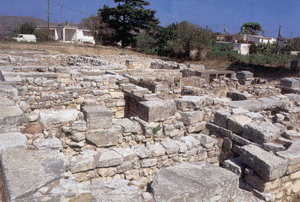
Tylissos: the Minoan town houses west of Heraklion
The most complete guide to Crete: 221 places on the map, 23 routes and 49 articles — with photos, videos and the story behind every place. No sign-up, no trackers.
Routes drawn along real roads
Weather at every stop
Full-text search
“Near me” by geolocation
Create your own printable itinerary
Satellite, terrain, dark mode
Works offline
⌕
Searches 1.7 million characters of descriptions, not just names
—places
4regions
—routes
—with video
Search results
—
Interactive map
Find what is near you
Filters narrow the map and the list at once. Zoom out and pins group together.
Region
Category
Фильтры карты
Landmarks
Featured places
RegionCategory
Routes
Ready-made day trips
Individual places
Articles about landmarks
Tylissos – the Minoan mansions
A chance find in a field led to one of the first major archaeological discoveries on Crete. A farmer turned up some huge bronze cauldrons, and before long archaeologists were uncovering the remains of an important Minoan settlement – three substantial houses of the kind that scholars now call villas or mansions, standing close together on the northern edge of the modern village.
Introduction
Ancient Tylissos (Τύλισος) lies some 14 to 16 kilometres south-west of Heraklion, right beside the present-day village, which has kept the old and probably pre-Greek name. It already appears on the Linear B tablets from Knossos, spelt “tu-ri-so”, where it occurs twice in a list of about fifty Cretan places; Tylissos is thus one of the few place names on the island that have been in unbroken use for some 3,400 years. In Venetian documents it resurfaces as “Tilise” (1271), “Dilisi” (1301) and “Tilisso” (1374).
The settlement stood on the route from Knossos to the west of the island and to the sanctuaries of Psiloritis, the Mount Ida of antiquity. That position tied it to important lines of communication, to fertile arable land and to the resources of the Malevizi district. The village of today, with a little over a thousand inhabitants, sits at about 200 metres above sea level in a valley filled with olive groves and vineyards, on the eastern foothills of Psiloritis. It gives its name to a municipal unit of 131 square kilometres, which counted 2,252 residents at the census of 2021.
The discovery
That an ancient city lay hidden here had already been suspected in the 19th century by the British travellers Robert Pashley and Thomas Spratt, who were struck by the place name and by the quantity of ruins visible on the surface. The real impetus, however, came in 1906, when a villager working his plot stumbled on some large bronze cauldrons and at first intended to sell them.
The exploration of the site is bound up with the name of Joseph Chatzidakis, a physician who was one of the founders of Cretan archaeology and of the island’s archaeological service. In the early years of the 20th century he examined the finds that a local man had made near the monastery of Chalepa, and went on to uncover three large buildings. His campaigns ran from 1902 to 1913. Later Nikolaos Platon and other archaeologists continued the work. Between 1951 and 1955 the walls were secured and restored under Platon, then Ephor of Antiquities for Crete, with the stonemason Zacharias Kanakis; a further excavation followed in 1971 under Athanasia Kanta, which looked at the fragmentary structures east of House A, and more consolidation was carried out in 1990–1994. On a hill above the village a Minoan peak sanctuary was investigated by Stylianos Alexiou in 1963; it yielded stone horns of consecration and clay figurines of people and animals. In this way a chance find grew into the methodical study of a whole town.
The earliest traces of habitation go back to the Prepalatial period, before 2000 BC – pottery shows that the place was occupied from the phase known as Early Minoan II. Tylissos reached its height in the Neopalatial period, between about 1650 and 1450 BC, and lived on through the Postpalatial period into the 12th century BC. Around 1450 BC part of the complex was destroyed by fire; later a building of Mycenaean type rose on the spot, and in historical times a Greek sanctuary with an altar. The rectangular base of that altar can still be seen in the paved court north-west of House C, a court that overlies earlier pavements of Minoan date and was bordered on its north side by a Postpalatial portico with seven wooden columns. A long-lived place of worship here may be one reason why life continued after the fire. Unlike many other Cretan sites, Tylissos was not abandoned even after the collapse of palatial rule around 1200 BC.
Three Minoan houses
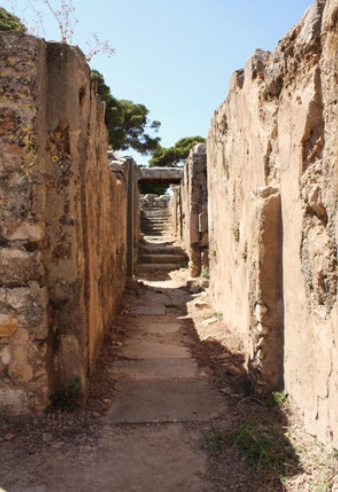
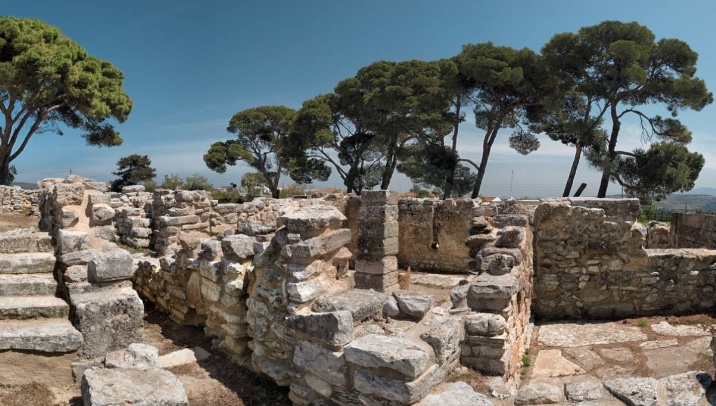
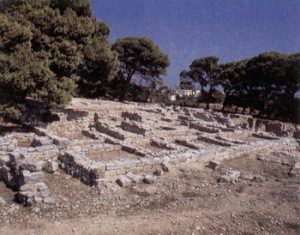
The houses that were uncovered did not form a palace in the strict sense, yet their size and their fittings attest to the high standing of the settlement. House A was a two-storey mansion with a monumental entrance, storerooms and living quarters grouped around a Minoan hall. Measuring roughly 35 by 18 metres, a ground area of about 630 square metres, and with 24 rooms, it is the largest of the three; it was built of dressed poros stone. A tripartite entrance on the east side, set back and framed by pillars, led into a room with a central column. To the north lay the storerooms, each with two square piers down the middle to carry the floor above, in which more than fifty large storage jars, known as pithoi, were found. The heart of the house, to the south, was the central megaron with a front of piers and multiple doors, the so-called polythyron, opening on to a light well; beside it was a sunken lustral basin, and near by a pillar crypt of the kind associated with cult. Large reception rooms are assumed to have occupied the upper floor.
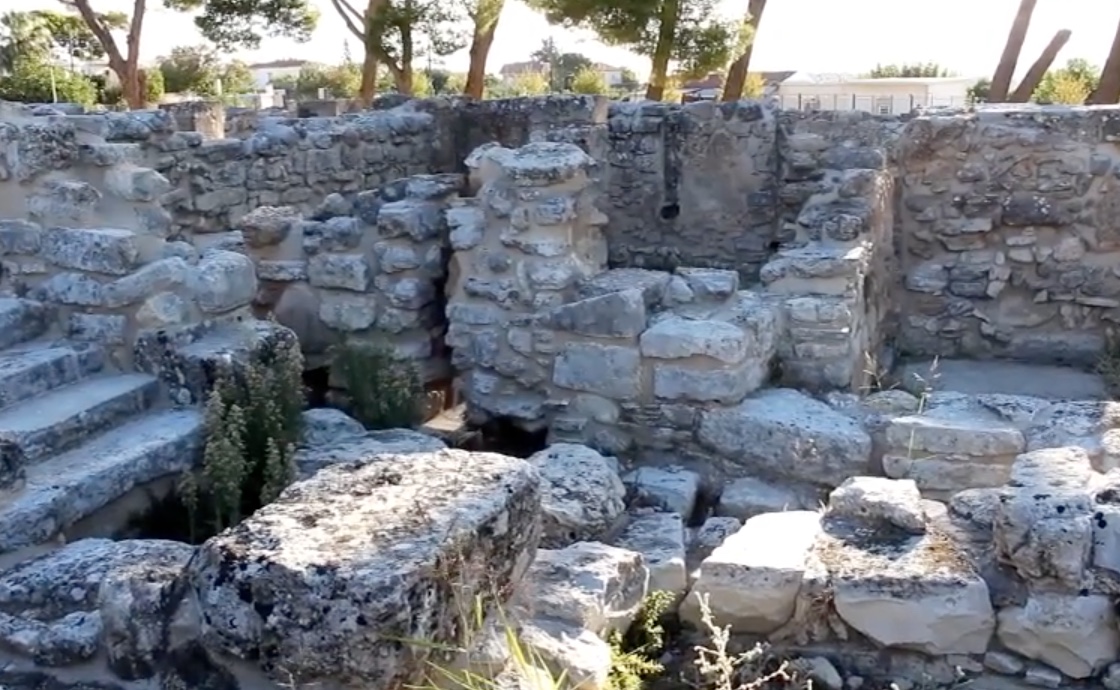
House B, to the west of House A, is likewise rectangular and two-storeyed but simpler in plan, its surviving ground floor given over largely to storage; it produced pithoi and a great deal of pottery – lidded boxes, cooking pots, jugs and cups. House C consists of two successive buildings: the Neopalatial one, which had its own hall with pier-and-door partitions, light well, lustral basin and pillar crypt, was destroyed around 1450 BC and rebuilt in the 14th to 13th century BC. Column bases and door thresholds survive here – one threshold of saw-cut limestone is 2.75 metres long – along with a stone water channel, a small cistern and, above all, a large circular masonry cistern with a flight of steps leading down to the water. It belongs to the later rebuilding and has counterparts at Archanes and Zakros. About 38 metres north-west of House C the clay pipes of an aqueduct came to light, which drew its water from the spring at what is now Agios Mamas – the same spring that supplies the village today.
Bronze and trade
The most famous finds are three enormous bronze cauldrons, unmatched in size anywhere in the prehistoric Aegean; they were hammered from sheets of copper and riveted together, and stood in the storerooms of House A. To these must be added a large cast bronze figure of a man, probably a worshipper in an attitude of prayer. Such pieces speak of highly developed metalworking and of access to considerable supplies of copper. Tylissos evidently did not merely obtain the metal from outside but worked it on the spot – for its own needs and for exchange. Other finds include gold leaf, bronze double axes, a sealstone and an offering table of steatite and, from the chamber tombs of about 1400–1200 BC, painted clay coffins (larnakes) with pottery, jewellery and seals. Most of the objects are now in the Heraklion Archaeological Museum.