The most complete guide to Crete: 221 places on the map, 23 routes and 49 articles — with photos, videos and the story behind every place. No sign-up, no trackers.
Routes drawn along real roads
Weather at every stop
Full-text search
“Near me” by geolocation
Create your own printable itinerary
Satellite, terrain, dark mode
Works offline
⌕
Searches 1.7 million characters of descriptions, not just names
—places
4regions
—routes
—with video
Search results
—
Interactive map
Find what is near you
Filters narrow the map and the list at once. Zoom out and pins group together.
Region
Category
Фильтры карты
Landmarks
Featured places
RegionCategory
Routes
Ready-made day trips
Individual places
Articles about landmarks
Malia
Present-day Malia is a holiday resort on the north coast of Crete, close to a Minoan palace with an exceptionally rich history.
Find on the map
Introduction
Malia is among the most important holiday centres on the island. Its broad sandy beaches – the shoreline runs for some six kilometres – and a well-developed tourist infrastructure draw guests from all over the world, who find here a wide choice of things to do as well as sights of cultural interest. Chief among the latter are the excavations of the Minoan town over which, according to myth, King Sarpedon ruled, and curious churches such as the Panagia Galatiani, which tradition says was built with milk instead of water. Malia is also famous for the finds from Chrysolakkos, the “gold pit”, which owes its name to the wealth of gold objects recovered there.
The place name is usually derived from the Greek word “omalia” – level ground: Malia lies in a fertile coastal plain at the foot of the Selena range, barely twenty metres above the sea and around 35 kilometres east of Heraklion. Administratively it now belongs to the municipality of Hersonissos; the municipal unit of the same name, which covers some sixty square kilometres, includes besides Malia itself – where about 3,500 people were counted as permanent residents at the census of 2021 – Stalida, three kilometres to the west, the hill village of Mochos at an altitude of around 400 metres, and Krasi, higher still on the north-western spurs of the mountains.
Modern Malia
Malia is one of the largest tourist centres in Crete and stretches along a magnificent sandy beach with good facilities. In summer especially, thousands of visitors arrive from all over the world; for sheer intensity of tourism only Limin Hersonissou can compete with it. The main street, which bears the name of Eleftherios Venizelos, links the seaside resort with the old village of the same name, which lies on slightly higher ground and is surrounded by green olive groves. An economy that once depended on the fields now revolves almost entirely around hotels, restaurants and shops.
Only a few decades ago Malia was a modest farming village. In Venetian documents and maps it appears around 1390 under the names “Manlia” and “Maglia”, and like many coastal places in Crete it suffered repeatedly from pirate raids. After the Ottoman conquest of 1646 the land fell to the Sultan; only when the Ottoman system of landholding was abolished around 1850 did the villagers come into possession of their fields. For a long time people lived by growing barley and carobs; later, numerous wind pumps raising groundwater to the fields turned the plain into a garden for vegetables and potatoes. Today the district is also known for its bananas, which thrive in greenhouses. The German occupation in the Second World War left a dark chapter behind it: forgotten minefields went on claiming many victims after the war had ended.
Tourism began in the 1950s; around 1960 the first hotel was built, and in the 1980s and 1990s Malia became one of the best-known holiday destinations on the island, above all for young travellers in search of the boisterous nightlife along the road to the beach – a reputation carried far and wide by a British film comedy of 2011, and one that the local hoteliers have since tried hard to live down. In the centre, by the church of Agios Nektarios, the two main axes cross: one leads from the old village down to the sea, while shops, cafés and services line the other. Those who want quiet will find it in the narrow lanes of the old village with its churches – among them those of St George and of the Archangels – or on the less frequented sandy beach east of the little port, in the direction of the excavations.
Ancient Malia
Malia, on the north coast of Crete, is one of the most important archaeological sites bearing witness to the greatness of Minoan civilisation. The city, wreathed in myth and legend, was with Knossos and Phaistos one of the three great centres of power in the Minoan world; its palace ranks as the third largest on the island after those two. The site was already settled in the Neolithic, and occupied continuously from the middle of the third millennium BC, but it flourished in the Bronze Age, between about 1900 and 1450 BC, when the palace with its complex architecture and advanced technical installations arose and prospered. It lies around three kilometres east of the modern town, close to the sea, on the edge of the fertile plain – a position that favoured both exchange with the agricultural hinterland and seaborne trade.
Like the other Minoan city-states, the realm of Malia was ruled, legend says, by mythical sovereigns, direct descendants of Zeus and Europa. Sarpedon, brother of Minos and Rhadamanthys, is supposed to have reigned over Malia and brought it prosperity and wealth. The site itself long remained unknown: only around 1880 did the landowner come upon small leaves of gold, whereupon treasure hunters plundered the spot and gave it the name Chrysolakkos; many a piece of Minoan jewellery was melted down at that time. Systematic excavation was begun in 1915 by the Greek archaeologist Joseph Chatzidakis; from 1922 the French School at Athens took over, first under Fernand Chapouthier, who dug here until 1936, and its work continues to the present day. What came to light was not only the palace but a many-layered town with houses, cult buildings and cemeteries – evidence of a highly developed social and economic order. Its administrators kept records, too: inscriptions in Cretan Hieroglyphic were found in the palace and in the town quarter known as Quartier Mu, along with a handful of tablets in Linear A.
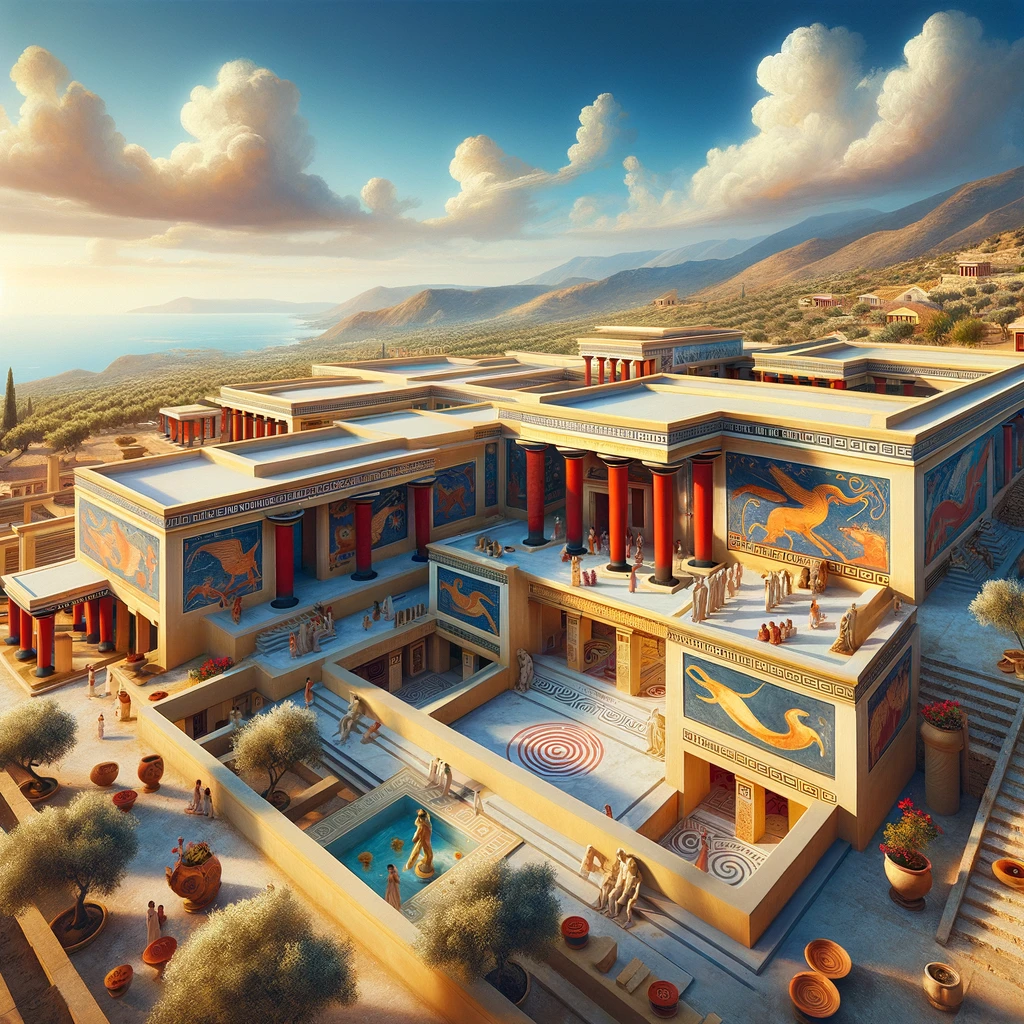
Among the most impressive features of Malia is the labyrinthine palace, which bears comparison with that of Knossos. With its multi-storeyed parts – it demonstrably had at least two floors – its central court, ceremonial halls, storerooms and living apartments, it testifies to the astonishing architectural and engineering skill of the Minoans. It was built of local stone: ironstone, sandstone and conglomerate. The main entrance lay on the north, towards the sea; raised processional ways crossed the paved west court. In the middle of the central court stood an altar – a sunken pit with four supports, of a kind found in no other palace – and colonnades ran along its north and east sides. The two-storeyed west wing united cult rooms, state rooms and living rooms; a raised hall with a pillar, the so-called Loggia, reached from the court by four steps, is interpreted by some scholars as a throne room on the model of Knossos, and a large assembly hall with a pillar crypt is also attested – one of its two massive pillars still shows an incised double axe. In the south were mainly workshops, in the north an oil press; to these must be added treasuries, workshops for ivory and metalwork, storerooms with drainage channels for the great pithoi – in the six east magazines the jars stood on raised benches with a gutter between them – and, in the south-west corner, two rows of round silos, eight in all, which presumably held grain. Water supply and drainage, and the carefully considered lighting and ventilation of the rooms, attest the high technical standard of this early civilisation.
Not far from the palace the burial complex of Chrysolakkos was discovered, dating from the Old Palace period (c. 1900–1700 BC): a rectangular structure of dressed stone, some 30 by 39 metres, divided into many small compartments. Here the archaeologists found numerous burials with rich grave goods, among them exquisite gold jewellery. The most famous piece is the gold pendant with two bees jointly clasping a honeycomb – an emblem of fertility and a masterpiece of the Minoan goldsmith’s art, found during Chatzidakis’s campaigns and now on display in the Heraklion Archaeological Museum. From the palace itself come, among other things, two small ceremonial swords with gold-decorated hilts, an altar stone with relief ornament and other ceremonial weapons. These finds confirm that Malia was an important religious and cultural centre in which craft and art flourished. Near by, moreover, was a peak sanctuary on the hill of Profitis Ilias.
As with many other Minoan cities, a succession of natural and historical convulsions put an end to Malia around the middle of the 15th century BC. The volcanic eruption on Thera (Santorini) had taken place as early as the 17th century BC; scholars attribute the final destruction of the palatial centre by fire around 1450 BC to a whole cluster of causes, not to a single catastrophe. Life did not cease altogether: parts of the site were reoccupied in Mycenaean times and were finally abandoned only around 1250 BC.
The grounds are open to visitors and for the most part accessible without steps. A protective roof over part of the town excavations shelters the fragile walls, and from the site the view ranges far out over the sea – most agreeably in the morning hours, before the midday heat sets in.
The “milk church” of Panagia Galatiani
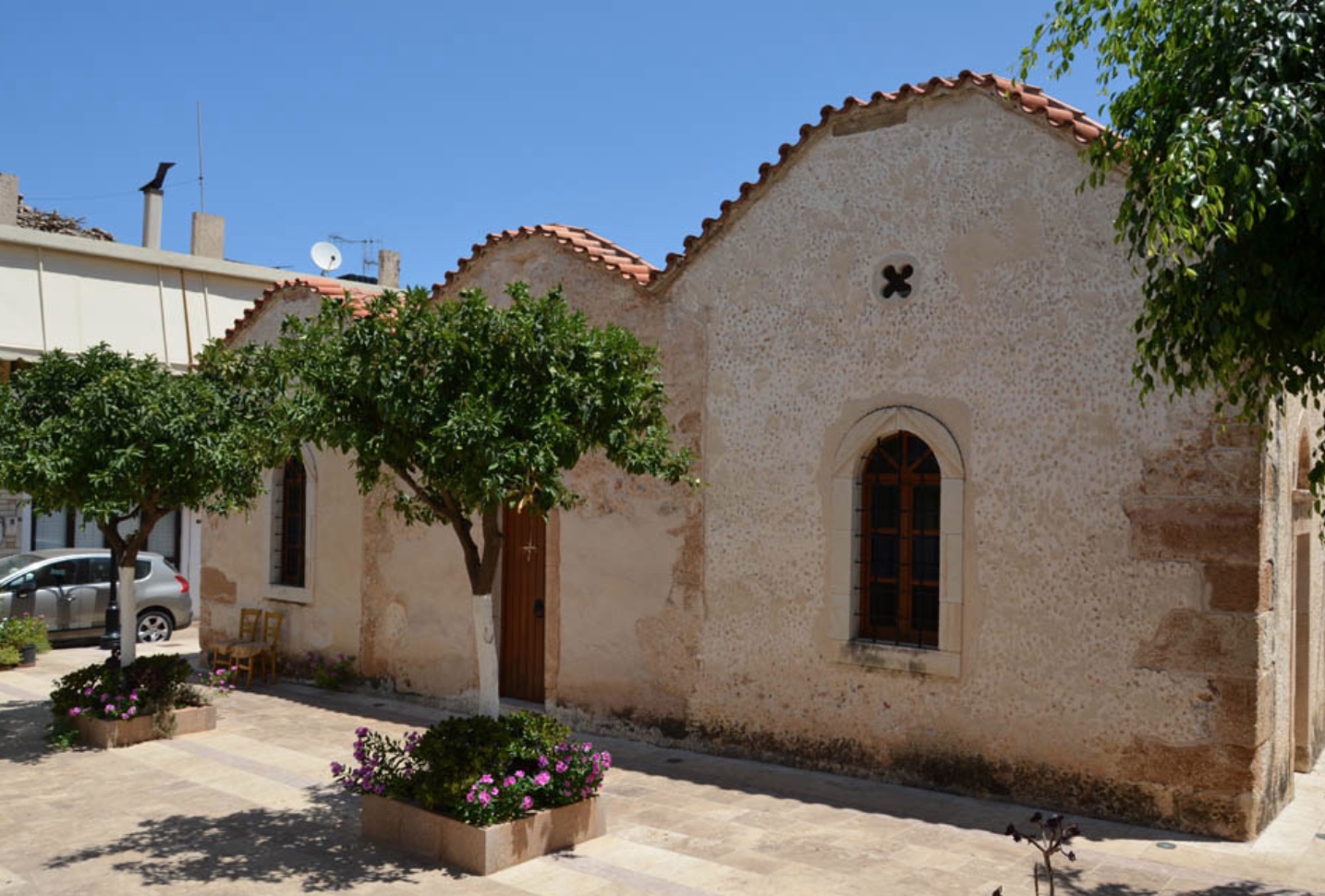
In the midst of the old village stands the church of the Panagia Galatiani (Παναγία Γαλατιανή), which is dedicated to the Presentation of the Virgin in the Temple and belongs to the Metropolis of Petra and Hersonissos. It owes its epithet to a local tradition according to which the builders mixed their mortar not with water but with milk – “gala” is the Greek for milk.