Agios Myronas and St Myron of Crete, the Wonderworker
The most complete guide to Crete: 221 places on the map, 23 routes and 49 articles — with photos, videos and the story behind every place. No sign-up, no trackers.
Routes drawn along real roads
Weather at every stop
Full-text search
“Near me” by geolocation
Create your own printable itinerary
Satellite, terrain, dark mode
Works offline
⌕
Searches 1.7 million characters of descriptions, not just names
—places
4regions
—routes
—with video
Search results
—
Interactive map
Find what is near you
Filters narrow the map and the list at once. Zoom out and pins group together.
Region
Category
Фильтры карты
Landmarks
Featured places
RegionCategory
Routes
Ready-made day trips
Individual places
Articles about landmarks
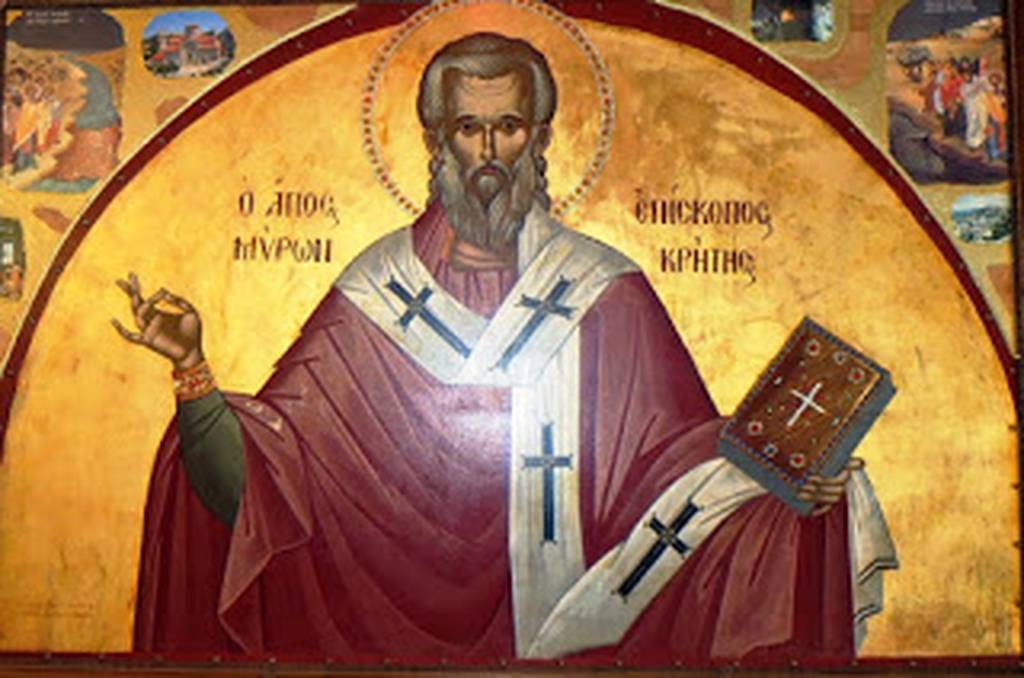
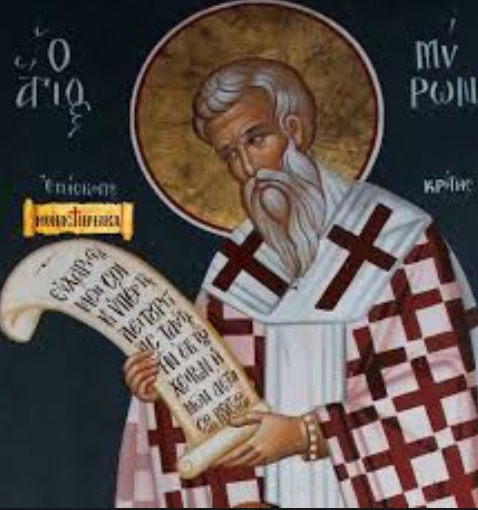
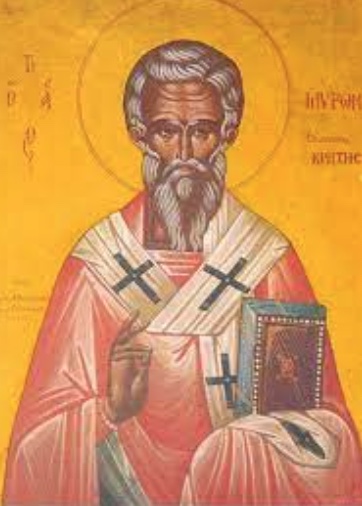
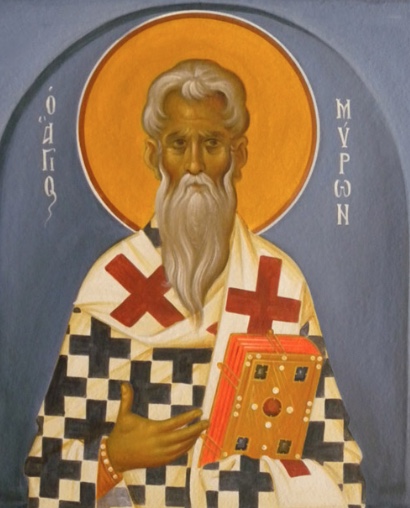
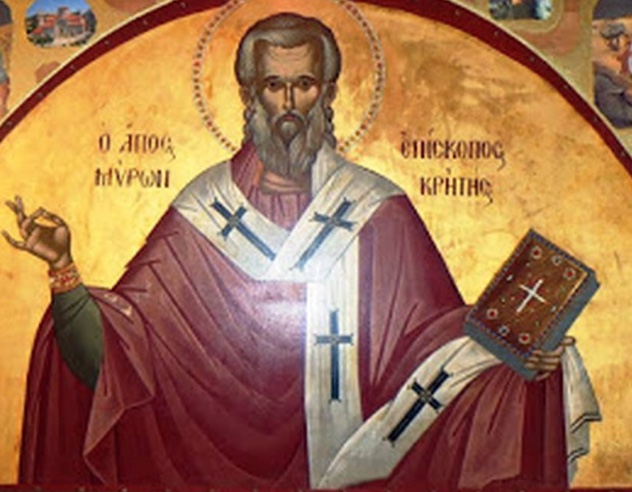
St Myron of Crete, bishop and wonderworker
Agios Myronas (Άγιος Μύρωνας) lies some 18 to 20 kilometres south-west of Heraklion, at a height of about 340 metres, with Krousonas a little over four kilometres away and the wine village of Dafnes under three. Greeks like to call it the “twin-peaked village”, for its houses are spread over two neighbouring hilltops, with lanes, flights of steps and small squares strung between them; the clock tower of the school is the landmark by which it is recognised from a distance. From the top the view runs far out over the country of Malevizi, of which Agios Myronas was long the chief village. All around, vineyards, olive groves and gardens run down the slopes; springs, stone fountains – among them a Venetian stone-built spring in the Kato Vrisi quarter – and the well-preserved rural architecture of the district give the place its character. At the census of 2021 it had 569 inhabitants.
The village stands on the ground of ancient Rafkos (Ραύκος, in Latin Rhaucus), a city of central Crete that is often mentioned in the Classical and Hellenistic periods. The ancient coastal handbook that goes under the name of Pseudo-Scylax places it south of Knossos in the direction of Gortyn, Polybius names it in his Histories, and the Cretan writer Antenor brought it into his account of the bees of the island; an old tradition even links the place with the cycle of legends about the Trojan War. The secure evidence consists of the city’s coins and numerous inscriptions; sherds, worked stones and chance finds from the area, the oldest of them going back to about 1900 BC, are kept in the Heraklion Archaeological Museum, and a chamber tomb of the Late Minoan IIIA period came to light here in 1941. There has so far been no systematic excavation, which is why much about ancient Rafkos remains obscure. According to local tradition the settlement kept its old name until the 4th century; after that it was called after its great son, St Myron – though exactly when the change of name took place cannot be said with certainty. The new name is found in written records by 1281.
The high point of the year is 8 August, the saint’s feast day, the day on which he is said to have died. Agios Myronas then celebrates one of the largest church festivals in Crete, the close of a week of cultural events, the Rafkia, that begins on 1 August and takes its name from the ancient city. Pilgrims from all over the island venerate the relics in the main church, go down to the grotto in which Myron is said to have lived as an ascetic, and draw the wonder-working holy water there – something that, in the crush of the feast day, by no means everyone manages to do.
Find on the map
Village, wine and history
Village life still rests on the vine and on wine-making; the wine of Malevizi is well thought of in Crete and beyond, and most of the villagers are farmers who produce wine and raisins. The district is known, too, for its tsikoudia, the clear spirit distilled from the pressed grape skins each autumn, and for the sweets of the vintage and the feast – moustalevria, a pudding of grape must, and the fried pastry spirals called xerotigana. In the Venetian census drawn up by Kastrofylakas in 1583 the village appears under the name “Samiro”, with 254 inhabitants; in 1837 it numbered seventy families, three of them Muslim. The severe earthquake of 1856 destroyed Agios Myronas almost completely; in the rebuilding, however, the characteristic features of Cretan building were kept, so that the village still has a coherent and unusually handsome appearance. Its population reached 1,117 in 1961 and has fallen since. Its people also had their share in the modern history of Greece: men from Agios Myronas fought in the Macedonian Struggle, in the Therisso revolt at the side of Eleftherios Venizelos, in the Balkan Wars and in the Second World War, and monuments in the village commemorate them.
The grotto and the holy spring
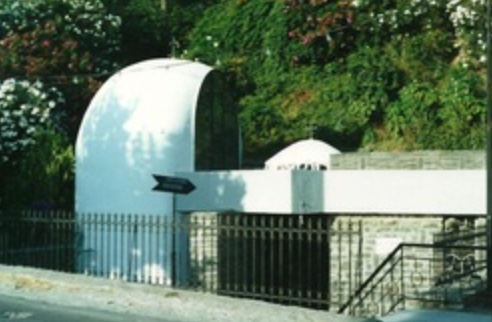
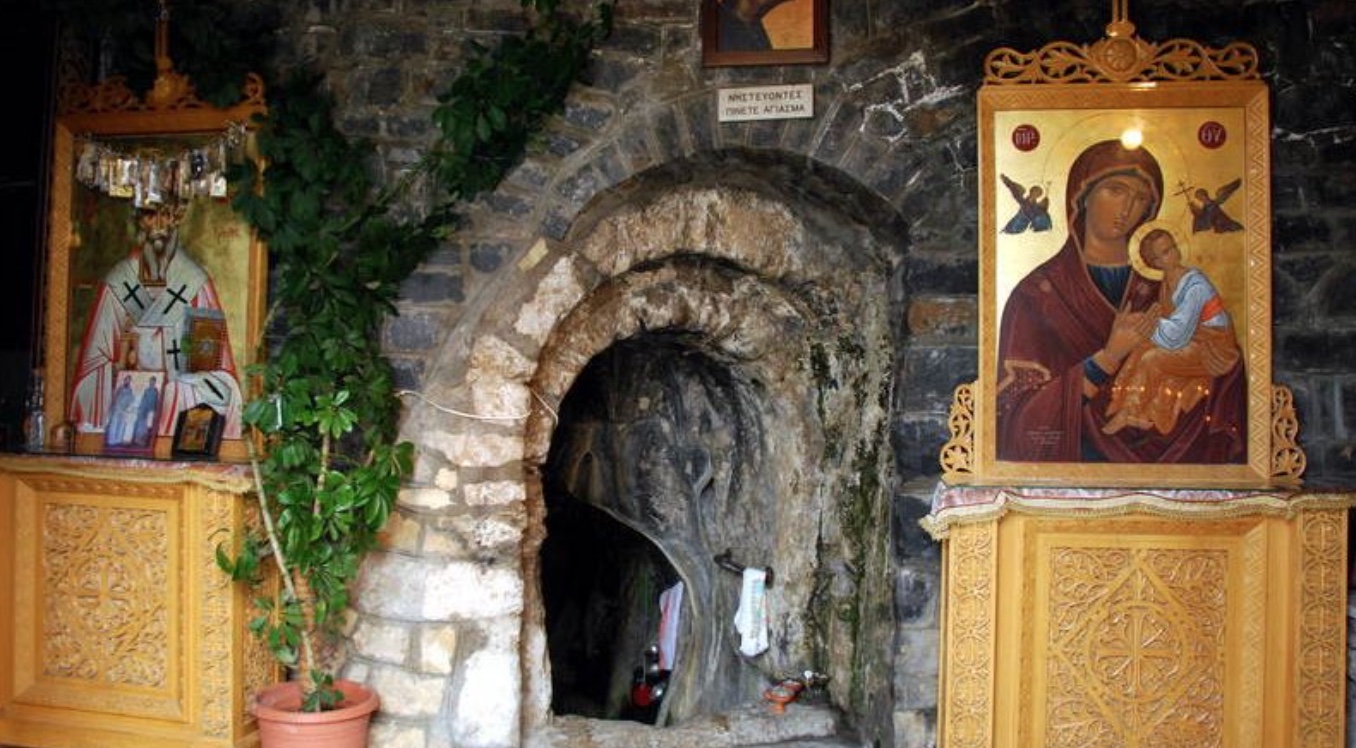
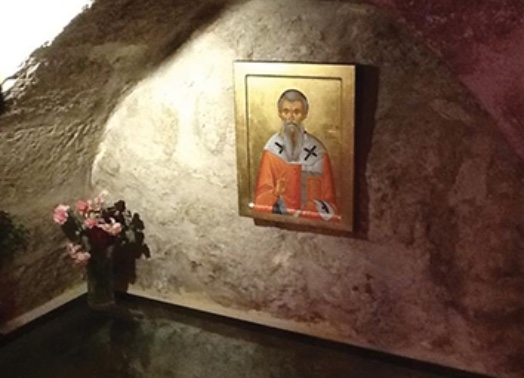
From the inner courtyard of the church, steps lead down the western slope to a small grotto that lies directly beneath the building. Local tradition holds it to be the place where St Myron prayed and spent the greater part of his ascetic life. The former hermitage, an underground chamber below the church, has today been fitted out as a chapel.
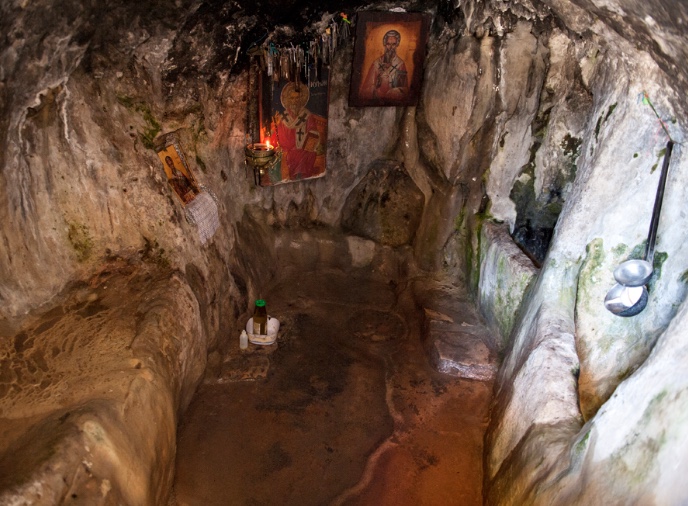
Three steps lead into the cave itself. Inside, a ledge of rock rises about half a metre above the floor – the saint’s “stone bed”, on which, tradition says, he rested from prayer. In the floor three small hollows can be seen, scooped out like bowls; in the middle one the water of the holy spring collects. In a niche stands the icon of the saint, before which an oil lamp is always kept burning.
The water that pilgrims have drawn here for centuries is regarded by the faithful as a gift of grace from St Myron, and its first appearance is held to have been miraculous. According to local tradition the spring fails neither in winter nor in summer; one story has it that it once broke forth during a drought in answer to the saint’s prayer. Another legend sees in the roof of the grotto the head of the petrified dragon of which more is said below.
Popular belief explains the source of the water in two ways: some trace it to the saint’s tomb, which lies beneath the church, others to the dampness of the grotto, which is said to be especially noticeable on the feast day during the reading of the Gospel. For believers the explanation matters less than the presence of the spring itself and the prayer with which one approaches it.
Pilgrims take up the water with the small spoons laid ready beside the basin, and use it with prayer. In the tradition of the Church holy water is no ordinary remedy but a sacred thing, bound up with prayer and with the memory of the saint. People with diseases of the eyes in particular have long sought out the spring; many accounts tell of their recovery.
The holy spring: the testimony of Father Nikolaos Kritsotakis
Father Nikolaos Kritsotakis, who has served as priest of the church since 1997, related that one day the sacristans wanted to clean the basin of the spring of small objects and oil. They baled the hollow out completely and washed it thoroughly – yet after a short while it had filled again, and with more water than before. In the memory of the parish this event lives on as a testimony to the wonder-working of the saint.
The church
The miracle stories that surround St Myron belong to the church tradition of Agios Myronas. Healings, help for prisoners and the protection of the church are understood in them as the working of divine grace through the saint’s intercession. For that reason each miracle is told below as a story of its own, with the names, circumstances and details that local tradition has preserved.
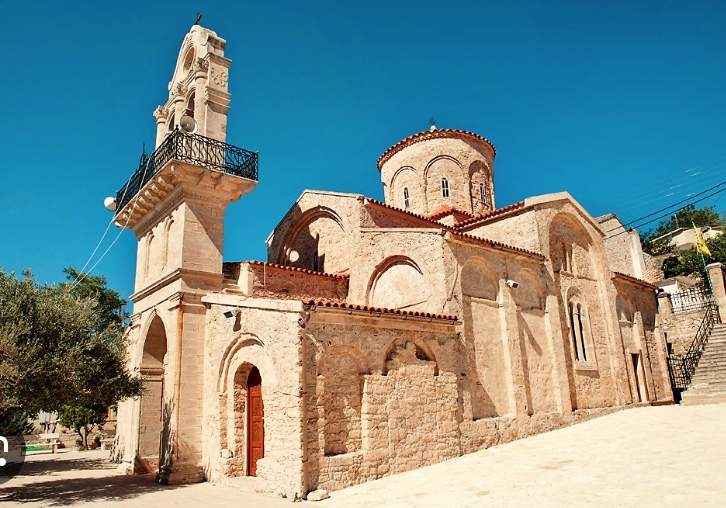
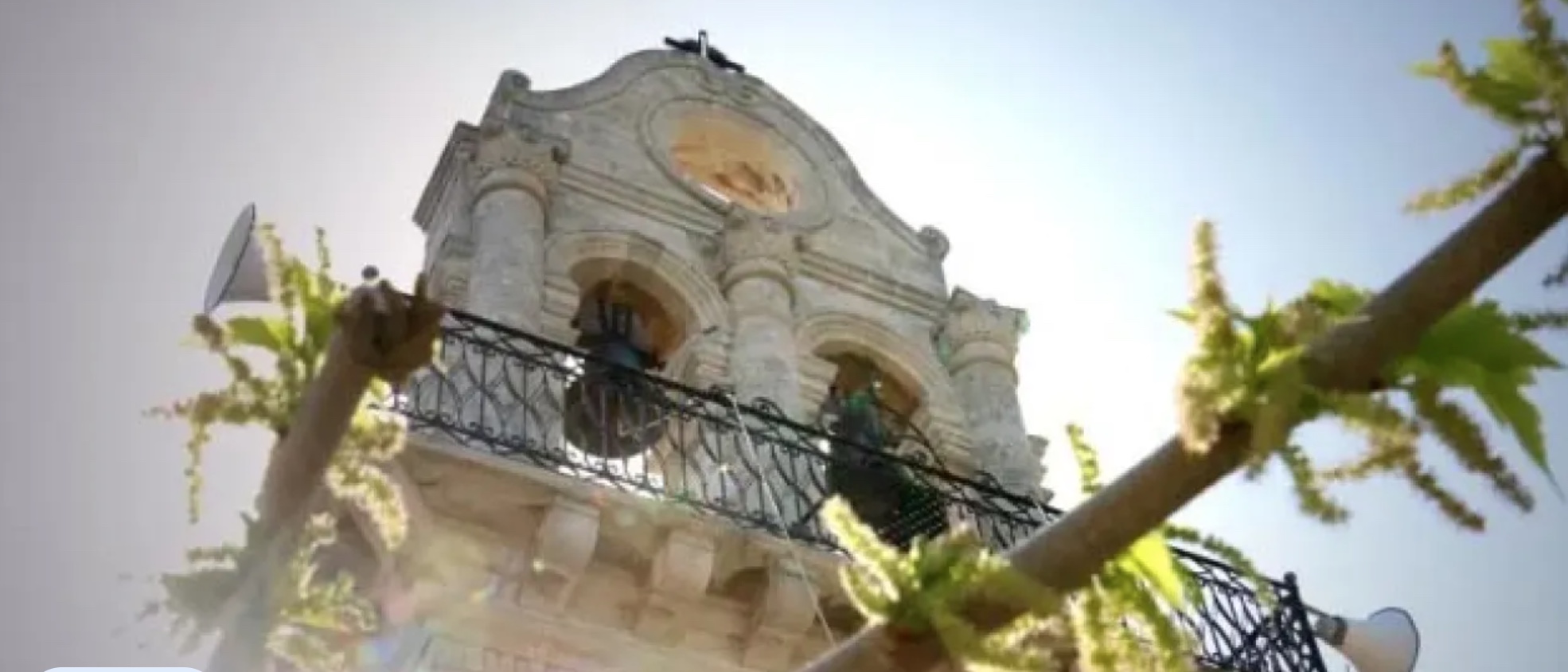
Beside the grotto stands the main church of Agios Myronas, whose bulk dominates the middle of the village; it is not the only church here, for the village also has one dedicated to the Transfiguration of the Saviour and St Charalambos. To this spot the saint’s relics were translated, and from him the settlement took its name. The church stands on the site of an Early Christian basilica, of which the great apse with its synthronon, the semicircular bench for the clergy, has survived. After the liberation of Crete from Arab rule in 961 the episcopal see of Knossos may have been moved here, which is likely to have prompted the building of the present church; its architectural forms point to the 12th century. It is a cross-in-square church with a dome carried on four supports; the tripartite narthex was added later and opens through three arches towards the aisles. In the 19th century the west wall of the narthex was replaced by a sturdy structure carrying a large bell tower of two arches. The interior is painted with modern frescoes. Having been in use, on this reckoning, since the saint’s own day, it is counted among the places of worship longest in continuous service in Greece.
The tomb of St Myron lies beneath the church; an arcosolium – an arched burial recess – on the south-east side is likewise associated with his burial. To the tomb and to the relics, from which according to tradition a sweet fragrance of myrrh arises, the faithful come to ask for healing, and local tradition knows many testimonies of such help.
The Life of St Myron of Crete
In the oldest account of his life Myron is called “president of Crete”, that is, bishop of the Church of the island. Later tradition calls him bishop of Knossos; this has to do with the fact that in the second Byzantine period the old see of Knossos was moved to the neighbourhood of Rafkos. Older tradition, by contrast, points to Gortyn. The two reflect different stages of the local tradition.
According to church tradition Myron was born about 250 at Rafkos, into a family that worked the land, and so grew up in the years of the persecution of Christians under the Emperor Decius; he fell asleep in great old age on 8 August about the year 350. His parents, well-born and devout, sheltered him in that dangerous time and brought him up in the faith. Even as a child he was noted for prudence, obedience and compassion, and kept away from the follies of his contemporaries. About 320 to 330, by then a man of seventy or so, he was raised to the episcopal throne of Gortyn; later he became famous for his miracles and for his care of the needy. Although the calendars sometimes style him a martyr, he died a quiet and natural death.
The miracle of the grapes and the wine
Once the young Myron gave away the whole vintage of the family vineyard to the poor. His mother reproached him: after a full year’s work the family now had nothing with which to fill its wine casks. Myron answered: “God has kept something for us too.” In the vineyard only a single cluster with three grapes was still to be found. When he laid it in a cup, the must began to flow from the grapes and filled the family’s casks and finally those of the whole village. So local tradition tells of the saint’s open-handedness – a fitting story for a village that still lives by its vines.
Mercy towards the thieves
In his youth Myron tilled the land and helped the hungry, widows and orphans; each year, it is said, he set grain aside for the poor, and his harvests were none the smaller for it. One night thieves came to his threshing floor to steal corn. One of them could not lift his sack. Then the saint himself hoisted the load onto the man’s shoulder and said: “God forgive you.” Another time he caught men who meant to steal his chickpeas; instead of pursuing them he blessed them, made them a present of the crop and asked only that they keep silent about it. Both stories lay the stress not on punishment but on the mercy of the Gospel, by which, according to tradition, Myron moved people to repentance; the thieves of the threshing floor are said to have been so ashamed that they led honest lives from then on.
From farmer to bishop
Myron married a devout and believing woman, who died young. After her death he gave himself wholly to prayer, fasting, the reading of Holy Scripture and the service of others. He was ordained reader, and later priest. When the persecutions ended under Constantine the Great, he preached the Gospel by word and by the example of his life. After the death of the bishop of Crete, clergy, magistrates and people chose him as bishop of Gortyn, although he would have preferred solitude; from there he is said to have sent representatives in support of the First Ecumenical Council. Church tradition reports that he lived to be about a hundred and left behind many disciples and a rich work of charity: he fed the hungry, clothed the naked, cared for widows and orphans and took in strangers.
The crossing of the River Triton
On a winter visitation of his diocese Myron found the River Triton – today called the Giofyros (Γιόφυρος), which runs into the sea west of Heraklion – swollen and impassable. The bishop traced a sign over the water with his pastoral staff, whereupon the current stood still and his companions crossed dry-shod, as if over firm ground. He then told his deacon to repeat the same sign, and the river resumed its course.
The dragon of Agios Myronas
One of the best-loved legends of the village tells of a dragon that devoured people and animals in the district. One Sunday morning, during the liturgy in the church of the Saviour (Sotiras), Myron sent his deacon out with the bishop’s staff and had the beast commanded, in the name of Christ, to stir no more. The dragon froze. After the service the saint threw a large stone at it, and stones fell like rain until the monster had become a huge rock of some 1,000 square metres. This “dragon” can still be seen outside the village, and the farmers read the weather from it: if white foam appears from its clefts, rain is on the way; if sounds come from within it, a hard winter lies ahead – a natural barometer all its own.
The freeing of the prisoners in 1826
Local church tradition relates that in 1826 an Ottoman detachment from Megalo Kastro, the present Heraklion, under the command of Hasan Pasha, rounded up the inhabitants of the surrounding villages and brought them to Agios Myronas. The prisoners were held beside the church – some accounts say on its roof; the next day they were to be marched to Heraklion, some of them to be killed and the rest sold into slavery. All night long the prisoners prayed to St Myron. Towards midnight a dazzling light appeared above the church and sank upon the building like tongues of fire; then came thunder and a tremendous din. The guards fell into a panic, believing that a Christian army was advancing on the village, and fled. The villagers set the prisoners free.
The healing of Hussein Aga
Hussein Aga of Archanes, an Ottoman dignitary, had according to tradition taken part in massacres of Christians before he went blind. Neither physicians nor sorcerers could help him; Christian acquaintances advised him to make the pilgrimage to the Mother of God on Tinos, but from there too he came back blind. When he heard of the miracles of St Myron he came to the village church and knelt at the saint’s tomb throughout the Divine Liturgy. As the priest read the Gospel, the blind man cried out: “Glory to God and glory to the holy elder – I can see!” After the service he went down into the grotto, washed his eyes with the water of the holy spring and was completely healed. Until his death in 1859, it is said, he came back to the church again and again and endowed it with gifts.
Further traditions from the Ottoman period
The parish preserves other stories besides. An Ottoman official named Bentri Efendi is said to have permitted the repair of the church, but another, Hadji Mustafa, forbade the work, meant to turn the church into a mosque and killed Bentri; on the road to Heraklion he died of dysentery, and the building was spared. On another occasion Ottoman troops stored provisions under guard in the church, until a fearful thundering began in the night and the sentries fled screaming that a white-bearded old man in a golden robe was driving them out. The next day the provisions were removed and the church given back to worship. Finally, in the summer of 1861, so tradition has it, a woman of Heraklion named Marigo, gravely ill with a nervous disorder, was healed during the service after five days of common prayer, fasting and daily liturgies at the saint’s tomb.