The most complete guide to Crete: 221 places on the map, 23 routes and 49 articles — with photos, videos and the story behind every place. Everything is open and free: no sign-up, no paid sections and no advertising, open or hidden. You can install the guide on your smartphone as an app.
Routes drawn along real roads
Weather at every stop
Full-text search
“Near me” by geolocation
Create your own printable itinerary
Satellite, terrain, dark mode
Works offline
⌕
Searches 1.7 million characters of descriptions, not just names
—places
4regions
—routes
—with video
Search results
—
Interactive map
Find what is near you
Filters narrow the map and the list at once. Zoom out and pins group together.
Region
Category
Фильтры карты
Landmarks
Featured places
RegionCategory
Routes
Ready-made day trips
Individual places
Articles about landmarks
Agios Nikolaos has comfortable accommodation of every kind and category, from the small family hotel on the hillside to the spacious resort by the sea. In the centre, cafés, tavernas, bars and shops stand shoulder to shoulder. Tourism has long since become a matter-of-fact part of the town’s life, yet its true face is still defined by the harbour, by the lake at its heart and by the monuments strung along the coast.
Find on the map
Agios Nikolaos
A town on Mirabello Bay
Agios Nikolaos (Άγιος Νικόλαος) is the administrative seat of the regional unit of Lasithi in eastern Crete, 64 kilometres from Heraklion, and one of the Greek towns most thoroughly shaped by tourism. It spreads over several hills on the western shore of the broad Mirabello Bay; its white houses step down towards the water, and because the ground is steep, countless flights of steps link one lane with the next. Around 20,000 people live within the municipal area and about 11,000 in the town itself; the census of 2021 put the figures somewhat higher, at 21,562 and 13,605. Harbour, promenades, residential quarters, archaeological sites and holiday complexes merge here without a seam, and Agios Nikolaos also has the first marina to be built on Crete.
Unlike Heraklion, Chania or Rethymno, Agios Nikolaos was for long stretches of its history a place of no great consequence. It owes its present role as district capital and holiday centre to the developments of the 19th and 20th centuries – and yet the traces of human settlement here reach back to Minoan times, and at Priniatikos Pyrgos, a little way along the bay, occupation has been followed from about 3000 BC down to the Roman period.
From Lato pros Kamara to Byzantium
As early as Minoan times there was a small landing place a little to the north of the present harbour. In the Dorian period the town of Lato pros Kamara (Λατώ προς Καμάρα) grew up on the hill between today’s lake and the harbour, as the seaport of powerful Lato, whose impressive ruins lie some ten kilometres inland near Kritsa; the people of the hill city came down to the shore once access to a harbour had come to matter more to them than a defensible height. The port was at its most prosperous in the 3rd century BC; for a time it was independent and struck its own coins, on which Artemis, Eileithyia and Hermes were shown. With fluctuating fortunes the settlement lasted into the Early Byzantine period, to about the 6th century AD. One of the best-known finds of the district comes from a grave in the Roman cemetery: the skull of a young man – presumably an athlete – still wearing a wreath of gold, and buried with a coin; it is dated to the 1st century AD.
In Byzantine times the place was known as the seat of a bishop under the name Episkopi Kamaras, but it remained small and little developed. To that era belongs the church of St Nicholas, after which the modern town is named.
The church of St Nicholas and the memory of the town
The little cross-in-square church stands on the Ammoudi peninsula, north of the town centre and right by the sea, today within the grounds of a hotel. It is usually dated to the 9th century, which makes it one of the oldest surviving churches on Crete. For art historians its importance lies in the earliest layer of painting: this shows no images of saints at all, only geometric and plant ornament and crosses – what is known as aniconic decoration, typical of the age of Iconoclasm or of the decades immediately following it. Over it lie later figural wall paintings ascribed to the 14th century. Frescoes of that century have survived in other churches of the district as well, for instance in the celebrated Panagia Kera near Kritsa.
The position of the church at the water’s edge is a reminder that the life of the place was originally governed entirely by the harbour and the sea lanes, not by the hotels that surround it now. In the Orthodox world St Nicholas is the patron of seafarers; chapels such as this often stood where fishermen and boatmen prayed for a safe return. So it is that religious memory has outlasted every rupture of history in a changing townscape – and in the end has given the whole town its name.
The fortress of Mirabello
After the Fourth Crusade Crete at first came under the sway of the Genoese freebooter Enrico Pescatore, who around 1206 had a fortress built on the hill of Kefali above the harbour. Because the whole bay could be surveyed from it, it was given the name Mirabello – “fine view”. Among other things, the castle housed a store for the salt from the pans of Elounda. When Venice took over the rule of the island, the name of the fortress passed to the entire province of Merambello.
An earthquake in 1303 badly damaged the fortifications, and in 1537 the castle was set on fire in a pirate raid. It was then rebuilt – according to a widespread but unproven tradition to plans by the Veronese military architect Michele Sanmicheli. The settlement at its foot nevertheless remained small, and was inhabited chiefly by experienced fishermen. During the Cretan War the Venetians blew up the fortress in 1646 so that it should not fall into the hands of the Ottoman army. Only slight traces of the castle are left; the administrative centre of the town later arose on its site, and today the prefecture building stands there.
The Ottoman period and a fresh start in the 19th century
Under Ottoman rule the place at first remained the chief settlement of the province, but it gradually fell into decay. An Ottoman survey of 1671 records only 42 male inhabitants for “New Merambello”, which probably means hardly more than 160 people in all. At times the site was all but deserted, yet the harbour went on being used to ship out the produce of the hinterland – carob above all. For want of warehouses, the few churches of the place even served in part as stores for goods.
The real history of the modern town begins after the great Cretan uprising of 1866. It was then that people from various parts of the island settled by the harbour: families from Kritsa, Sfakians from the south-west and seafaring merchants from the east of Crete. The trade in citrus fruit brought modest prosperity, still commemorated by a quarter that bears the name “Citrus Square” – Kitroplatia. Just how small the place was at the time is shown by the census of 1881: Agios Nikolaos was a village of the commune of Kritsa with a mere 95 inhabitants.
The decisive turn came at the beginning of the 20th century, when the administrative seat of Lasithi was transferred here from Neapoli in 1904. With that decision the little harbour assumed the role of district capital. By 1928 the town already numbered 1,543 inhabitants, and in 1991 just under 8,000.
Lake Voulismeni
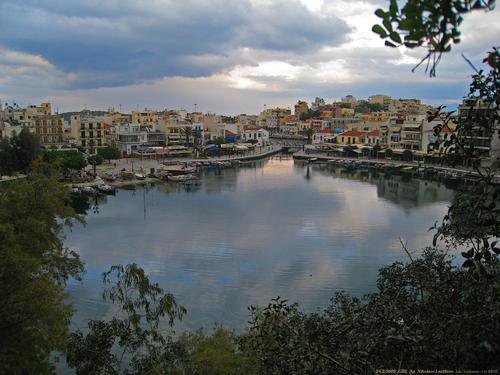
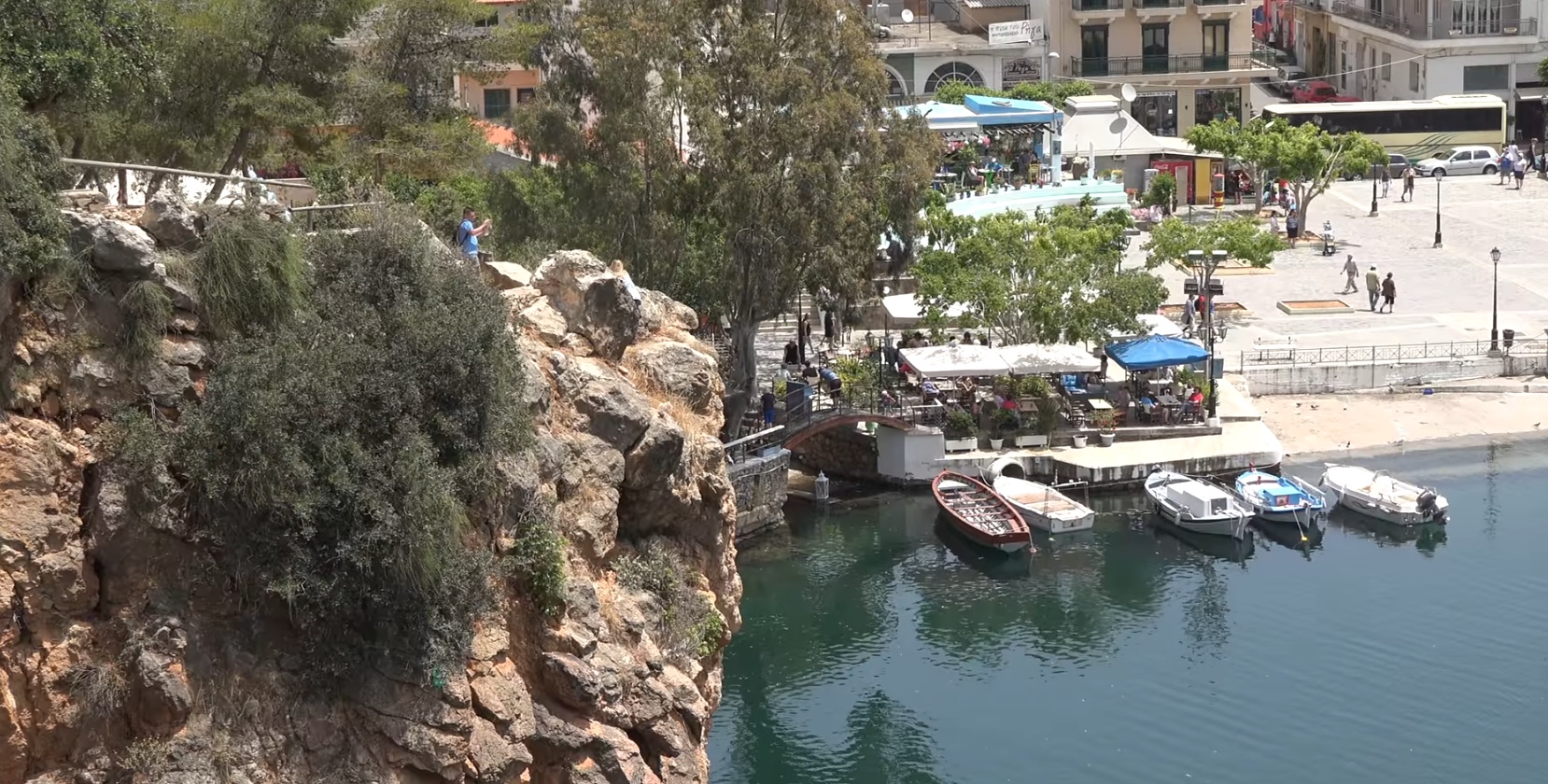
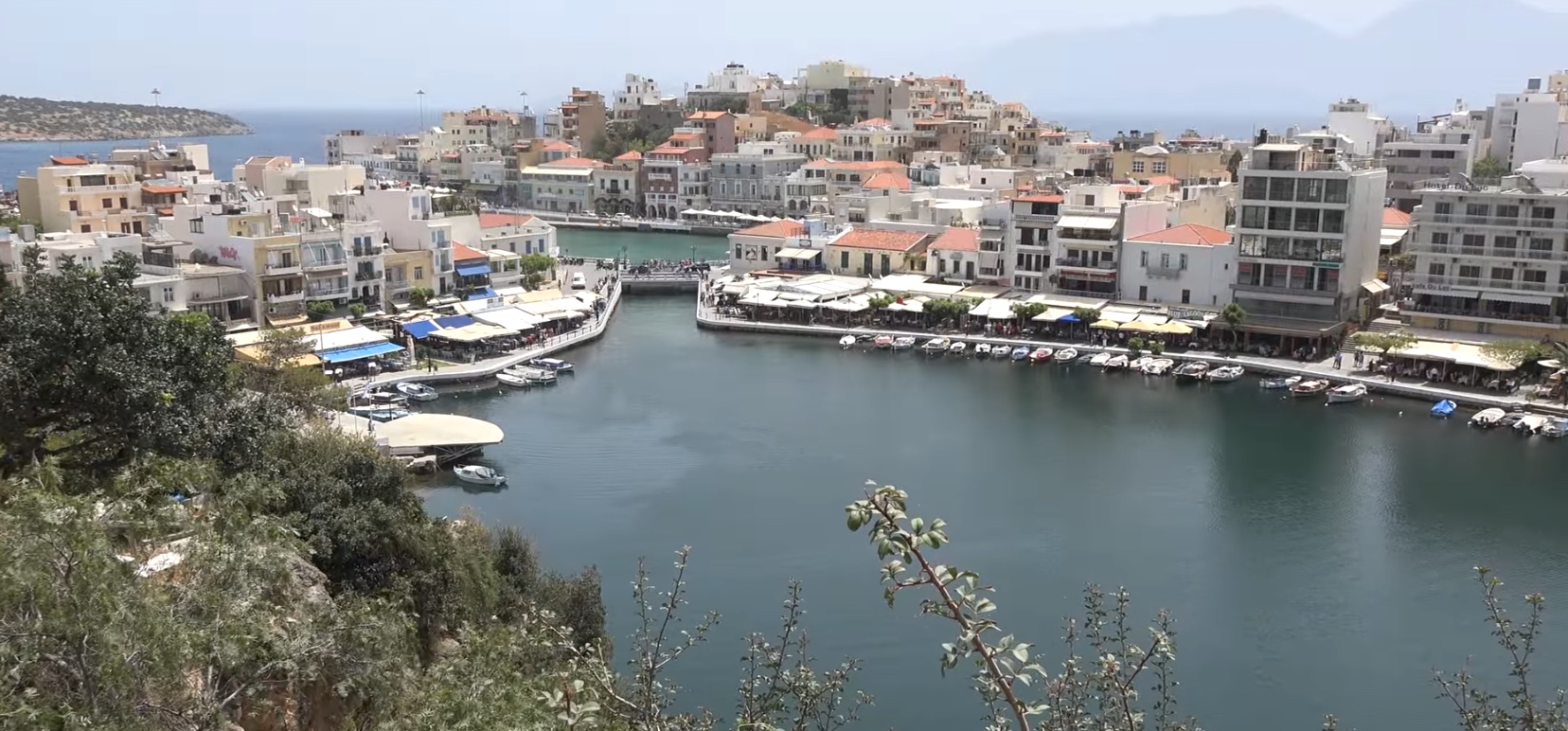
The emblem of the town is Lake Voulismeni, right in the centre. Until 1871 it was an enclosed body of water, originally fresh; only then was it joined to the sea by a channel cut through the rock – a work begun in 1867 under the Ottoman governor Kostis Adosidis Pasha, widened by French troops between 1905 and 1907 and spanned by a concrete road bridge since 1954 – and today small boats and fishing caiques tie up in it. The lake is circular, 137 metres across, and was sounded in 1852 at about 64 metres; a survey in 2000 measured 48.8 metres. Its sheer rock walls and its unusual, almost perfectly round shape have given rise to numerous legends: for a long time it was said to have no bottom at all, and to be the crater of a volcano, though there is no volcanic rock anywhere near it. In myth it was here that the goddess Athena came to bathe. Geologically it is a collapsed karst hollow fed by underground watercourses. Another story, of more recent date, relates that the German forces sank military equipment in the lake before their withdrawal in 1944.
After the channel was dug, a lively public space grew up around the shore, with steps, stone terraces and numerous cafés and restaurants whose tables reach to the water’s edge; a small park on the cliff above gives a view down over the whole basin. In the evening especially, when the lights are mirrored in the dark water, the scene is exceedingly picturesque. On Easter night, by old custom, an effigy of Judas is burnt on the lake amid fireworks and firecrackers, and in the warm months public events are held here, as are diving competitions.
The Archaeological Museum
The Archaeological Museum of Agios Nikolaos holds finds from eastern Crete ranging from the Neolithic to the Roman period. It was created after the Second World War so that discoveries from Lasithi need no longer be taken without exception to Heraklion; its building, designed by the architect Patroklos Karantinos, went up in the 1960s, the collection was installed in 1969 and it opened in 1970. The collection brings together material from settlements, tombs and sanctuaries across the region and makes the town a centre for the study of the Cretan east.
Among the most famous holdings are the grave goods from the Early Minoan cemetery of Agia Fotia near Sitia (3000–2300 BC), with their Cycladic-style pottery and a bird-shaped rhyton; the clay “Goddess of Myrtos”, an Early Minoan cult vessel in the form of a woman carrying a jug, found at Fournou Korifi and dated to 2500–2300 BC; finds from the Minoan palace of Malia, among them a stone rhyton in the shape of a triton shell of about 1550–1500 BC; gold jewellery; and the skull with the gold wreath from Roman times already mentioned. There are also clay figurines and horns of consecration from the peak sanctuary of Petsofas. The museum is thus more than an assemblage of individual treasures: it shows how settlements, trade, religious practice and burial customs changed in eastern Crete, and ties the modern town to the wide historical landscape of Lasithi. The building was closed for many years for rebuilding and extension, during which a photographic exhibition on the history of the town was shown for a time; it reopened to the public in 2024 after a thorough renovation.
What to see
A walk through the town is best begun at Lake Voulismeni. From there the way leads across the channel to the seafront promenade and the old harbour, then up to the Archaeological Museum and on to the church of St Nicholas on the Ammoudi peninsula. Those who want to swim will find small town beaches such as Ammoudi in the north, Kitroplatia beach close to the centre and the sandy beach of Almyros about a kilometre and a half to the south, at the mouth of a small river, where there is a protected wetland. Off the coast rises the little island of Agii Pantes, a reserve for the kri-kri, the Cretan wild goat.
Agios Nikolaos is also an ideal base for excursions into the surrounding country: to Kritsa with the church of Panagia Kera, to the ruins of ancient Lato, to Elounda and the Venetian island fortress of Spinalonga, and to the many other sights around Mirabello Bay.
The Agios Nikolaos of today has grown up where sea routes, administrative history and the development of tourism intersect. A tour of the town therefore joins the mysterious hollow of Voulismeni, the harbour, the scant remains of the fortress and the evidence of older ages in the museum into a single picture, in which the past shows through everywhere behind the cheerful façade of the resort.