Panagia Kera – the frescoed Byzantine church near Kritsa
The most complete guide to Crete: 221 places on the map, 23 routes and 49 articles — with photos, videos and the story behind every place. Everything is open and free: no sign-up, no paid sections and no advertising, open or hidden. You can install the guide on your smartphone as an app.
Routes drawn along real roads
Weather at every stop
Full-text search
“Near me” by geolocation
Create your own printable itinerary
Satellite, terrain, dark mode
Works offline
⌕
Searches 1.7 million characters of descriptions, not just names
—places
4regions
—routes
—with video
Search results
—
Interactive map
Find what is near you
Filters narrow the map and the list at once. Zoom out and pins group together.
Region
Category
Фильтры карты
Landmarks
Featured places
RegionCategory
Routes
Ready-made day trips
Individual places
Articles about landmarks
Panagia Kera
The church is famous for its magnificently preserved frescoes of the 14th century, widely held to be the finest of the Byzantine era on Crete.
Find on the map
Introduction
About a kilometre before the mountain village of Kritsa, some twelve kilometres from Agios Nikolaos and on the first slopes of the Dikti Mountains, the church of Panagia Kera (Παναγία Κερά) stands among olive trees. In the Cretan dialect “Kera” means “the Lady” – an affectionate title of honour for the Mother of God. The church, which took its present form around the turn of the 13th and 14th centuries, is dedicated to the Dormition of the All-Holy Mother of God and to St Anthony and St Anne, each of whom has an aisle of their own. It was, and remains, a true refuge of the soul – for the Orthodox Christian and equally for anyone who values the great art of Byzantium. Tradition adds that it once housed a miracle-working icon of the Virgin, which was carried off by a Greek merchant in 1498, under Venetian rule, and found its way to Rome; the icon venerated here now was painted in 1732.
Architecturally, Panagia Kera is a three-aisled, barrel-vaulted church built of stone and roofed with tiles, measuring only about 10 by 10.5 metres; the central aisle carries a dome. The oldest part is the central aisle, which was probably built in the Middle Byzantine period and received a first scheme of painting in the early 13th century, remnants of which survive in the sanctuary. In the early 14th century it was renewed, the dome rebuilt and the interior repainted; the south and north aisles were added at about the same time, together with the western entrance and the belfry. The most distinctive feature of the exterior is the row of stout triangular buttresses along the side walls, which give the building its unmistakable profile. The church was renovated in 1722. In the early 1950s cracks in the dome were repaired and the endangered paintings secured; excavations in and around the church brought numerous cist graves to light.
The frescoes
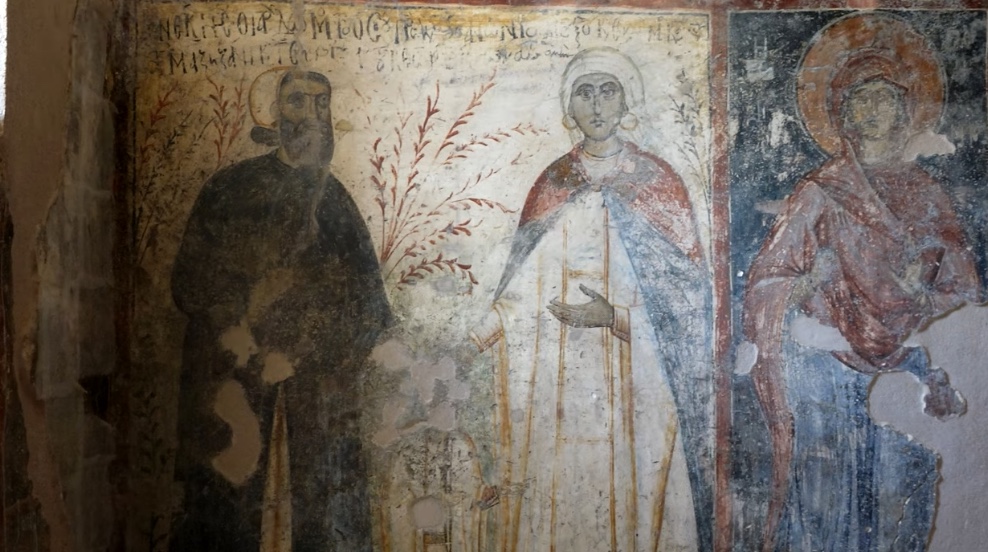
The 14th-century frescoes, wonderfully preserved, are a living testimony to steadfast faith and to the high art of Orthodox icon painting. Many of their subjects are drawn from the apocryphal gospels, and so detailed a cycle of the life of the Virgin is exceptionally rare for the Byzantine period. The faces of the saints radiate spirituality and grandeur, and masterfully drawn plant ornament lends the scenes liveliness and depth (see the video above). In the central aisle, pictures from the life of Christ and the feast-day scenes in the dome – the Presentation in the Temple, the Baptism, the Raising of Lazarus and the Entry into Jerusalem – tell the story of salvation, while the west wall carries the Crucifixion and, beneath it, the punishments of the damned. The Last Supper and Herod’s Feast are particularly impressive.
The three aisles and their paintings
The south aisle, dedicated to St Anne and decorated by an exceptionally gifted painter, shows scenes from the lives of Joachim and Anne: Anne’s prayer for a child, and the Nativity of the Mother of God, which symbolises the beginning of a new age in the history of salvation. These paintings are regarded as especially expressive and true to life; beside them appear holy women such as Irene, Kyriaki and Barbara. The north aisle, dedicated to St Anthony and painted around the middle of the 14th century, shows Christ Pantocrator, hierarchs and apostles, and calls to mind the greatness of the Church and its teaching. Its central composition is the Second Coming of Christ, the Last Judgement, which extends over the whole vault and is a reminder of the inevitability of judgement and of eternal life; Paradise is shown with the patriarchs Abraham, Isaac and Jacob and with the Virgin. On the wall are the portraits of the donors, a family named Mazizanis, with their inscriptions. A notable curiosity is a rare depiction of St Francis of Assisi in the habit of his order and bearing the stigmata – evidence of the encounter between East and West in Venetian Crete. Elsewhere in the church St George appears as the slayer of the dragon.
Influences of the schools of painting
Art-historical studies have shown that the frescoes combine features of the Macedonian and Cretan schools with those of the late Byzantine revival known as the Palaiologan Renaissance, so that each picture is a unique witness to the variety of Orthodox icon painting. This fusion of styles not only enriches the experience of the faithful but also underlines the ecumenical character of the Orthodox Church, embracing all peoples and uniting within itself differing cultural and spiritual traditions.