The most complete guide to Crete: 221 places on the map, 23 routes and 49 articles — with photos, videos and the story behind every place. No sign-up, no trackers.
Routes drawn along real roads
Weather at every stop
Full-text search
“Near me” by geolocation
Create your own printable itinerary
Satellite, terrain, dark mode
Works offline
⌕
Searches 1.7 million characters of descriptions, not just names
—places
4regions
—routes
—with video
Search results
—
Interactive map
Find what is near you
Filters narrow the map and the list at once. Zoom out and pins group together.
Region
Category
Фильтры карты
Landmarks
Featured places
RegionCategory
Routes
Ready-made day trips
Individual places
Articles about landmarks
The sacred stone
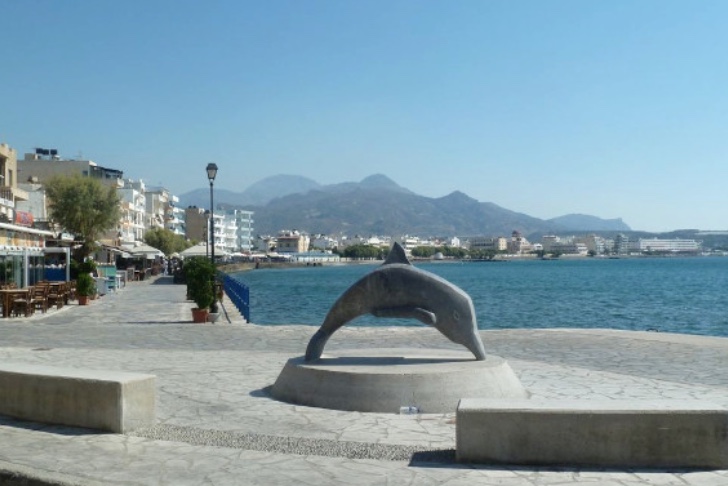
The name Ierapetra goes back to the ancient name of the town and is usually taken to mean “sacred stone”. The present town, which had 17,710 inhabitants at the 2021 census, lies on the south coast at the narrowest point of Crete, only about 30 kilometres south of Agios Nikolaos and 104 kilometres by road from Heraklion, and occupies the site of ancient Hierapytna. It has an unbroken urban tradition, even though the individual phases of settlement have shifted over the centuries. Ancient sources also give the names Kyrba, Kamiros and Pytna.
From antiquity to Byzantium
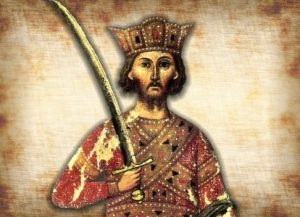
From the 4th century BC Hierapytna rose to become one of the strongest cities of eastern Crete; in the Hellenistic age it subdued neighbouring towns, vied with Praisos, earned a name for piracy in the 3rd century BC and took part in the Cretan War, and quarrelled with Itanos over influence and over islands such as Koufonisi. It was the last free city of Crete to fall to Rome, in 67/66 BC, but it lived on and flourished within the empire as a naval base and wealthy trading town, with theatres, baths and temples. A severe earthquake towards the end of the 8th century and the Arab conquest of Crete in 824 brought destruction; in 961 Nikephoros Phokas won the island back for Byzantium and restored its ecclesiastical and administrative network. After 1204 Crete passed to Venice, under which the town prospered again, and in 1647 Ierapetra fell to the Ottomans.
The Venetian fortress of Kales
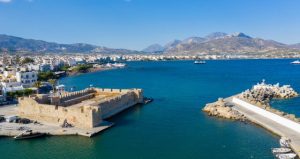
The fortress of Kales stands at the entrance to the town harbour and is considered the only surviving urban fortification on the south coast of Crete. Its core is attributed to the early Venetian period – local legend prefers to credit the Genoese adventurer Pescatore with building it in 1212 – and it was strengthened in 1626, under Francesco Morosini; the Ottomans altered it several times. The severe earthquake of 1508 struck the town and its walls as well. Today Kales recalls the strategic importance of the harbour and still keeps watch over the approach to the old quarter; in summer exhibitions and events are held within its walls.
The old town
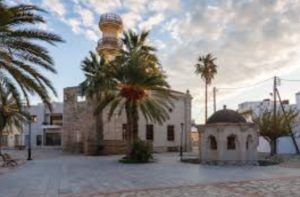
The Palea Poli, also known as Kato Mera, keeps its narrow lanes, low houses and churches of Venetian and Ottoman date. Its monuments include the church of Christ the Lord (Afendis Christos), the Panagia Kaleiotissa and the church of St Nicholas, as well as a former mosque with a minaret and an Ottoman fountain. They are best looked at together with the buildings around them: they are not isolated pieces of scenery but parts of a historic quarter that has grown up over time. In its midst stands the so-called House of Napoleon, where local tradition has the general spending a night on 26 June 1798 on his way to Egypt; the modest house is still there.
The archaeological collection
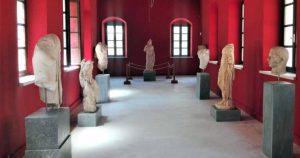
The Archaeological Collection of Ierapetra is housed in a former Ottoman school (mektep) of 1899, now a listed building. The collection began to take shape at the end of the 19th century, largely through the efforts of townspeople who founded an educational association for the purpose. The exhibits come from ancient Hierapytna and its surroundings and range from the Bronze Age – the earliest pieces belong to the 3rd millennium BC – to the 4th and 5th centuries AD. On show are pottery, gravestones, sculpture, inscriptions, lamps and coins; the showpiece is a painted Minoan clay sarcophagus (larnax) from Episkopi with hunting and animal scenes, alongside a Roman statue of the 2nd century AD, a goddess in a peplos identified as Demeter or as her daughter Persephone.
Ierapetra today
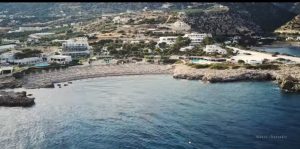
Today Ierapetra is the port and commercial centre of the south coast. The plain around it is covered with greenhouses – some fifteen square kilometres of them, a method of growing introduced here by the Dutchman Paul Kuypers – whose vegetables are sold throughout Europe; the mild climate, with more than 3,100 hours of sunshine a year, an annual mean temperature of about 20°C and very little rain, makes the region one of the most important growing areas in Greece. Tourist facilities, beaches that have repeatedly been awarded the Blue Flag and water sports lie right beside the fortress, the old town and the museum. This combination explains why the town appeals not only as a seaside resort but also as a historic centre. About eight nautical miles offshore lies the island of Chrysi, five kilometres long and nowhere much higher than thirty metres, with its junipers and pale sandy beaches, reached in season by boat from the harbour.
The picturesque old town
A walk through the old town, with its snug little houses, flowering courtyards and narrow lanes, carries the visitor back into the particular atmosphere of earlier times. The churches of Venetian date – Christ the Lord, the Panagia Kaleiotissa and St Nicholas – give the quarter its special character and make it a living witness to the town’s long history. The walk is at its best in the early evening, when the heat eases and the residents sit outside their doors; in a town that is among the hottest and sunniest in Greece, the middle of a summer day is better spent on the beach or in the museum.
Cultural and archaeological wealth
The archaeological museum on the central square opens up the rich history of Crete from Minoan to Graeco-Roman times. It preserves a singular collection of works of art, gravestones and sculpture, together with the painted clay coffins of the Minoans, that testify to the high level reached by the cultures of south-eastern Crete – from the Minoans to the flourishing Roman port. Anyone who has seen the display will afterwards look with different eyes at the unassuming stretches of ancient wall that survive here and there in the town.