Kapsa Monastery: the cliffside house of St Joseph Gerontogiannis
The most complete guide to Crete: 221 places on the map, 23 routes and 49 articles — with photos, videos and the story behind every place. No sign-up, no trackers.
Routes drawn along real roads
Weather at every stop
Full-text search
“Near me” by geolocation
Create your own printable itinerary
Satellite, terrain, dark mode
Works offline
⌕
Searches 1.7 million characters of descriptions, not just names
—places
4regions
—routes
—with video
Search results
—
Interactive map
Find what is near you
Filters narrow the map and the list at once. Zoom out and pins group together.
Region
Category
Фильтры карты
Landmarks
Featured places
RegionCategory
Routes
Ready-made day trips
Individual places
Articles about landmarks
A rock of holiness
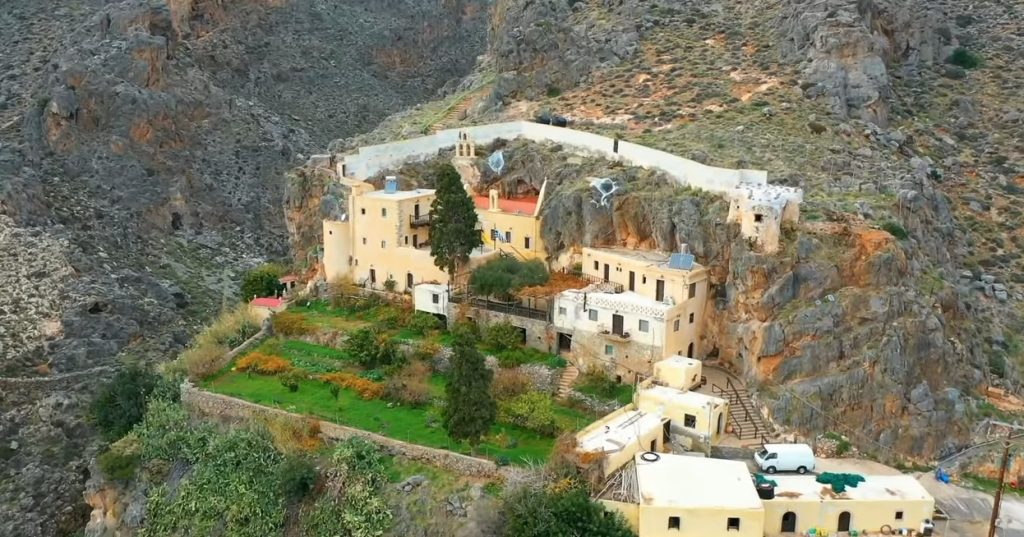
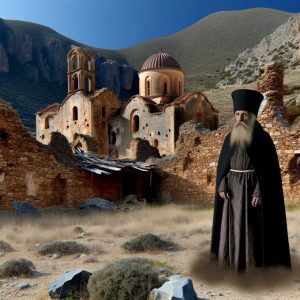
The Monastery of St John the Baptist at Kapsa (Ιερά Μονή Τιμίου Προδρόμου Καψά) stands on a steep slope where the Pervolakia Gorge opens to the sea, about five kilometres west of Cape Goudouras on the south-east coast of Crete, eight or nine kilometres east of Makry Gialos and some 33 from Ierapetra. Its early history is obscure. Frescoes of the 13th and 14th centuries, of which a few fragments survive, and inscriptions, the oldest of them dated 1512, nevertheless show that a religious community existed here long before the revival of the 19th century; the monastery proper is generally assigned to the 15th century, and much of it is said to have been laid waste in a pirate raid of 1471.
Find on the map
Introduction
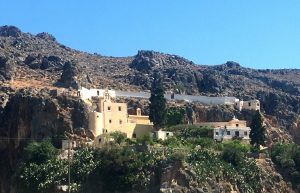
The Monastery of the Prophet and Forerunner at Kapsa lies 57 metres above the sea on a steep, grey-red mountainside, surrounded by numerous caves of varying size and bounded on the west by the Pervolakia Gorge. It grew up on the site of an old cave church dedicated to John the Baptist and the Holy Trinity, and is regarded as a jewel of the spiritual life of Crete. Anyone driving east along the coast road from Makry Gialos sees its white walls from a long way off, bright between the reddish rock and the deep blue water. The road passes directly below the monastery and across the mouth of the gorge, where there is a quiet pebble beach.
Architecture and natural setting
The katholikon is built into a natural cave and has two aisles, one for John the Baptist and one for the Holy Trinity. It retains a stone floor inlaid with sea pebbles, a carved wooden iconostasis and icons of the Cretan School. The monastic buildings rise up the slope on several levels. From the monastery the view extends across the Libyan Sea as far as the island of Koufonisi. The gorge behind it is about four kilometres long and drops some 300 metres from the village of Pervolakia to the sea between high, arid walls; it is usually dry, the waymarked path is easy apart from a few short scrambles, and the walk takes about an hour and a half downhill or two hours up. Its limestone ledges are one of only two places where Limonium cornarianum, among the rarest of Cretan plants, is known to grow.
Visiting
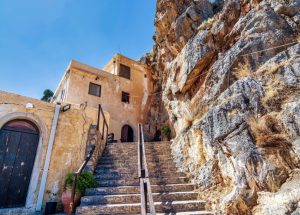
The monastery receives pilgrims and visitors in the morning and again in the afternoon; it is best to ask about current times before setting out. Venerated in the church are the icon of John the Baptist, the tomb and relics of St Joseph Gerontogiannis, relics of other saints – among them the Baptist himself, St Basil the Great, St Panteleimon and St Charalambos – and a fragment of the True Cross. The cave in which St Joseph lived as a hermit can also be visited: it lies about a hundred metres to the north-west, up the steep side of the ravine, and is reached by steps from the back of the monastery.
Patronal feast
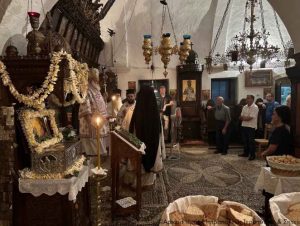
The Beheading of John the Baptist is commemorated on 29 August. On that day the Divine Liturgy and a procession are celebrated, followed by a panigiri, and pilgrims come to the monastery from all over Crete. Other feast days are 7 August, the commemoration of St Joseph, and the vigil on the night of 6 to 7 January for the feast of the Baptist.
The history of the monastery before the Blessed Joseph
No written records of the original foundation survive. The monastery’s codex of 1890 and the surviving inscriptions point to a Byzantine or Venetian origin. The dates on the walls and on the ambo – from the 16th to the 18th and early 19th centuries – show that the place served many generations as a spiritual refuge, even in the long periods when, exposed as it was to raiders from the sea, it lay half in ruins.
The history of the monastery after the Blessed Joseph
After the death of St Joseph Gerontogiannis his grandson, the archimandrite Joseph Gerontakis, carried the work forward: he built new cells, piped water from the spring of the Forty Martyrs and extended the farm. In 1881 five monks and five laymen were living here. In 1900 the monastery was attached to Toplou Monastery, of which it remains a dependency (metochi). During the German occupation Kapsa became a refuge for Greek and Allied soldiers, who were taken from here to Egypt; the monks joined the resistance at the risk of their lives. In November 1943 the German authorities declared the district a prohibited zone and ordered the monastery to be cleared. After the war the hieromonk Ilarion Syntychakis began the rebuilding; in 2005–2006 the west wing, the inner courtyard and the frescoes were restored under archaeological supervision. Kapsa is still a working monastery for men.
The life of the Blessed Joseph
The early years of Gerontogiannis
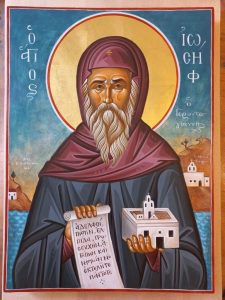
Ioannis Vitsentzos, known as Gerontogiannis (“old Yannis”), was born in 1799 in the half-ruined monastery of the Baptist (Prodromos) at Kapsa. His devout parents, Emmanouil and Zambia, had fled from Turkish outrages to the ruins of this lonely, remote spot. Later, when the persecutions eased, they moved to the neighbouring village of Lithines, in the hills above the coast, and it is with Lithines that his name has been linked ever since. What schooling the boy received in those years came from the clergy.
Family life and trials
When he was grown he married Kalliopi, of the Gerontakis or Gerontis family, which was persecuted by the Turks – the family whose name clung to him as Gerontogiannis. She was in hiding on the south-east coast for fear of suffering the fate of her only sister, who had taken her own life rather than be dishonoured by the Turks. For that reason her parents had sent Kalliopi to the secluded shores near Kapsa Monastery; there, in the ruined church of the Baptist, she married Gerontogiannis, and she bore him four children – three daughters and a son.
Gerontogiannis did not bow to the Turks, yet he was at the same time an exceptionally devout Christian. Again and again he attracted the attention of the Ottoman authorities, and the Turkish police pursued him. He therefore often hid with his family in the Pervolakia Gorge, where it was impossible to track him down. For most of the year they lived on the monastery farm of Katsaroli, not far from Lithines.
Tragedy and transformation
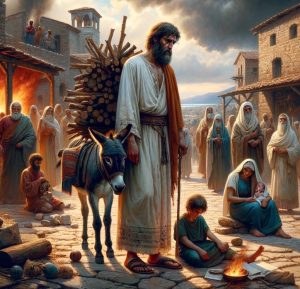
After the death of his little daughter Irini, who perished in a fire, Ioannis understood what had happened as a call to repentance and a punishment for his sins. He gave up his former way of life, settled in Lithines and from then on lived in prayer, fasting and works of mercy. The monastery’s codex says that the hard, quick-tempered man became a person of patience, gentleness and forgiveness – a change that Orthodox tradition regards as the spiritual transfiguration of a human being.
Vision and spiritual awakening
According to the tradition of the monastery, in 1841 – at Easter, it is said – Ioannis Gerontogiannis fell into a long, deep sleep that lasted forty-three hours, and on waking spoke of having seen and heard wonders that could not be put into words; afterwards a paralysed old woman was healed. From then on the sick and the suffering came to him, and every day many people from the Sitia district passed by his house to ask for his blessing and advice. The stories of the help obtained through his prayers became part of the spiritual memory of Kapsa.
The saint before the governor
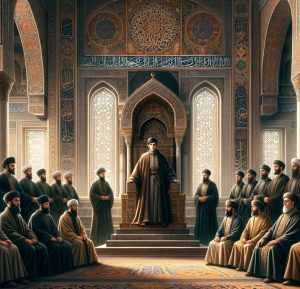
Three times Gerontogiannis was summoned before the governor of Crete, Mustafa Pasha. He won his freedom when, as tradition has it, he prayed for the governor’s gravely ill child and for a female relative, who thereupon recovered. These stories belong to the monastic tradition of the saint’s gift of healing; in gratitude he accepted a donation for the church and was able to go about his work unmolested from then on.
The rebirth of the monastery
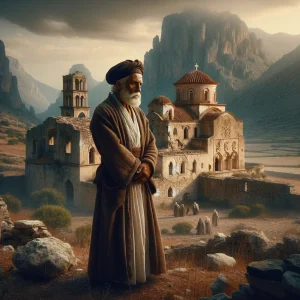
Later Bishop Ilarion Katsoulis of Ierapytna and Sitia (1846–1869) advised him to withdraw to a remote place so that the protests and complaints of the Turks might die down. No more fitting place could be imagined than the half-ruined monastery of Kapsa, where he had been born, baptised and married. With the holy man’s decision to settle in the wilderness of Kapsa in 1841, the modern history of the monastery begins.
After 1840 the administration of Crete under Mustafa Naili Pasha took a lenient view of the restoration of monasteries and the repair of many churches that had stood abandoned for centuries. This applied also to the monastery to which Joseph Gerontogiannis retired. In 1841 the last owner of the land on which the ruined monastery of the Prophet and Forerunner stood, Chatzi-Nikolaos Zafiridis of the village of Agia Triada near Sitia, who had bought it from the Turk Dervish Aga Chatzarifakis, made over the cave church and the surrounding land to St Joseph Gerontogiannis, the founder and restorer of the monastery.
The elder could neither read nor write and left no written record; what he found at Kapsa at that time cannot therefore be stated with certainty. What is certain is that there was a church of St John, which evidently drew many of the faithful from the surrounding villages, together with two buildings beside the church and a well of brackish water – signs of an older monastery, on whose ruins the new one arose.
The abandoned monastery came back to life: pilgrims and the sick arrived to meet the hermit and to receive his blessing for the healing of their ills. The Blessed Gerontogiannis lived for seventeen years, from 1841 to 1858, in a secluded cave north-west of the rock church, a hundred metres or so up the side of the ravine, while the old cells were given over to the many pilgrims and to the numerous novices who wished to take the monastic habit. In this way the nucleus of the first community of monks was formed.
Monastic profession
This development made it necessary to restore the monastery, to repair the old buildings and to put up new ones. The work went on for several years, interrupted only in 1858, when a new uprising in Ottoman-ruled Crete led Gerontogiannis to withdraw for five months to the island of Kasos. In 1861 a second aisle, that of the Holy Trinity, was added to the main church in the rock. The buildings extended over four levels and comprised cells, a guest house, a refectory, a kitchen, a bakery, storerooms and a large cistern for rainwater. By 1863 the monastery was complete, and Bishop Ilarion Katsoulis consecrated the main church. Ioannis was professed as a monk of the Great Schema and received the monastic name Joseph.
Withdrawal into solitude
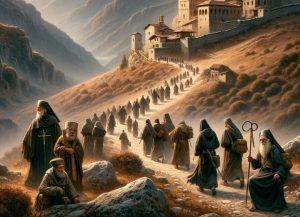
The Blessed Gerontogiannis remained at Kapsa until the uprising of 1866. Fearing that the conquerors might destroy the monastery, he then withdrew with his community to the old, forgotten and deserted monastery of Agia Sofia on the Armeni plateau, in the middle of the province of Sitia. At Kapsa he left only one monk in charge until 1870. At Agia Sofia he restored the monastery completely and worked its lands, so that within a short time he had transformed the district and aroused general admiration. Because many pilgrims from the surrounding villages flocked to him, he became the victim of slander. On the instructions of the then Bishop of Ierapytna, Neofytos Kalogeridis (1869–1878), he therefore returned to his original monastery.
The Blessed Joseph lived in strict abstinence, in prayer and in fasting. He ate only dry food, chiefly olives, wild greens and rusks. He spent the greater part of the day praying in his cell. He followed the services through the window of his cell, which looked into the church; only on Sundays, when he received Holy Communion, did he go down into the church.
The gift of healing
The tradition of the monastery ascribes to St Joseph the gift of healing, of clairvoyance and of help for all who turned to him in faith. It is also told that he recognised stolen objects brought to him as offerings and insisted that they be returned to their owners. These testimonies form part of the veneration of St Joseph Gerontogiannis.
The last years and the legacy
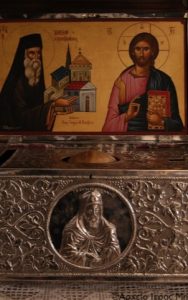
Joseph Gerontogiannis died on 6 August 1874, at the age of seventy-five, and was buried in the south-west corner of the church. On 7 May 1982 his bones were exhumed; they now rest in a silver reliquary from which, as the faithful testify, an indescribable fragrance issues. His memory is celebrated on 7 August, and to this day people come to Kapsa from all over Crete to pray at the tomb of the saint – the one-time shepherd and rebel who became the spiritual father of the Cretan south-east.