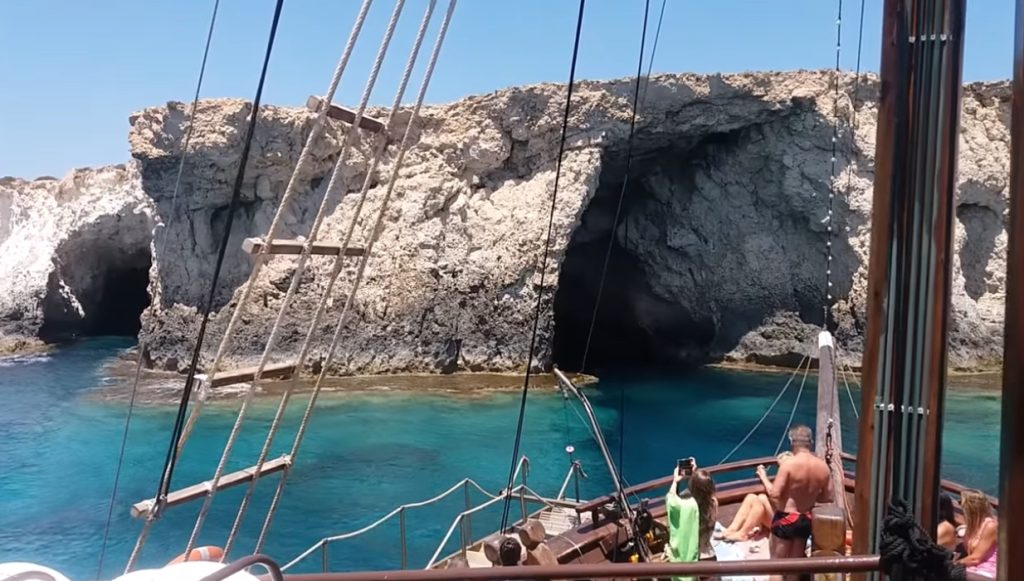
The little Delos
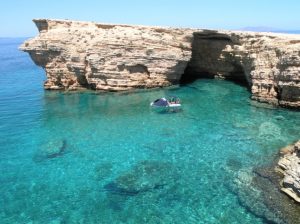
Koufonisi, known in antiquity as Lefki (Λεύκη), lies in the Libyan Sea opposite Makry Gialos, about three nautical miles – 5.6 kilometres – south of Cape Goudero on the Cretan coast. Together with Gavdos and a handful of small islets it forms the southernmost outpost of Greece. The island is small, roughly six kilometres long and five and a half across, with an area of 5.25 square kilometres, and it has four still smaller companions: Makroulo, Marmaro, Strongyli and Trachilos. The way there is across open water, and with wind and current the crossing can be decidedly rough. The white limestone shores, the coves and the sandy beaches – some 36 of them, large and small, are counted along a coastline of about 14 kilometres – give the feeling of a separate, almost uninhabited world. In the middle of the low island stands a lighthouse, bombed in 1944; otherwise sand, rock, juniper and the light of the south make up the scene.
Why the island is called the little Delos
The comparison with Delos does not rest on any outward likeness between the two islands but on the combination of archaeological monuments with far-reaching maritime trade. On Koufonisi traces of settlement run from Minoan times down to the Roman and early Byzantine periods; Minoan pottery and the remains of a Prepalatial fortification attest the early occupation, and a Minoan acropolis and cemeteries have been identified. The ancient name Lefki, recorded by Pliny, refers to the white gleam of the limestone and marl. In antiquity the island was an important staging post on the sea route to Egypt and at the same time a place of cult and festivals. Travellers noticed its ruins long before anyone dug them: Captain Thomas Spratt in the mid-19th century, and Bosanquet and Currelly in 1903.
The excavations at Lefki
The excavations, which began after a survey of the island in 1976, brought to light a settlement of the Hellenistic and Graeco-Roman period. Its showpiece is a well-preserved stone theatre for about a thousand spectators on the north-eastern edge of the island, near the beach of Kamareles. Twelve rows of seats survive, across a greatest width of 34 metres, together with parts of the stage building – some 20 metres long and 9 deep – the entrances, a vaulted passage and underground rooms; the semicircular orchestra was paved with clay tiles. Close by, a Roman bath complex was uncovered, with hypocausts, heated rooms, a sweating room, cold, warm and hot baths and changing rooms arranged around a garden; it was in use from the 1st to the 4th century AD, had marble floors, and its heating walls still stand four metres high. Vaulted cisterns and built conduits brought spring water to the town from the north of the island. There were also houses of eight and nine rooms – two of them with black-and-white mosaic floors in geometric patterns – the remains of a temple measuring 18 by 15.7 metres, a colossal statue and a villa with a workshop for processing murex shells. The statue, a Hellenistic cult image of a deity enthroned on a cube-shaped seat, stood more than 2.5 metres high; only fragments remain, because the temple was pulled down around 1920 to provide stone for the lighthouse, which rose five metres from its eastern entrance.
Purple and seaborne trade
In antiquity Lefki was a centre of sponge fishing and of the manufacture of purple dye from sea snails, above all the spiny dye-murex (Murex brandaris) – a trade handed down in Crete from generation to generation since Minoan times. Aristotle and Pliny described the value of this dye: thousands of snails were needed for a tiny quantity of pigment, which is why purple-dyed cloth was extraordinarily costly, the dye itself being reckoned worth its weight in silver. The heaps of smashed shells that have been found, and the remains of the workshops – they turned up in the fishermen’s houses as well as in the villa, alongside fishing gear – confirm the island’s specialisation. The income from purple, sponges and fishing gave rise to a prosperous merchant class.
The ancient theatre and the necropolis
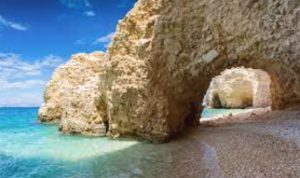
Stretches of the residential quarters survive on the island, together with Minoan and later burials, tholos tombs among them, and traces of Roman urban infrastructure. The theatre was not only for performances: it bears witness to an organised community able to maintain public buildings and to accommodate a large number of residents and visitors. Towards the end of the 4th century AD the settlement was violently and completely destroyed, the theatre burnt along with it – whether by pirates, by zealous Christians or by both remains unresolved. With that, almost two thousand years of habitation came to an end; large parts of the site still lie beneath the sand. In later centuries passing seamen carved their names and dates into the ruins – one that can still be read is 1630 – and Christians used the island’s caves as chapels.
Historical connections
Lefki is mentioned in the long quarrel between Itanos and Hierapytna, today’s Ierapetra, over possession of the island. The inscription recording the arbitration, delivered by judges from Magnesia and usually dated to the 2nd century BC – to 112–111 BC, more precisely – is built into the façade of Toplou Monastery, where it can still be seen. Nor was the island left untouched in modern times: in April 1823 a band of 28 Cretan insurgents landed on Koufonisi and fell upon the janissary Mehmet Pilavas and his men, killing 27 of them – an episode from the history of the Greek Revolution in Crete. Later a few families from the coast came over in summer to work fields of grain, and wheat and barley were still being harvested on the island in the 20th century.
Nature and visiting
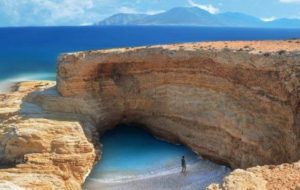
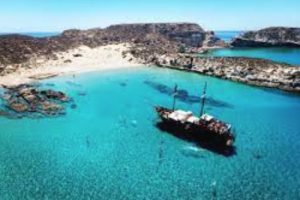
Today Koufonisi draws visitors with its clear water, sandy beaches, sea caves and a quiet, austere landscape. Among the best-known landing places for the excursion boats are the beaches of Chiliaderfia, Prosfora and Pigadia. The island is uninhabited and archaeologically fragile, and it is a designated Important Bird Area where Eleonora’s falcons breed: keep to the marked areas, do not move stones and do not pick up finds. The monuments already show visible signs of decay and are in urgent need of care.
Day trips by boat run in season mainly from Makry Gialos, some 18 kilometres away by sea, and occasionally from harbours further east. Plan the trip around the weather and the timetable, for in stronger winds the crossings are cancelled. Take plenty of drinking water, sun protection and food, since the island has neither shops nor anything that offers shade.