Faneromeni Monastery in the Gorge of All Saints near Sitia
The most complete guide to Crete: 221 places on the map, 23 routes and 49 articles — with photos, videos and the story behind every place. Everything is open and free: no sign-up, no paid sections and no advertising, open or hidden. You can install the guide on your smartphone as an app.
Routes drawn along real roads
Weather at every stop
Full-text search
“Near me” by geolocation
Create your own printable itinerary
Satellite, terrain, dark mode
Works offline
⌕
Searches 1.7 million characters of descriptions, not just names
—places
4regions
—routes
—with video
Search results
—
Interactive map
Find what is near you
Filters narrow the map and the list at once. Zoom out and pins group together.
Region
Category
Фильтры карты
Landmarks
Featured places
RegionCategory
Routes
Ready-made day trips
Individual places
Articles about landmarks
Faneromeni Monastery in the Gorge of All Saints
Not far from Sitia, in the far east of Crete, the Agion Panton gorge (Φαράγγι Αγίων Πάντων) opens towards the sea. The way to the monastery starts at the hamlet of Platani, one of the two small seaside settlements belonging to Skopi, and leads through a valley where caves, small chapels and the traces of monastic seclusion have survived to this day. The gorge itself begins near the village of Skopi, one of the largest villages in the municipality of Sitia, in the locality known as Sfakidia, and runs down to the coast, where it comes out at the beach of Limni beside Platani. It is a short gorge, about three kilometres long, and among the gentlest walks of its kind on the island. In the winter months the Skafidaras stream carries water and may flood the bed, turning the mouth of the gorge into a small seasonal wetland; for the rest of the year it is generally dry. Two perennial springs – Koutsounari, whose water falls over a high rock, and Chosti Vrysi, which emerges from the interior of a cave – allow myrtle, carob, plane trees and oleander to flourish. According to local tradition the Koutsounari spring once inspired the poet Vitsentzos Kornaros, author of the Cretan verse romance “Erotokritos”, who is said to have composed parts of the poem beside it.
The gorge is also a geological spectacle, and it forms one of the marked geotrails of the Sitia Geopark. Sandstones that weather slowly alternate here with soft layers of marl which the water washes out more easily. The rocks are of Neogene age, laid down on a sea floor, and fossil bivalves and sea urchins can be picked out in them. The result is a series of white and pale yellow, finely bedded rock walls, tinted here and there by oxides, from which rise shapes like gigantic mushrooms and twisted columns; the best of them stand towards the lower end. In winter and spring anemones, poppies and ox-eye daisies cover the slopes, and old terraces and abandoned vineyards recall that the valley was once carefully cultivated. Beside the path, near the exit, lies the Byzantine chapel of Agii Pantes, which gave the gorge its name; its courtyard is shaded by plane trees and very old olives.
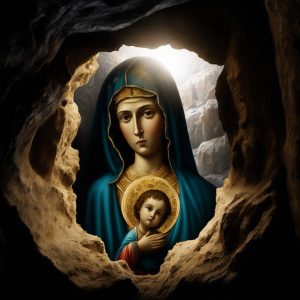
Several monasteries on Crete bear the name Faneromeni; the one described here, also called Faneromeni of Trachila after the nearby cape, should not be confused with its namesakes elsewhere on the island. Attached to it is the legend of an icon of the Virgin which a shepherd found in a cave in the rock – and which always returned to the place where it had been found.
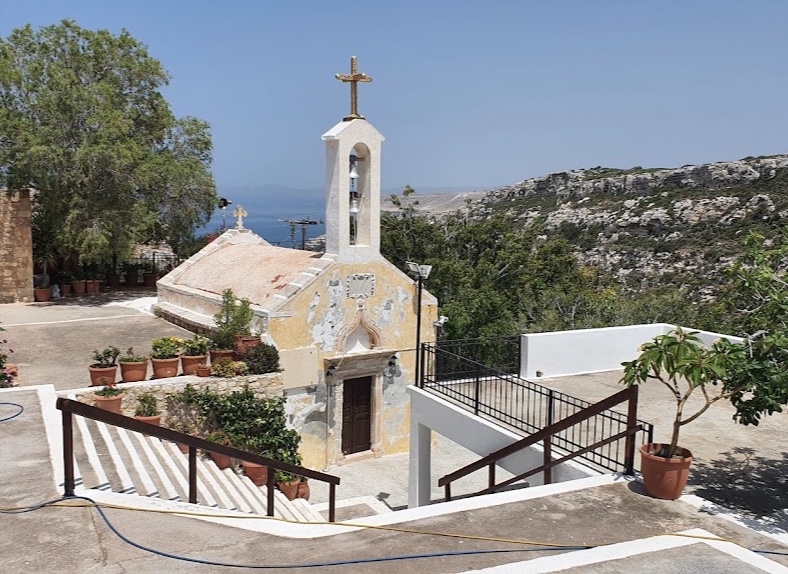
The complex brings together a church that is still in use, old monks’ cells and farm buildings, some of the ancillary ranges dating from the 18th century. Icons, remnants of frescoes and inscriptions from various periods have survived in the church. In the 19th century the monastery was laid waste; later the church and buildings were restored little by little. Faneromeni is no longer permanently inhabited and has not functioned as a monastery since the first years of the 20th century; it belongs to the parish of Skopi. On feast days, however, services are held here and pilgrims are received, and in August the quiet place turns for a few weeks into a small and lively settlement.
The history of the monastery
Foundation and destruction by pirates
The great age of the monastery is attested by the inscriptions preserved on the south-west side of the katholikon, the main church, by the scratched names of the brothers and priest-monks Gabriel and Meletios Pantogalos, and by names from the large Cornaro (Kornaros) family, one of the most important Veneto-Cretan noble houses. An exact date of foundation nevertheless cannot be established. It probably goes back to the 13th century, and tradition names the first founder as a hermit called Ioannikios. The church historian N. I. Papadakis assumed that the monastery existed until pirates destroyed it in the 16th century. From the earliest dates, he reasoned, it may be concluded that the monastery was founded before 1455; the breaking-off of the visitors’ inscriptions in turn shows that it no longer existed after 1536 and probably perished in the raid of Hayreddin Barbarossa in 1537–38 (N. I. Papadakis, “The Church of Crete”, p. 112).
The coast of Sitia was notorious in the 15th and 16th centuries for its countless pirate raids, and a house standing only a kilometre and a half from an open shore was an obvious target. Since the original building cannot be dated precisely, while the years scratched into the church range from 1455 to 1598, the written and epigraphic evidence permits one firm statement above all: the restoration of the monastery falls in the year 1624.
A church in the rock
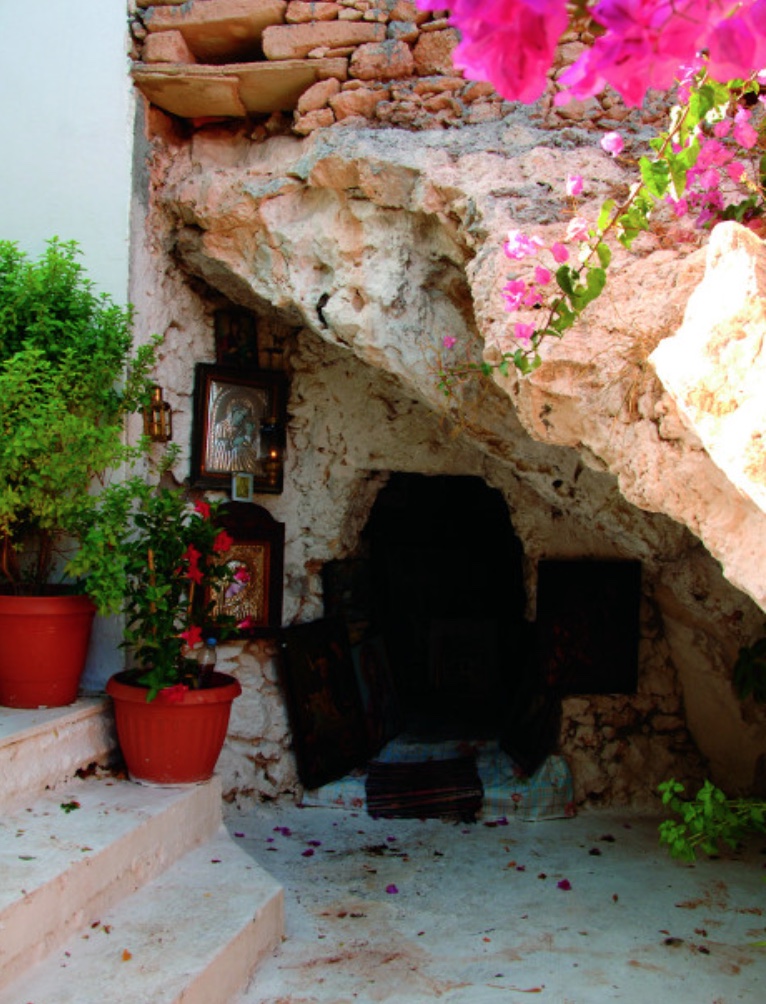
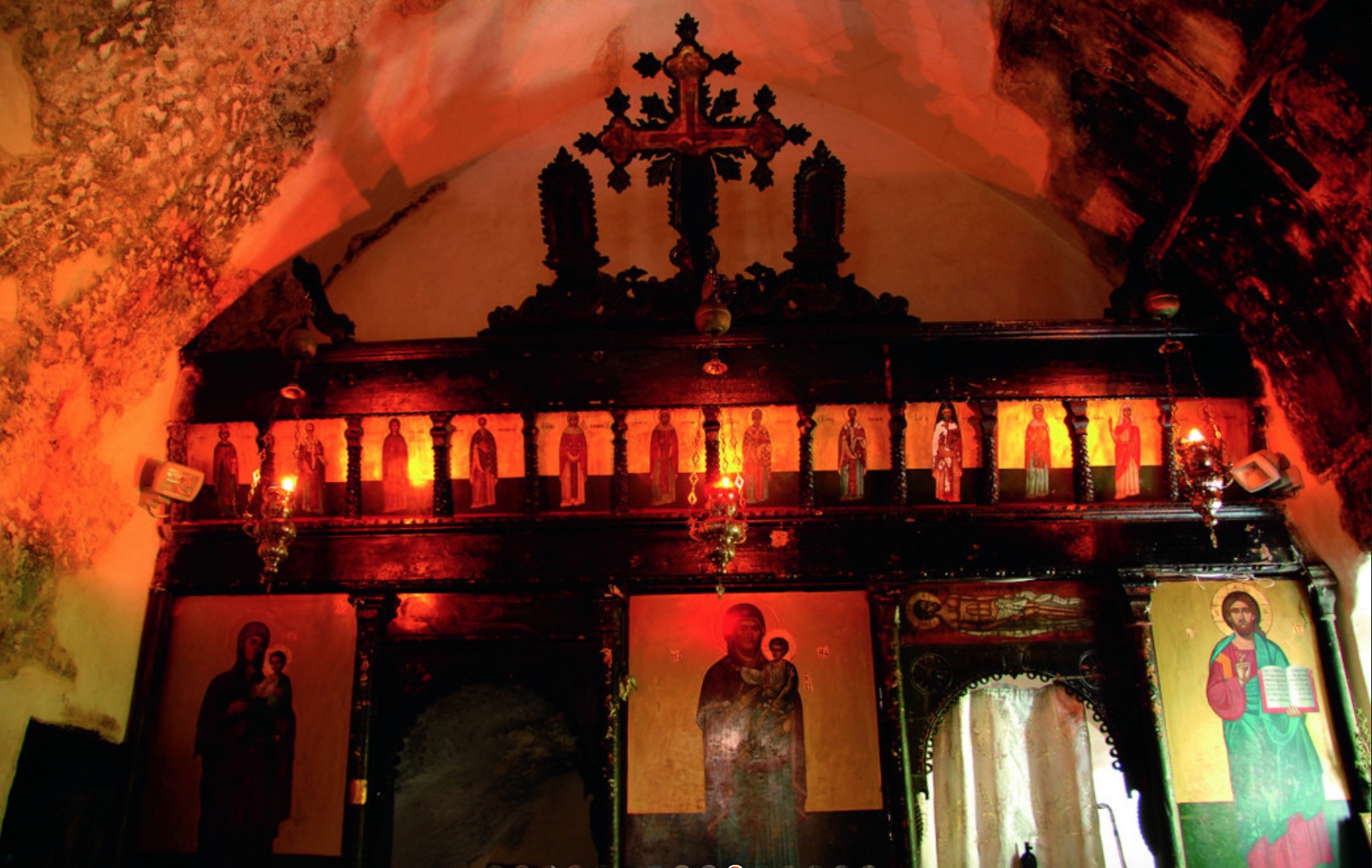
The centre of the complex is the two-aisled church, dedicated to the Dormition of the Virgin (Kimisis tis Theotokou) and to St George. Around the katholikon are grouped more recent buildings which serve as cells for the “Dekapentistes” – those of the faithful who spend the first fifteen days of August fasting and praying in the monastery. Inside the church itself lies a small cave, often called the Hermit’s Cave, in which, according to legend, the icon of the Virgin was found; the discovery prompted the building of the church, and a small icon is still kept in the mouth of the cave. Further caves open in the surroundings, in the Gorge of All Saints, which served ascetics as places of solitude and prayer. The cave to the west of the church is regarded today as the dwelling of a hermit who lived here even before church and monastery were founded.
Building the church demanded considerable skill in both craft and engineering, something by no means to be taken for granted under the conditions of the time: space was short, and the rules of Orthodox church architecture are strict. Moreover, the builders did not wish to leave the cave of the Faneromeni outside the house of God. They therefore gave up the usual east–west alignment and laid the church out from north to south. The sanctuary lies in a low cave in the roughly hewn rock. The church has two entrances; inside, corresponding to the two aisles, stand two altars which face one another on the rock in symmetrical niches, each with its own apse.
Cells, bakehouse and oil mill
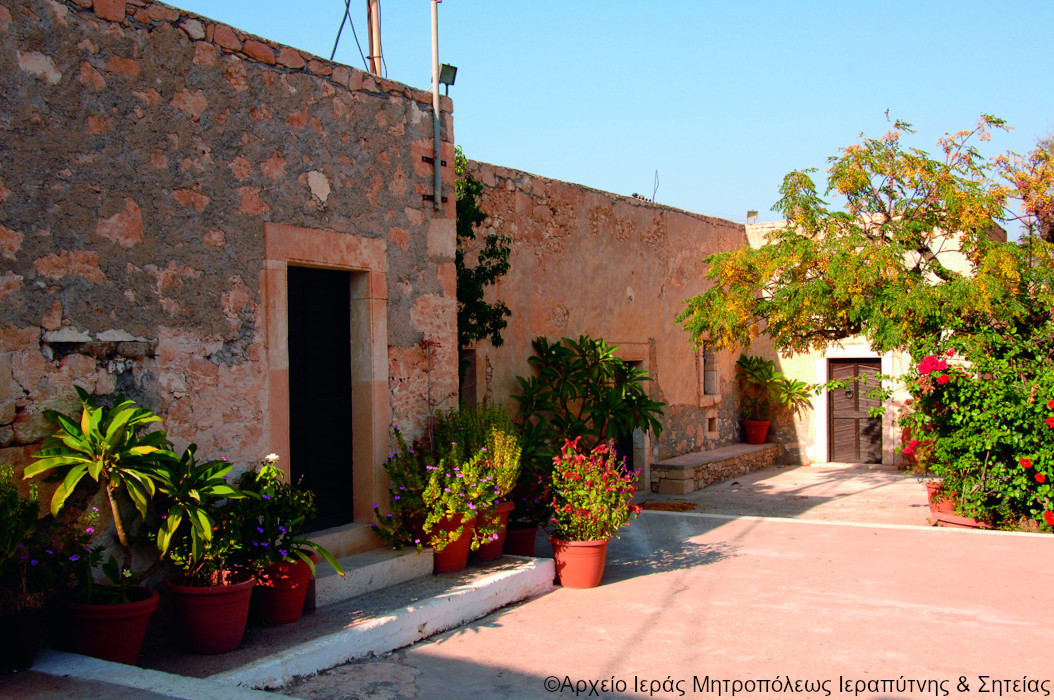
Six very old cells in the medieval manner survive, with iron-bound doors and small window openings; there is also a room that serves as a dormitory. Besides the monastery’s own cells there are numerous private ones, which local people – chiefly from the village of Skopi – have put up with parish funds in order to lodge pilgrims, especially in August. From the villages of the Sitia region, above all from the neighbouring places of Skopi, Piskokefalo, Achladia, Chamezi, Exo Mouliana, Mirsini and Mesa Mouliana, and from the town of Sitia itself, the Dekapentistes come to pay their devotions to the Virgin, and around the feast of the Dormition pilgrims gather here in great numbers.
The inner courtyard is very spacious; during the Dekapentismos, the fifteen-day fast of the Virgin, many people rest here on stone benches. Above the sanctuary, the bema, the form of the cave is visible to this day. The “Great Cell”, a broad room spanned by a medieval arch, bears witness to former labour: here the monastery’s olives used to be milled. The “Tholos” is a cell in the upper part of the complex with a vaulted stone roof. The “Bakehouse”, finally, a large cell at the beginning of the upper row of cells, contains a huge oven in which bread was baked for the monastery and for many of its metochia, the dependent estates. Many older people remember, besides the bakehouse, the oil press within the monastery precinct, which was used by the “metocharides”, the stewards of the monastic estates, and by the tenants of the monastery’s property.
The doorway and the founder’s inscription
The church, the fresco decoration and the inscriptions of the katholikon are especially noteworthy for their state of preservation and their artistic value. Best preserved of all is the entrance doorway in the south wall. Its moulded, finely carved frame rests on capitals set upside down and ornamented with flowers. Above rises an obliquely cut lintel with a pointed, fluted relief arch, its apex adorned with a pine-cone finial and its springings with a floral motif. In the door jamb a scratched inscription of the year 1469 can be seen.
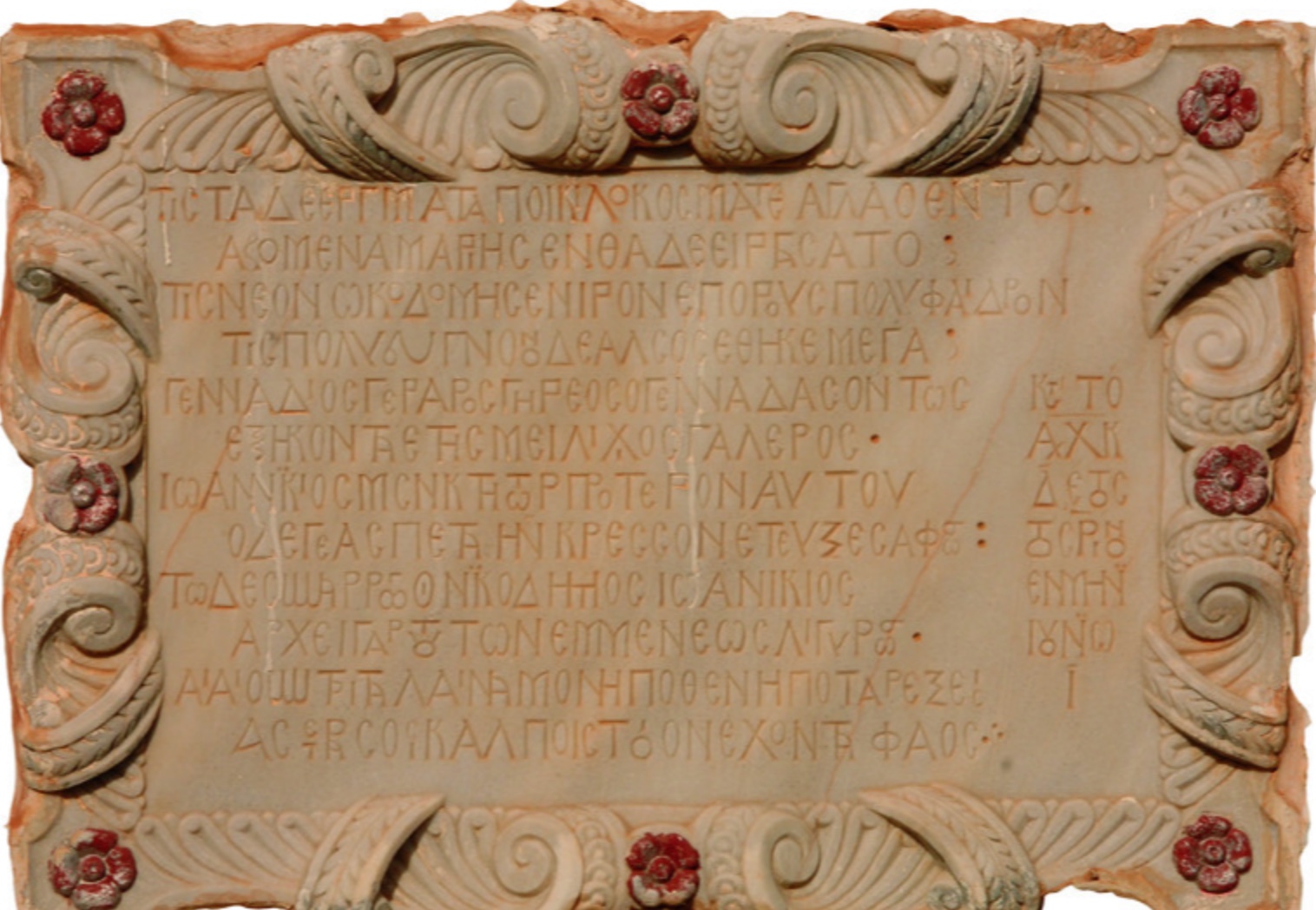
Let into the wall above the lintel is a building inscription which supplies essential information about the history of the monastery. According to it, Gennadios restored the monastery in 1624, after it had been destroyed in Barbarossa’s pirate raids of 1538. The founder before him was Ioannikios. The work fell in the last decades of Venetian rule over Crete – a time in which monasticism on the island, borne up by the flowering of the Cretan Renaissance in art and literature, enjoyed a remarkable revival.
The Greek inscription runs, in the rendering of the philologist Stylianos Alexiou, roughly as follows: “Who, out of reverence for Mary, has raised these works, in manifold adornment and in splendour? On the mountain that enlarged the fragrant grove a new and lovely sanctuary is built. The steadfast Gennadios, advanced in years, truly great-hearted, gentle and noble, at the age of sixty. Ioannikios was the founder before him, and the great labours of Ioannikios he has visibly completed and improved. His helpers are Nikodimos and Ioannikios, whom he directs with energy and skill. Alas, poor monastery, when and from where will you ever again find so radiant a star in your bosom? In the year of our salvation 1624, on the 10th of June.”
The inscription consists of six elegiac couplets and is composed in an archaising Greek modelled on the language of the ancient poets. It names the abbot Gennadios and the venerable Ioannikios, together with the names of the monks who helped in the work – Ioannikios and Nikodimos. In the view of Stylianos Alexiou the original founder Ioannikios is the same person as the helper named in the inscription; he thereby underlines the outstanding part this monk played in the history of the monastery.
Frescoes and scratched inscriptions
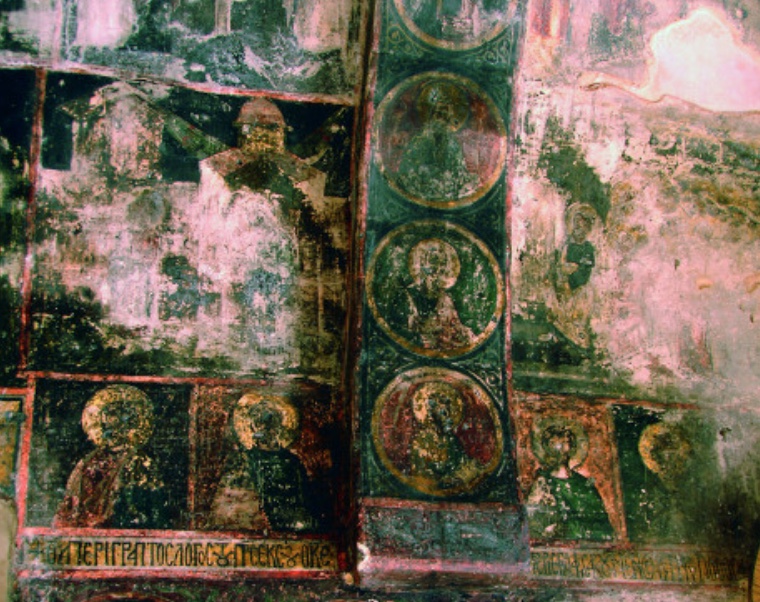
The aisle in which the inscription is found is divided from the sanctuary by a wall with two arched openings. Surviving traces of colour show that the frescoes once covered its whole surface. With funds from the parish of Skopi the walls were cleaned and conserved by restorers of the 13th Ephorate of Byzantine Antiquities. According to the Ephorate’s investigations the surviving frescoes are hard to make out: layers of soot, damaged paint and coatings of modern mortar conceal them. There is also the damage done by a fire set by the Ottoman occupiers, which blackened the walls. The wall paintings are dated to 1455, which is also the earliest of the scratched dates.
Among the scenes that have been identified are the punishments of the damned on the south wall, the Bride in Paradise and the Apostle Peter on the west wall – motifs which probably belong to the iconography of the Last Judgement – and full-length saints on the side walls. An inscription on the south side of the dome speaks of the “ineffable Word of the Father, from thee, Mother of God”.
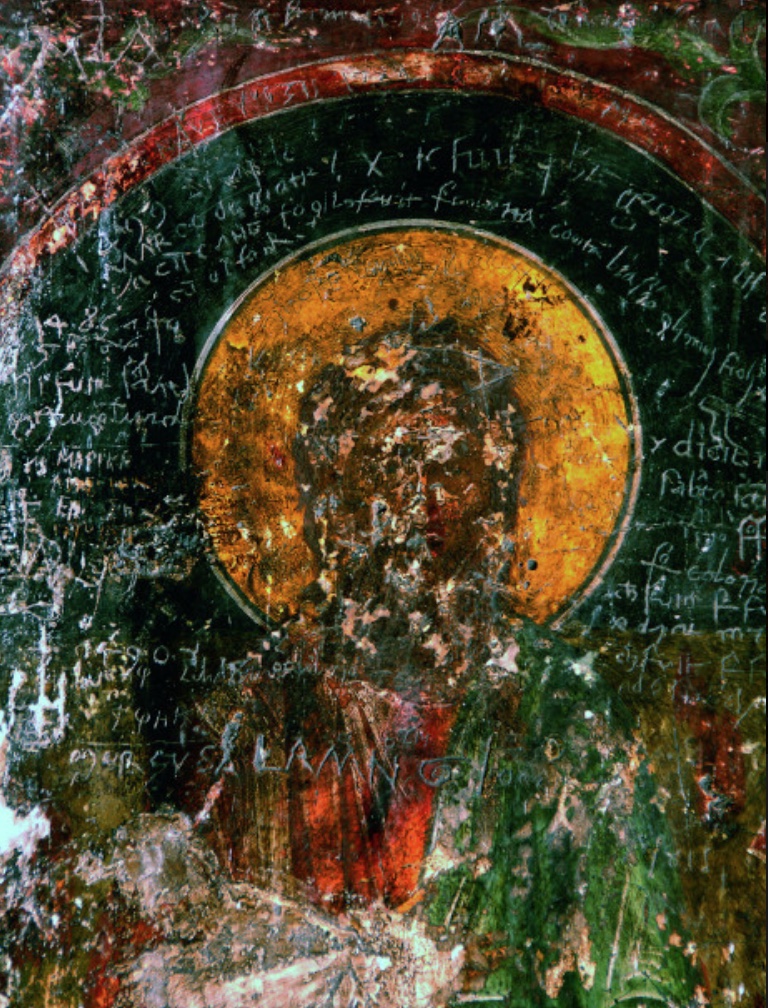
On the inner walls of the church numerous further inscriptions and dates were found, which testify to the long history of the monastery and to the high regard in which it was held. Scratched inscriptions on the south and west walls give the names of distinguished visitors, among them members of the powerful house of Cornaro, to which the poet of the “Erotokritos” is also assigned, a native of the Sitia district.
Under Ottoman rule
During the Ottoman period the monastery continued to exist until 1829, according to the testimony of Emmanouil Angelakis, who lived on Crete in those years, and kept up “at least a minimal complement” (Emmanouil Angelakis, “Seteia”, p. 221). Written evidence for each individual year of this period has not come down to us. That the monastery’s property remained intact into the early 20th century, however, suggests that the monastery was never wholly deserted: the common life went on, and buildings and lands alike were looked after to the extent that was needed.
In 1829, during one of the many Cretan uprisings, Faneromeni was destroyed. The Ottomans plundered the monastery as they left Sitia and destroyed everything they found, including the icons, whose eyes they scratched out in “terrible fanaticism” (Emmanouil Angelakis, “Seteia”, p. 221). The monks themselves got away.
After fifty years of oblivion the monastery was restored in 1879, as a date carved into the lintel of a cell records, and a handful of monks settled here again. N. Psilakis notes in the second volume of his work “Monasteries and Hermitages of Crete” that Faneromeni did not come to the notice of those 19th-century monks who strove, wherever it was possible, to revive old monasteries.
After 1870 the monastery passed into the possession of Toplou Monastery, whose monks tried to rescue and restore what could still be saved. The repairs concerned the cells and the communal rooms; the oil press was brought back into use, and the surrounding land was worked again as well. The years from 1870 to about 1900 thus formed a brief but significant phase in the life of the monastery, during which the monks of the Panagia Akrotiriani of Toplou looked unceasingly after the upkeep of the buildings.
The 20th Century
From 1900 the monk Grigorios Papadakis took over the supervision of the monastery; the monk Gerasimos and the nun Salome also lived here. After a pilgrimage to the Near East, however, Grigorios returned in penitence to his own monastery and refused to go back to Faneromeni. The buildings fell into decay once more, and the church stood unused.
According to the documents in the archive of the Metropolis of Lasithi, the monastery was leased to private individuals after 1900, very little land being left to the house itself. In 1900 Faneromeni was declared dissolved under the Statute of the Church of Crete and attached to the stauropegial monastery of the Panagia Akrotiriani and St John the Theologian at Toplou; by 1901 it had ceased to function altogether. Subsequently the local people secured the transfer of church and buildings to the parish – which led to lawsuits between Sitia, Piskokefalo and Skopi over the ownership of the monastery. In the end Faneromeni was awarded to the parish of Skopi, but its property was expropriated; the monastery was left with only the cells, a few gardens and the offerings of the pilgrims.
When the living of Skopi fell vacant in 1937, a priest from Chamezi took it on. A parish committee consisting of Rousos Fragoulis, Agapitos Kotsifakis and Konstantinos Vasilakis had cells rebuilt and repaired and laid out the first cistern for rainwater. As early as 1917 the inner courtyard had been remodelled; acacias and other trees were planted then, which give shade to the pilgrims to this day. Concern for the monastery continues: in the summer of 2023 the Metropolitan of Ierapetra and Sitia announced repair work on the historic masonry of the church.
Miracles associated with the monastery
Notes for visitors
The monastery lies about eight kilometres west of Sitia on the edge of steep ground between Cape Trachila and the bay of Bambakia, roughly a kilometre and a half from the coast, and commands a wide view of the sea. A paved road leads all the way to it, so that it can be reached by car without difficulty. Anyone who wishes to see the landscape at its best should combine the visit with a walk through the Gorge of All Saints, which is well waymarked, almost level and takes about an hour and a half from end to end; the finest time for it is winter and spring, when the stream is running and the slopes are in flower, though after heavy rain the bed may be under water. As the monastery is not permanently inhabited, the church may be locked outside the festival periods. Faneromeni is at its most impressive, but also very busy, in the first half of August and on 15 August.